Meituan LongCat Team Open-Sources WBench: The First Systematic Multi-Round Benchmark for Interactive Video World Models
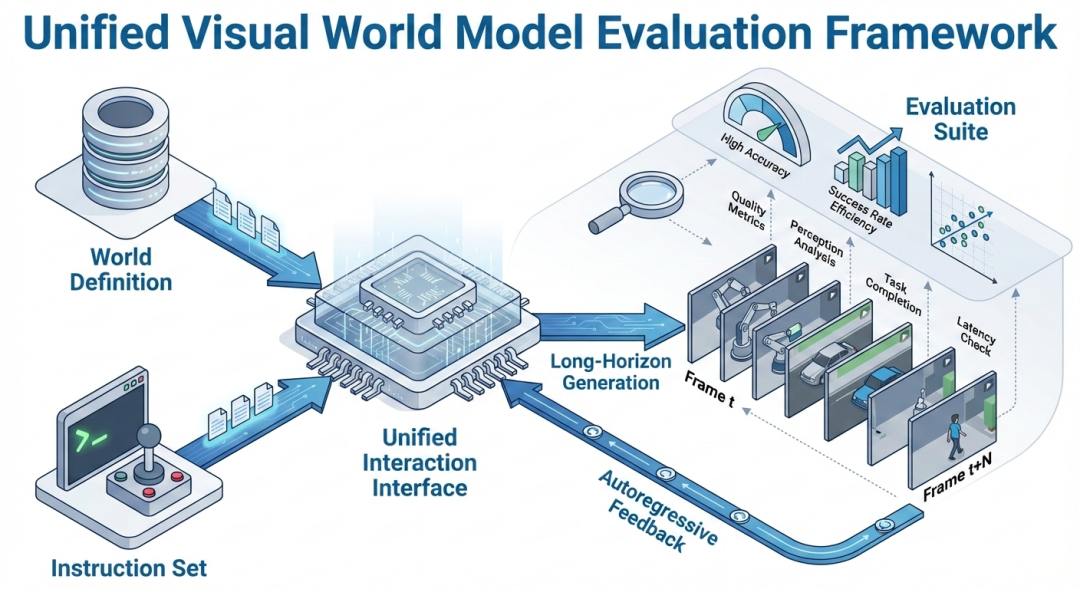
The Meituan LongCat team has officially released and open-sourced WBench, a groundbreaking evaluation framework designed to measure the capabilities of interactive video world models. As the first systematic multi-round benchmark of its kind, WBench serves as a diagnostic "CT scanner" for the AI industry, pinpointing the specific technical hurdles models face when transitioning from passive video generation to active, multi-round interaction. By evaluating performance across diverse scenarios—ranging from lunar explorations to complex cybernetic urban environments—WBench establishes a new standard for assessing how world models understand and react to interactive prompts. This open-source initiative aims to provide researchers with the tools necessary to identify where current models fail and how to push the boundaries of interactive artificial intelligence.
Key Takeaways
- Pioneering Benchmark: Meituan's LongCat team has introduced WBench, the first systematic multi-round evaluation benchmark specifically for interactive video world models.
- Diagnostic Capabilities: Described as a "CT scanner," WBench is designed to precisely locate the technical bottlenecks that prevent world models from achieving seamless interaction.
- Shift to Active Interaction: The benchmark focuses on the transition from "passive viewing" (simple video generation) to "active interaction" (responding to multi-round inputs).
- Open-Source Contribution: By open-sourcing WBench, Meituan provides the global research community with a standardized tool to measure and improve world model boundaries.
- Diverse Testing Scenarios: The framework evaluates models across a wide spectrum of environments, including "Moonwalks" and "Cyber Cities," to test the limits of spatial and temporal consistency.
In-Depth Analysis
The Diagnostic Evolution: WBench as a "CT Scanner" for AI
In the rapidly evolving landscape of generative AI, world models have emerged as a critical frontier. However, evaluating these models has historically been a challenge due to the lack of standardized metrics for interactivity. The Meituan LongCat team addresses this gap with WBench. By framing the benchmark as a "CT scanner," the team emphasizes a shift from holistic, often subjective, assessments to precise, diagnostic evaluations. Just as a medical scanner identifies internal structural issues, WBench is engineered to identify exactly where a world model's logic or consistency breaks down during the interactive process. This level of granularity is essential for researchers who need to understand whether a model's failure stems from a lack of physical common sense, poor temporal coherence, or an inability to process sequential user commands.
Bridging the Gap: From Passive Viewing to Active Interaction
Most current video generation models excel at "passive viewing"—creating a single, coherent video clip based on a static prompt. However, the true potential of a "world model" lies in its ability to act as a simulator that users can interact with in real-time. WBench is specifically designed to measure this transition. The "multi-round" aspect of the benchmark is its most significant innovation. Instead of testing a single output, WBench evaluates how a model maintains consistency and logic over several rounds of interaction. This simulates real-world applications where an AI must navigate a changing environment, such as a lunar landscape or a futuristic city, while responding to continuous user input. By measuring the boundaries of these interactions, WBench highlights the current limitations of AI in maintaining a stable "world state" over time.
Industry Impact
Standardizing World Model Evaluation
The introduction of WBench marks a significant step toward the standardization of world model research. In an industry where "world model" is often used as a broad marketing term, WBench provides a rigorous, systematic framework that defines what successful interaction actually looks like. By providing a clear set of criteria and multi-round testing protocols, it allows different research teams to compare their models' performance on a level playing field. This standardization is likely to accelerate the development of more robust AI simulators for robotics, gaming, and autonomous systems.
Accelerating Open-Source Innovation
By choosing to open-source WBench, Meituan is positioning itself as a key contributor to the global AI infrastructure. Open-sourcing such a benchmark lowers the barrier to entry for smaller research teams and academic institutions, allowing them to test their models against industry-leading standards without developing their own proprietary evaluation tools. This collaborative approach is expected to foster a more transparent research environment where failures are as documented as successes, ultimately leading to faster iterations and more reliable interactive AI technologies.
Frequently Asked Questions
Question: What makes WBench different from existing video generation benchmarks?
Unlike traditional benchmarks that focus on the visual quality of a single generated video (passive viewing), WBench is the first to offer a systematic, multi-round evaluation. It specifically tests how well a model handles ongoing interaction and maintains consistency across multiple steps, which is the core requirement for a true "world model."
Question: Why does the Meituan team refer to WBench as a "CT scanner"?
The term "CT scanner" is used as a metaphor for the benchmark's diagnostic precision. Rather than just giving a model a "pass" or "fail" grade, WBench is designed to pinpoint the exact stage or round where a model's interactive capabilities break down, allowing developers to see the "internal" logic errors of the model.
Question: What kind of scenarios does WBench use for testing?
WBench utilizes a variety of complex scenarios to test the boundaries of AI world models. These include diverse environments such as "Moonwalks" (testing low-gravity physics and unique environments) and "Cyber Cities" (testing complex urban structures and high-density visual data), ensuring the models are evaluated against a wide range of physical and architectural logic.