Meituan LongCat Team Launches WBench: The First Systematic Multi-Round Evaluation Benchmark for Interactive Video World Models
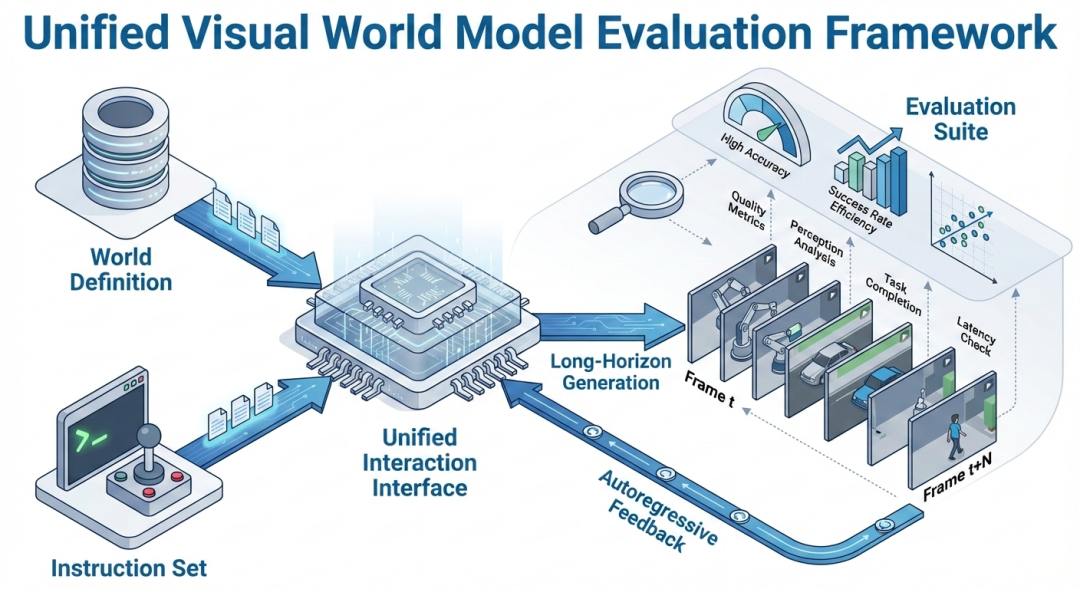
The Meituan LongCat team has introduced and open-sourced WBench, a groundbreaking evaluation benchmark designed for interactive video world models. As the first system of its kind, WBench provides a systematic, multi-round framework to assess how AI models transition from 'passive viewing' to 'active interaction.' Described by the developers as a 'CT scanner' for AI, the tool is engineered to precisely diagnose the technical bottlenecks and boundaries of current world models. By evaluating performance across diverse scenarios—ranging from lunar environments to futuristic urban settings—WBench offers the industry a vital diagnostic tool to identify exactly where models struggle during complex, interactive tasks.
Key Takeaways
- Pioneering Benchmark: Meituan's LongCat team has open-sourced WBench, the first systematic multi-round evaluation benchmark for interactive video world models.
- Diagnostic Precision: The tool functions as a "CT scanner," allowing developers to pinpoint specific failure points in a model's interactive capabilities.
- Focus on Interaction: WBench measures the critical transition from "passive viewing" (simple video generation) to "active interaction" (responsive world simulation).
- Open Source Contribution: By making WBench public, the LongCat team provides a standardized framework for the AI community to test the boundaries of world models.
In-Depth Analysis
Bridging the Gap Between Passive and Active AI
The development of WBench by the Meituan LongCat team marks a significant evolution in the evaluation of generative AI. Until now, many video-based world models have been assessed primarily on their ability to generate visually consistent sequences—a state the team refers to as "passive viewing." However, the true potential of a "world model" lies in its ability to act as an interactive environment. WBench is specifically designed to evaluate this transition, testing how well a model can handle "active interaction." This involves maintaining consistency and logic over multiple rounds of user input, moving beyond the generation of a single, static video clip to a dynamic, responsive experience.
The "CT Scanner" Approach to Model Evaluation
One of the most striking aspects of WBench is its diagnostic nature. The LongCat team describes the benchmark as a "CT scanner" for world models. This metaphor suggests that WBench does not merely provide a surface-level score; instead, it performs a deep dive into the model's performance to identify exactly where the system "gets stuck." Whether the model is simulating a "moonwalk" or a complex "cyber city," WBench tracks the boundaries of the model's capabilities. By providing a systematic multi-round evaluation, it can reveal whether a model loses coherence, fails to respond to specific prompts, or struggles with spatial and temporal logic during an interactive session.
Industry Impact
The release of WBench is a significant milestone for the AI industry, particularly for teams working on autonomous systems, gaming, and immersive simulations. As the field moves toward creating more sophisticated world models, the lack of standardized, multi-round evaluation tools has been a major hurdle. WBench fills this gap by providing a rigorous framework that encourages the development of models capable of true interaction. By open-sourcing the project, Meituan is fostering a more transparent and collaborative environment, allowing researchers worldwide to benchmark their progress against a common standard and accelerate the transition from passive video generation to fully interactive digital worlds.
Frequently Asked Questions
Question: What is the primary purpose of WBench?
Answer: WBench is designed to be a systematic multi-round evaluation benchmark that measures the boundaries of interactive video world models, specifically focusing on the transition from passive observation to active user interaction.
Question: Why is WBench described as a "CT scanner"?
Answer: It is called a "CT scanner" because it can precisely locate and diagnose the specific technical bottlenecks and failure points within a world model during the interaction process.
Question: Who developed WBench and is it accessible to others?
Answer: WBench was developed by the Meituan LongCat team and has been open-sourced, meaning it is available for the global AI research community to use for testing and improving their own world models.