
Back to List
ReasoningBank: Google Research Explores New Methods for Enabling AI Agents to Learn from Experience
Research BreakthroughGoogle ResearchGenerative AIAI Agents

ReasoningBank: Google Research Explores New Methods for Enabling AI Agents to Learn from Experience

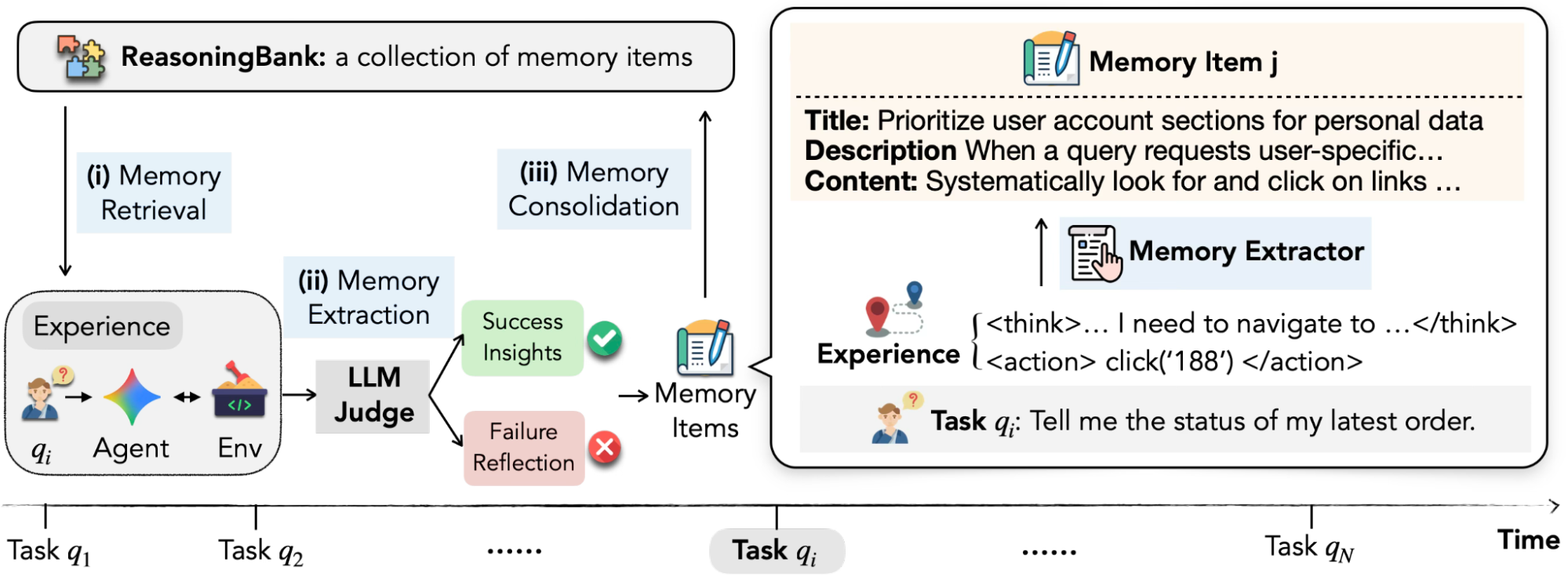
Google Research has introduced ReasoningBank, a development focused on the evolution of generative AI agents. According to the publication, this initiative aims to enable agents to learn more effectively from their experiences. While the specific technical architecture and detailed performance metrics remain within the scope of Google Research's broader generative AI initiatives, the announcement highlights a shift toward more autonomous learning capabilities in artificial intelligence. This development represents a significant step in the field of generative AI, focusing on how agents can refine their reasoning processes over time. The project underscores Google's ongoing commitment to advancing the boundaries of how AI systems interact with and learn from the data and environments they encounter.

Google Research Blog

Key Takeaways

  • Google Research has announced ReasoningBank, a project centered on generative AI.
  • The primary focus of the initiative is enabling AI agents to learn from experience.
  • The project is part of Google's broader research into advancing generative AI capabilities.

In-Depth Analysis

Advancing Generative AI through Experience

ReasoningBank represents a strategic focus by Google Research into the field of generative AI. The core objective of this initiative is to bridge the gap between static model responses and dynamic learning. By focusing on how agents learn from experience, the research suggests a move toward AI systems that do not just process information but adapt based on previous interactions and outcomes.

The Role of Reasoning in AI Agents

The title 'ReasoningBank' implies a repository or a structured framework for reasoning processes. In the context of generative AI, this suggests that Google is looking for ways to make AI agents more reliable and capable of complex task execution. By enabling these agents to learn from their past actions, the research aims to improve the overall efficiency and intelligence of autonomous systems.

Industry Impact

The introduction of ReasoningBank by Google Research signals a significant trend in the AI industry toward 'experiential learning' for models. If agents can successfully learn from experience, the industry may see a reduction in the need for constant manual fine-tuning. This could lead to more robust AI applications in various sectors, where agents become more proficient the more they are utilized, ultimately setting a new standard for generative AI development.

Frequently Asked Questions

Question: What is the main goal of ReasoningBank?

ReasoningBank is designed to enable generative AI agents to learn from their experiences, improving their reasoning and performance over time.

Question: Who is the organization behind this research?

The project is being developed and was published by Google Research.

Question: How does this relate to generative AI?

ReasoningBank is a specific application or framework within the generative AI field that focuses on the learning and reasoning capabilities of AI agents.
Related News

Microsoft Research Introduces SocialReasoning-Bench to Evaluate Whether AI Agents Act in Users’ Best Interests
Research Breakthrough

Microsoft Research Introduces SocialReasoning-Bench to Evaluate Whether AI Agents Act in Users’ Best Interests

Microsoft Research has announced the development of SocialReasoning-Bench, a new framework designed to measure the social reasoning capabilities of AI agents. Authored by a multi-disciplinary team including Tyler Payne and Asli Celikyilmaz, the benchmark addresses a critical gap in AI evaluation: determining if autonomous agents prioritize and act in the best interests of their human users. As AI transitions from simple task execution to complex agency, this research provides a standardized method to assess how well these systems navigate social nuances and ethical alignment. The initiative underscores Microsoft's commitment to developing trustworthy AI that moves beyond logical accuracy toward human-centric social intelligence.
DFlash: Advancing AI Inference with Block Diffusion for Flash Speculative Decoding
Research Breakthrough

DFlash: Advancing AI Inference with Block Diffusion for Flash Speculative Decoding

DFlash, a new project by z-lab, has emerged as a significant development in AI inference optimization, specifically focusing on Flash Speculative Decoding through a method known as Block Diffusion. Featured on GitHub Trending and supported by a research paper (arXiv:2602.06036), DFlash introduces a structured approach to accelerating the decoding process in large-scale models. The project represents a technical intersection between diffusion-based methodologies and speculative decoding frameworks, aiming to enhance the efficiency of model outputs. As an open-source initiative, DFlash provides the community with both the theoretical foundations and the practical implementation necessary to explore high-speed, block-based decoding strategies, marking a notable entry in the evolution of performance-oriented AI tools.

OncoAgent: A Dual-Tier Multi-Agent Framework for Privacy-Preserving Oncology Clinical Decision Support
Research Breakthrough

OncoAgent: A Dual-Tier Multi-Agent Framework for Privacy-Preserving Oncology Clinical Decision Support

OncoAgent is a specialized dual-tier multi-agent framework designed to provide privacy-preserving clinical decision support within the oncology sector. Published on the Hugging Face Blog on May 9, 2026, this framework addresses the critical intersection of artificial intelligence and healthcare security. By utilizing a multi-agent architecture, OncoAgent aims to assist clinicians in complex decision-making processes while ensuring that sensitive patient data remains protected. The framework's dual-tier structure suggests a sophisticated approach to managing medical data and providing actionable insights for cancer treatment. This development represents a significant step forward in the integration of secure AI tools in clinical environments, focusing on the unique challenges of oncology and data confidentiality.