LangSmith Tool Gateway Enters Public Beta for Secure, Governed AI Agent Tool Use
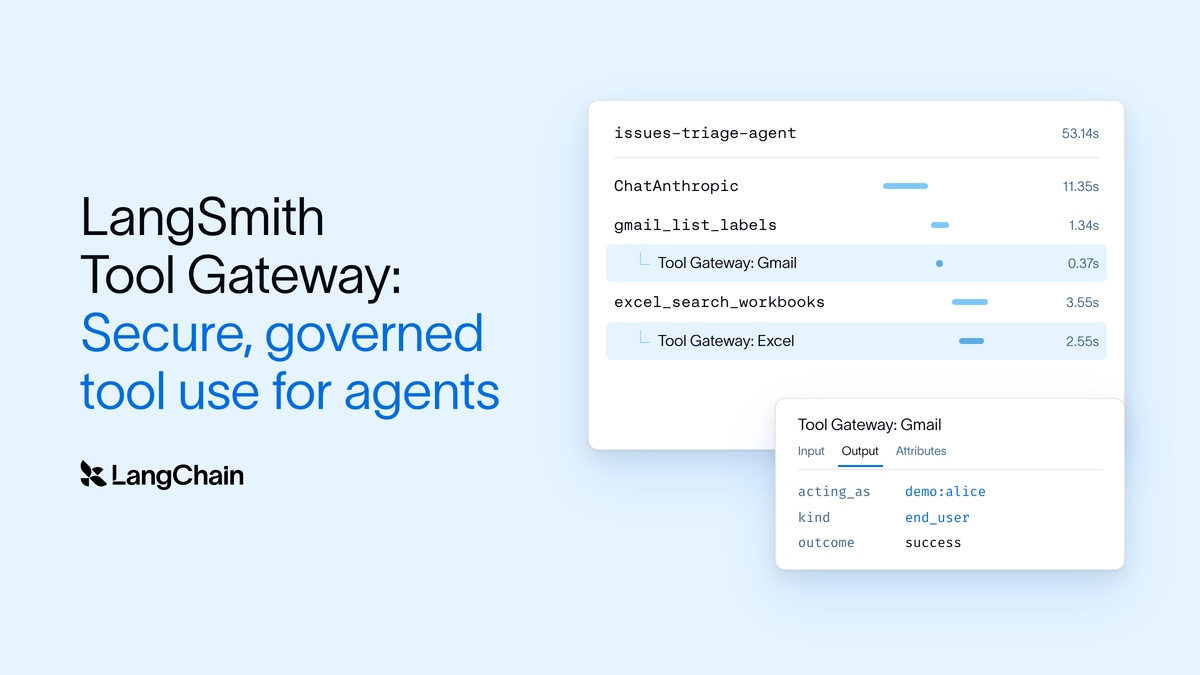
LangChain announced that LangSmith Tool Gateway is in Public Beta. The gateway handles credentials, identity, and access for every agent tool call, with policies, approvals, and traces. The announcement frames secure, governed tool use around the individual call: its focus is on how agents access tools, rather than on what those tools or agents can do. The update identifies what the gateway covers but does not explain how credentials are managed, how access decisions are made, when approvals apply, or what information traces contain. The Public Beta is the only release status stated in the announcement.
Key Takeaways
- LangChain announced that LangSmith Tool Gateway is in Public Beta.
- The gateway handles credentials, identity, and access for every agent tool call.
- LangChain lists policies, approvals, and traces alongside those responsibilities as part of its approach to secure, governed tool use.
- The announcement establishes the scope of the gateway but does not detail its implementation or say that every call requires approval.
In-Depth Analysis
The individual tool call is the unit of governance
The most specific phrase in LangChain’s announcement is “every agent tool call.” It identifies where the gateway’s stated responsibilities apply: to each call an agent makes to a tool. That is narrower than a claim about governing everything an agent does, but more specific than a general promise of secure tool use. LangChain names three things the gateway handles at that point: credentials, identity, and access. The distinction matters when reading the announcement. Credentials and identity are listed separately from access, so the product is not described solely as a way to handle credentials. At the same time, the source does not explain whose identity is represented, how credentials are handled, or how access is determined. The announcement is therefore clear about the scope of the gateway’s role without specifying the mechanics behind it. Its focus is the call to a tool, not the behavior of the agent as a whole or the capabilities of the tool being called.
Policies, approvals, and traces describe different aspects of oversight
LangChain lists policies, approvals, and traces together, but the terms point to distinct questions a reader can ask about a tool call: what rules apply, whether a decision calls for approval, and what record is available to examine. That distinction helps explain the announcement’s emphasis on both secure and governed tool use. The product description is not limited to whether access is possible; it also identifies controls and records as part of the picture. The wording is important, however. “Every agent tool call” establishes the scope of credential, identity, and access handling; it does not establish that each call must be approved. Nor does the announcement specify which policies are available, who or what provides approval, or which details appear in a trace. Readers can distinguish the named features from assumptions about how they interact. The source, for example, does not establish what the trace of an approved or denied call would contain.
Public Beta is the stated release status
The release milestone is Public Beta. That is the status LangChain gives the gateway, and the announcement does not describe a subsequent release or provide a timeline. It also does not list supported tools, explain how the gateway is configured, or specify which forms of credentials and identity it handles. Those omissions are worth noting because the scope of a product’s role is different from the scope of its compatibility. “Every agent tool call” describes the unit to which the gateway’s handling applies. It does not, on its own, identify which agents or tools can use the gateway. The announcement answers what the product is intended to handle and where that handling applies, while leaving questions about setup and compatibility open. For readers evaluating the Public Beta, that difference is more useful than treating the short announcement as a complete description of the product.
Industry Impact
The significance for the AI industry is the way LangChain frames the problem. Rather than presenting the launch as a new capability for agents or tools, the company focuses on governing the calls between them. An agent’s ability to call a tool is a different question from how credentials, identity, and access are handled when that call occurs. LangSmith Tool Gateway is presented as addressing the second question. Policies, approvals, and traces broaden that framing by making oversight part of the product description alongside access handling. The announcement thus draws attention to the moment an agent uses a tool, not just to whether the agent has that ability.
That framing also gives teams a way to evaluate what the announcement does and does not answer. A team interested in approval requirements would need to know when approvals apply. A team interested in reviewing calls would need to know what the traces contain. A team focused on access would need more detail about how identity and credentials are handled for the tools it uses. These are evaluation questions prompted by the announcement, not claims about requirements the gateway already satisfies. The source establishes a Public Beta and describes its intended role in tool-call governance. It does not establish adoption, demonstrate security outcomes, or provide a basis for comparing the gateway with other products.
Frequently Asked Questions
What does LangSmith Tool Gateway do?
According to LangChain, it handles credentials, identity, and access for every agent tool call. The announcement also lists policies, approvals, and traces as part of the gateway’s approach to secure, governed tool use.
Does every agent tool call require approval?
The announcement does not say that. It states that the gateway handles credentials, identity, and access for every agent tool call and includes approvals. It does not specify when an approval is required.
What is the release status of LangSmith Tool Gateway?
LangChain says the gateway is in Public Beta. The announcement does not give a date for a subsequent release.