AI News on November 20, 2026

Japanese Investors Seek $9.4 Billion in Anthropic IPO Shares and Receive $2.98 Billion
Industry News

Japanese Investors Seek $9.4 Billion in Anthropic IPO Shares and Receive $2.98 Billion

Japanese investors sought $9.4 billion in shares in Anthropic’s initial public offering and were ultimately allotted US$2.98 billion, Tech in Asia reported. The report cites a filing for the final allotment. The two figures describe different things: the $9.4 billion is the reported value of the shares Japanese investors sought, while the US$2.98 billion is the value of the shares they were allotted. The allotment was therefore lower than the amount sought. The available report does not identify the investors, explain why the allotment was lower, or give the overall size of the offering. It documents demand and allocation for Japanese investors without establishing how that demand compared with interest from other investors.

Tech in Asia•
Apple Is Hiring to Build an AI Agent That Can Work Across Apps
Industry News

Apple Is Hiring to Build an AI Agent That Can Work Across Apps

Apple is looking for an engineer to lead the creation of its own agentic AI assistant, according to a job listing spotted by Bloomberg and reported by The Verge. The assistant is described as being able to browse the web, work across apps, write code, and call services on a user's behalf. The listing is notable for the range of tasks it names: it describes an assistant that does work for users, rather than establishing how any one capability would function. The available report concerns hiring and the scope of the project. It does not announce a release or say which apps and services the assistant would be able to use.

The Verge•
Meta’s Muse Charm AI Wearable May Cost $300, but Meta Has Not Confirmed the Price
Industry News

Meta’s Muse Charm AI Wearable May Cost $300, but Meta Has Not Confirmed the Price

Meta’s upcoming Muse Charm AI wearable may cost $300, according to a TechCrunch AI article by Lucas Ropek that cites reporting from The Information. Meta did not deny the reporting, saying only that it would “have more to share soon” about the wearable. The distinction is that $300 is a reported possibility, not an official price. Meta’s response indicates that it expects to share more information, but it does not say when that will happen or whether the next update will address pricing. For now, the article establishes that Muse Charm is an upcoming AI wearable and that $300 has been reported as a possible price.

TechCrunch AI•
Recent Tech Outages Prompt a Y2K-Style Question: Are the Disruptions More Than Coincidence?
Industry News

Recent Tech Outages Prompt a Y2K-Style Question: Are the Disruptions More Than Coincidence?

TechCrunch AI examines whether recent outages involving airline booking systems, banking platforms, and productivity platforms are merely a coincidence. In the available excerpt, cybersecurity experts say something deeper is likely going on, but it does not specify what that might be or present evidence linking the disruptions. The headline invokes Y2K and AI agents, while the excerpt does not say that AI agents caused or contributed to any of the outages. Written by Dominic-Madori Davis and published on November 19, 2026, the piece raises a question about how to interpret disruptions across different kinds of services without establishing a common cause.

TechCrunch AI•
Meta’s Muse Charm Could Cost $300: What the Report Says About the AI Gadget
Industry News

Meta’s Muse Charm Could Cost $300: What the Report Says About the AI Gadget

Meta is planning to price its Muse Charm at $300, according to The Information, as cited by The Verge. The Charm is a small gadget with a screen that lets users chat with their Muse AI agent. Meta CEO Mark Zuckerberg revealed the device earlier in 2026 and said the company expected to ship it “in time for the holidays in December.” The price and shipping window come from different sources: The Information reported the planned price, while Zuckerberg described Meta’s shipping expectation. The available excerpt does not establish a final retail price or a specific shipping date, and it ends before explaining the qualification that follows Zuckerberg’s remarks.

The Verge•
Google Brings AI Chats to Its Homepage With a Collapsible Sidebar
Industry News

Google Brings AI Chats to Its Homepage With a Collapsible Sidebar

Google is updating its homepage to include AI searches, according to a November 19 report by Emma Roth for The Verge. In a post on X, Google vice president of product Robby Stein shared a GIF showing a collapsible sidebar that users can open to view and continue their AI chats. The sidebar gives those conversations a place on the homepage and makes it possible to return to a chat from there. The supplied excerpt starts to describe what users appear to click to open the sidebar, but it cuts off before identifying the control. The GIF shows what the sidebar does, while the excerpt leaves the exact step for opening it unspecified.

The Verge•
NVIDIA and Microsoft Expand Accelerated Computing Across Azure, Industrial Systems and Windows PCs
Industry News

NVIDIA and Microsoft Expand Accelerated Computing Across Azure, Industrial Systems and Windows PCs

NVIDIA and Microsoft are extending their full-stack accelerated computing collaboration across Azure infrastructure, industrial systems and Windows PCs. The companies say the collaboration is intended to help organizations build, customize and deploy intelligent applications. At Microsoft Ignite, they are expanding access to Azure virtual machines powered by NVIDIA Vera Rubin NVL72 systems. That is the most specific announcement in the available NVIDIA Newsroom excerpt: it identifies the cloud service and the NVIDIA systems that power it. The excerpt also begins to describe another customer availability update but ends before identifying what it covers. Industrial systems and Windows PCs are part of the collaboration’s stated scope, but the excerpt does not specify what customers can access in either setting.

NVIDIA Newsroom•
Gemini API Tool Retrieval Preview Gives Agents Access to Hundreds of Tools With Fewer Tokens
Product Launch

Gemini API Tool Retrieval Preview Gives Agents Access to Hundreds of Tools With Fewer Tokens

Google AI Blog announced that Tool Retrieval is now in preview in the Gemini API. The feature is presented as a way to give agents access to hundreds of tools while using fewer tokens. The announcement pairs those two points: the breadth of tool access and lower token use. It does not explain how Tool Retrieval works, specify how token use was measured, or quantify the reduction. It also does not provide an exact tool count beyond describing access to hundreds of tools. The stated release status is preview, and the announcement does not give a timeline for general availability.

Google AI Blog•
Research News

Claude Solves Two Open Problems in Black Hole Physics, According to a Hacker News Listing

A Hacker News listing dated November 19, 2026, carries the headline “Claude solves two open problems in the physics of black holes” and links to an Anthropic research page. The listing credits cybermango, but the supplied record contains no article text. It does not name either problem, describe Claude’s role in solving them, or explain how the results were checked. The headline therefore establishes what the listing claims, not what the underlying research demonstrates. The key question for readers assessing the AI research implications is what Claude contributed to each solution. The supplied material does not answer that question or establish whether the results were independently verified.

Hacker News•
Industry News

Anthropic’s Nasdaq Debut: What the Hacker News Listing Does and Doesn’t Say

A Hacker News entry titled “Anthropic’s Nasdaq debut” is dated November 19, 2026, at 17:02:40 UTC, credits wslh in its author field, and links to Reuters. The supplied entry contains no article text, so it identifies the topic but does not establish the details of the reported debut. In particular, the timestamp belongs to the Hacker News entry and does not establish when trading began. The material provides no ticker symbol, share price, valuation, trading results, or company statements. Without the linked article text, the available record supports a description of the listing, not an assessment of Anthropic’s market performance or the debut’s implications for the AI industry.

Hacker News•
Walter Isaacson on Curiosity, Creativity, and Human Judgment in the Age of AI
Industry News

Walter Isaacson on Curiosity, Creativity, and Human Judgment in the Age of AI

Walter Isaacson joins Google for an episode about curiosity and creativity in the AI age. The Google AI Blog announcement describes the discussion through a historical lens: how history’s greatest innovators inspire creativity and human judgment today. The title highlights curiosity and creativity, while the episode description explicitly brings human judgment into the conversation. The announcement is a brief invitation to watch rather than a recap. It does not identify the innovators discussed, give examples from their lives, or quote Isaacson’s observations. Readers interested in how the conversation connects historical innovation with creativity and judgment in the AI age can watch the episode through the Google AI Blog.

Google AI Blog•
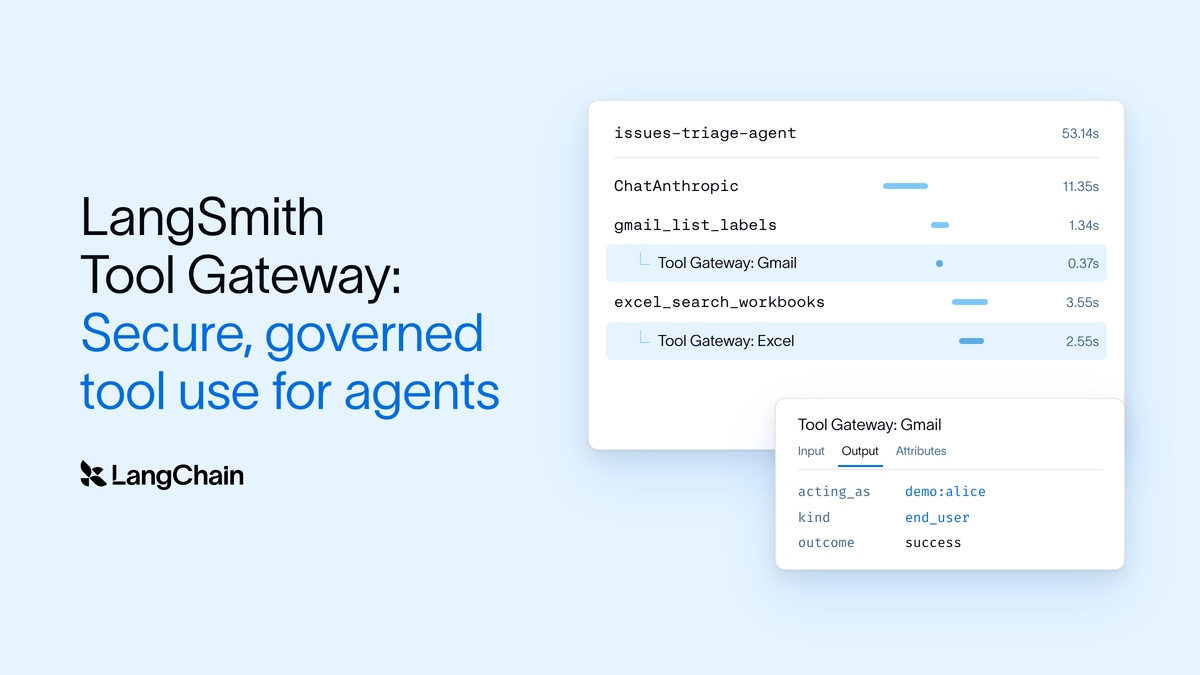
LangSmith Tool Gateway Enters Public Beta for Secure, Governed AI Agent Tool Use
Product Launch

LangSmith Tool Gateway Enters Public Beta for Secure, Governed AI Agent Tool Use

LangChain announced that LangSmith Tool Gateway is in Public Beta. The gateway handles credentials, identity, and access for every agent tool call, with policies, approvals, and traces. The announcement frames secure, governed tool use around the individual call: its focus is on how agents access tools, rather than on what those tools or agents can do. The update identifies what the gateway covers but does not explain how credentials are managed, how access decisions are made, when approvals apply, or what information traces contain. The Public Beta is the only release status stated in the announcement.

LangChain•
Kaggle and Google’s Free Agentic AI Course: What It Covers With Gemini and ADK
AI Education

Kaggle and Google’s Free Agentic AI Course: What It Covers With Gemini and ADK

In a KDnuggets article, Bala Priya C shares what they learned from Kaggle and Google’s free agentic AI course. The course teaches learners to build AI agents with Gemini and Google’s ADK. The published description names four areas of coverage: tools, memory, evaluation, and deployment. Together, those topics frame the course around both building agents and considering how to evaluate and deploy them. The description does not specify the course length, prerequisites, lesson sequence, or depth of coverage for each topic. For readers deciding whether to look further, the clearest takeaway is the course’s focus: agent development with Gemini and Google’s ADK.

KDnuggets•
Why Coding Agent Bills Spiral and How LangChain Frames the Fix
Technical Tutorial

Why Coding Agent Bills Spiral and How LangChain Frames the Fix

In a November 19, 2026 post, LangChain addresses a problem for coding agent users: bills that rise unexpectedly and become difficult to manage. The headline uses a doubled bill to frame the issue, while the description points to three ways to bring spending under control: trace it, compare it, and govern it. The post names Claude Code, Cursor, and Copilot and presents the ability to manage spending across those tools and others in one place as its focus. The supplied excerpt does not explain what drives bills higher, describe how spending is tracked, or provide prices or savings figures. Its central point is that coding agent costs should be understood across tools, not just as a total on a bill.

LangChain•
Singapore AI Video Startup Topview Launches Hybrid Film Studio and Reports Encore Trailer Premiere
Industry News

Singapore AI Video Startup Topview Launches Hybrid Film Studio and Reports Encore Trailer Premiere

Singapore AI video startup Topview has launched a hybrid Film Studio, according to a Tech in Asia report by Diya Lal. Topview also says it premiered a trailer for Encore, described in the report as a hybrid film, at the Neu Wave AI Film Festival. The report identifies the studio launch and the trailer premiere but does not explain how the two are connected. It also does not define what “hybrid” means for either the studio or the film. The festival premiere cited by Topview was for the trailer, not the full film, and the report does not provide a release date for Encore.

Tech in Asia•
NVIDIA SkillEvaluator: A Multi-Tier Framework for Evaluating AI Agent Skills and Plugins
Industry News

NVIDIA SkillEvaluator: A Multi-Tier Framework for Evaluating AI Agent Skills and Plugins

NVIDIA’s SkillEvaluator is a multi-tier framework for evaluating AI agent skills and plugins. The GitHub Trending description lists quality gates, security scanning, harness compatibility checks, semantic overlap detection, synthetic evaluation dataset generation, and live agent evaluation. The live evaluation component measures how skills affect agent behavior, distinguishing it from checks concerned with quality, security, or compatibility. The description presents these capabilities as parts of the same framework but does not explain how the tiers are organized or which criteria, metrics, or tools they use. The supplied excerpt ends mid-sentence after “Ships reusable,” so it does not establish what reusable resources the project ships.

GitHub Trending•
Cursor Plugins: What the Official GitHub Repository Says About Its Specification and Structure
Industry News

Cursor Plugins: What the Official GitHub Repository Says About Its Specification and Structure

The Cursor plugins repository is described as a home for the Cursor plugin specification and official plugins for popular developer tools, frameworks, and software-as-a-service products. The GitHub Trending excerpt explains one concrete aspect of the repository’s layout: each plugin occupies a standalone directory at the repository root. The excerpt starts to describe what each plugin directory contains, but it ends partway through a code identifier. As a result, it does not establish the complete name or purpose of that item. The listing provides a brief overview of the repository’s scope and organization, rather than a plugin catalog, an installation guide, or a complete account of the specification.

GitHub Trending•
PaperOrchestra: A Multi-Agent Framework for Automated AI Research Paper Writing
Industry News

PaperOrchestra: A Multi-Agent Framework for Automated AI Research Paper Writing

A GitHub Trending entry dated November 19, 2026, lists PaperOrchestra, a project attributed to google-research. The entry describes it as a multi-agent framework for automated AI research paper writing. That description identifies the framework’s approach and intended task, but the supplied excerpt does not explain what the agents do, how they work together, or which parts of paper writing the framework automates. It also provides no examples or evaluation results, so readers cannot assess the quality of its output from the listing alone. The entry links to the PaperOrchestra repository, but the supplied text does not establish a project launch date.

GitHub Trending•
CLI-Anything on GitHub Trending: What Its Agent-Native Software Claim Tells Us
Industry News

CLI-Anything on GitHub Trending: What Its Agent-Native Software Claim Tells Us

A GitHub Trending entry dated November 19, 2026, lists CLI-Anything under the author name HKUDS and describes it with the tagline “Making ALL Software Agent-Native.” The entry points to the HKUDS/CLI-Anything GitHub repository and separately links to a site labeled CLI-Hub. The tagline is the entry’s only substantive description of the project. It states a broad goal but does not explain what the project means by “agent-native,” how it would make software agent-native, or which applications it supports. The listing is therefore useful as a pointer to the project and its associated site, but it does not establish technical capabilities, universal compatibility, or adoption.

GitHub Trending•
last30days-skill: An AI Agent Skill for Research Across Reddit, X, YouTube, and the Web
Industry News

last30days-skill: An AI Agent Skill for Research Across Reddit, X, YouTube, and the Web

A GitHub Trending entry attributed to mvanhorn describes last30days-skill as an AI agent skill that researches a topic across Reddit, X, YouTube, HN, Polymarket, and the web, then synthesizes the findings into what the listing calls a grounded summary. The supplied excerpt also displays the heading `/last30days`, but it ends partway through a link. The documented workflow is therefore limited to two steps: researching a topic across the listed sources and synthesizing the resulting material. The excerpt does not explain how sources are selected or verified, what the finished summary looks like, or whether the project name reflects a fixed 30-day research window.

GitHub Trending•
Industry News

How OpenAI Uses Codex in Its Performance Factory to Help Keep ChatGPT Fast

OpenAI’s blog describes the Performance Factory, a system of Codex-powered workflows that the company built to help keep ChatGPT fast. The workflows serve two related purposes: finding performance issues and fixing them. The key distinction is that the Performance Factory is presented as a system for addressing performance problems, rather than as a single speed improvement. Codex is identified as powering the workflows, but the description does not explain what Codex does at each step or how much of the process is automated. It also provides no examples of individual fixes or measurements of their effect, so the stated goal of keeping ChatGPT fast should not be read as a quantified performance result.

OpenAI Blog•
Gemini 4 Neon Scores 61 on the Intelligence Index as Anthropic Prices IPO at $83
Industry News

Gemini 4 Neon Scores 61 on the Intelligence Index as Anthropic Prices IPO at $83

Latent Space’s November 18, 2026 news brief reports that Google’s middle-tier Gemini 4 Neon scores 61 on the Intelligence Index. The headline frames Gemini 4 Neon as GDM’s contender to Opus and Sol, but the brief does not provide scores for either or explain how the index is calculated. In a separate item, it reports that Anthropic priced its initial public offering at $83. The text gives no further terms for the offering. The two figures are the central facts: one is a reported model benchmark score, and the other is a reported IPO price. Neither figure comes with enough context to establish a competitive ranking or an overall company valuation.

Latent Space•
Listing Brief

Gemini 4 Neon on Product Hunt: What the Source Record Confirms

The supplied Product Hunt record is titled “Gemini 4 Neon,” credits Zac Zuo as the author, and gives a publication timestamp of November 19, 2026, at 02:32:38 UTC. No article body was provided. The source URL ends in `/products/gemini-6`, which differs from the supplied title, but the record does not explain that difference. The available information therefore identifies the listing by its supplied title and records its source, author credit, and date. It does not establish what Gemini 4 Neon is, whether it was released, or what connection, if any, the title has to the wording in the URL. The publication timestamp should not be read as a product launch date.

Product Hunt•
Product Demo

OpenAI’s Codex Security Plugin Demo: From Getting Started to Reviewing Results

OpenAI’s blog invites readers to watch a recorded demonstration of the Codex Security Plugin. The description gives the demo two clear endpoints: getting started with the plugin and reviewing the results shown in the recording. The post frames the recording as a way to see the workflow in action rather than listing individual steps in the written description. It does not specify what the results contain or how they are reviewed. The demo is therefore the source for the walkthrough itself, while the accompanying text offers a brief guide to what viewers can expect to see.

OpenAI Blog•
Product Listing

Wispr Flow Notetaker for iPhone: What the Product Hunt Listing Confirms

A Product Hunt entry titled “Wispr Flow Notetaker for iPhone” lists Kate Ramakaieva as the author and November 18, 2026, as the publication date. The title identifies Wispr Flow Notetaker and names the iPhone, but the supplied entry contains no article body or product description. It does not explain how the notetaker works, whether it uses AI, what it costs, or when it became available. The publication date therefore applies to the entry and should not be read as a confirmed launch date. The supplied Product Hunt link identifies the source, but the available information does not support a feature overview, a product comparison, or an assessment of industry impact.

Product Hunt•
Product Listing

Room AI on Product Hunt: What the Supplied Listing Does and Does Not Say

The supplied Product Hunt record is titled “Room AI,” credits Marc Köhlbrugge as the author, and gives a publication timestamp of November 18, 2026, at 15:37:31 UTC. The record includes a link to Product Hunt but no article body. As a result, it identifies the listing without explaining what Room AI does, who it is for, or whether the publication date corresponds to a product launch. The author credit does not establish who created or operates Room AI. This overview separates the information available in the record from product and industry questions that the supplied material does not answer.

Product Hunt•