
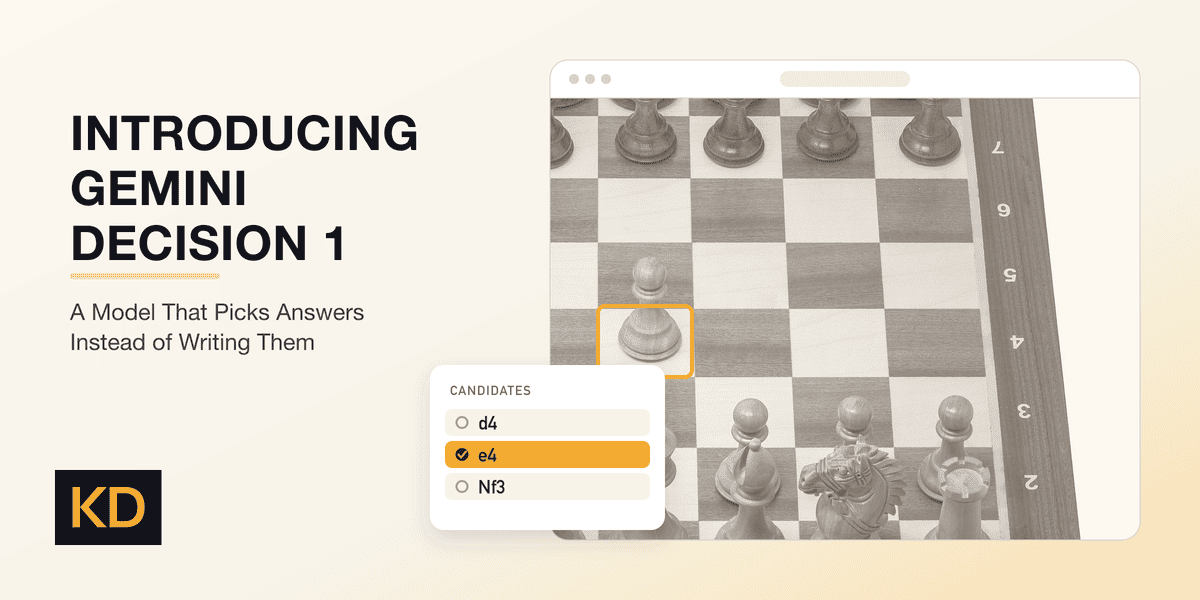
Google’s Gemini Decision 1 Picks Answers Instead of Writing Them Across Five Input Types
Google’s Gemini Decision 1 is a model designed to pick answers rather than write them, according to Shittu Olumide’s report for KDnuggets. It reads text, images, video, audio, and PDFs in a single forward pass and supports up to 262,144 input tokens per request. The central distinction is between what the model reads and what it does with that input: it accepts several kinds of material, but its stated task is answer selection, not answer writing. The token figure describes the maximum input per request, not how much the model outputs. The report does not explain how answers are presented for selection or provide results showing how well the model performs.
Key Takeaways
- Gemini Decision 1 picks answers instead of writing them. The KDnuggets report describes answer selection as the Google model’s sole job.
- It reads five listed input types: text, images, video, audio, and PDFs.
- The report describes a single forward pass and gives a maximum of 262,144 input tokens per request.
- The report describes the task, not its results. It does not explain how the choices are supplied, how the selection is returned, or how accurately the model picks answers.
In-Depth Analysis
Answer selection is the task, not a shorter form of writing
The most important distinction in the KDnuggets report is in its headline: Gemini Decision 1 picks answers instead of writing them. Shittu Olumide describes the model as having one job and doing it without writing a word. That description is about the nature of the task, not the length of an answer. A brief written response would still be a written response; the report instead describes a model whose role is to select an answer. The distinction also matters when interpreting what the report leaves unsaid. It says the model picks, but it does not say who or what supplies the choices, how those choices are presented, or how the selected answer is returned. In particular, the statement that Decision 1 does not write an answer should not be read as a statement that it returns no result. The report identifies the action the model takes without specifying the form in which that action is communicated.
The input list describes what the model reads, not what it produces
Text, images, video, audio, and PDFs are all named as inputs. The list is worth reading alongside the answer-selection description because the two explain different things: one describes the material the model can read, and the other describes the job it performs. Nothing in the list suggests that Decision 1 writes text or produces images, video, audio, or PDFs. Likewise, the statement that the model reads this material in a single forward pass describes how the report says it processes input; it is not a timing measurement. The report gives no processing times and no comparisons across input types. It also does not spell out how different kinds of input are arranged within a request. The claim to retain is that the model reads the five listed types in a single forward pass, without inferring a particular request format or speed from that wording.
The 262,144-token figure is a per-request input limit
The report’s numerical detail is precise: up to 262,144 input tokens per request. Both qualifications matter. “Input” ties the figure to what Decision 1 reads, rather than to anything it returns. “Per request” states where the limit applies, and “up to” marks it as a maximum rather than a requirement for every request. The report does not translate the figure into pages of a PDF, minutes of video or audio, or a count of images. Nor does it present the limit as evidence that a selection will be accurate when a request reaches that size. The figure answers a question about the stated size of the input, not a question about the quality of the decision. Keeping those questions separate makes it possible to report the exact capacity claim without treating it as a performance result.
Industry Impact
The significance of Gemini Decision 1 in this report is the contrast between the range of material an AI model can read and the scope of the job it is designed to perform. The list of supported inputs is broad, while the stated task is narrow: pick an answer. Those are separate characteristics. A description that focused only on the input list and token count would miss what makes this announcement distinct. A description that focused only on answer selection would omit the kinds of material the model is reported to read while performing that task.
For AI industry readers, the distinction also clarifies what a comparison would need to address. The report supports a comparison at the level of purpose: picking an answer is different from writing one. It does not support a judgment that picking is more accurate, faster, or more useful than writing. The single-pass description does not provide a speed comparison, just as the input ceiling does not provide a measure of answer quality. The report also offers no evidence about adoption or how Decision 1 is used in practice. Its contribution is to identify a different model objective and describe the inputs available to it, not to establish the consequences of that design.
Frequently Asked Questions
What does Gemini Decision 1 do instead of writing answers?
It picks answers. KDnuggets describes answer selection as the model’s sole job. The report does not explain how the choices are presented to Decision 1 or what form its selection takes when returned.
What types of input can Gemini Decision 1 read?
The report lists text, images, video, audio, and PDFs. It says Decision 1 reads this material in a single forward pass but does not give processing times or specify how the input types are arranged in a request.
Does the 262,144-token limit describe what the model outputs?
No. The figure is the stated maximum number of input tokens per request. It describes how much input the model can receive, not the length or format of the result it returns.

