Introducing OlmoEarth Embeddings: Custom Export Features from OlmoEarth Studio for Downstream Analysis
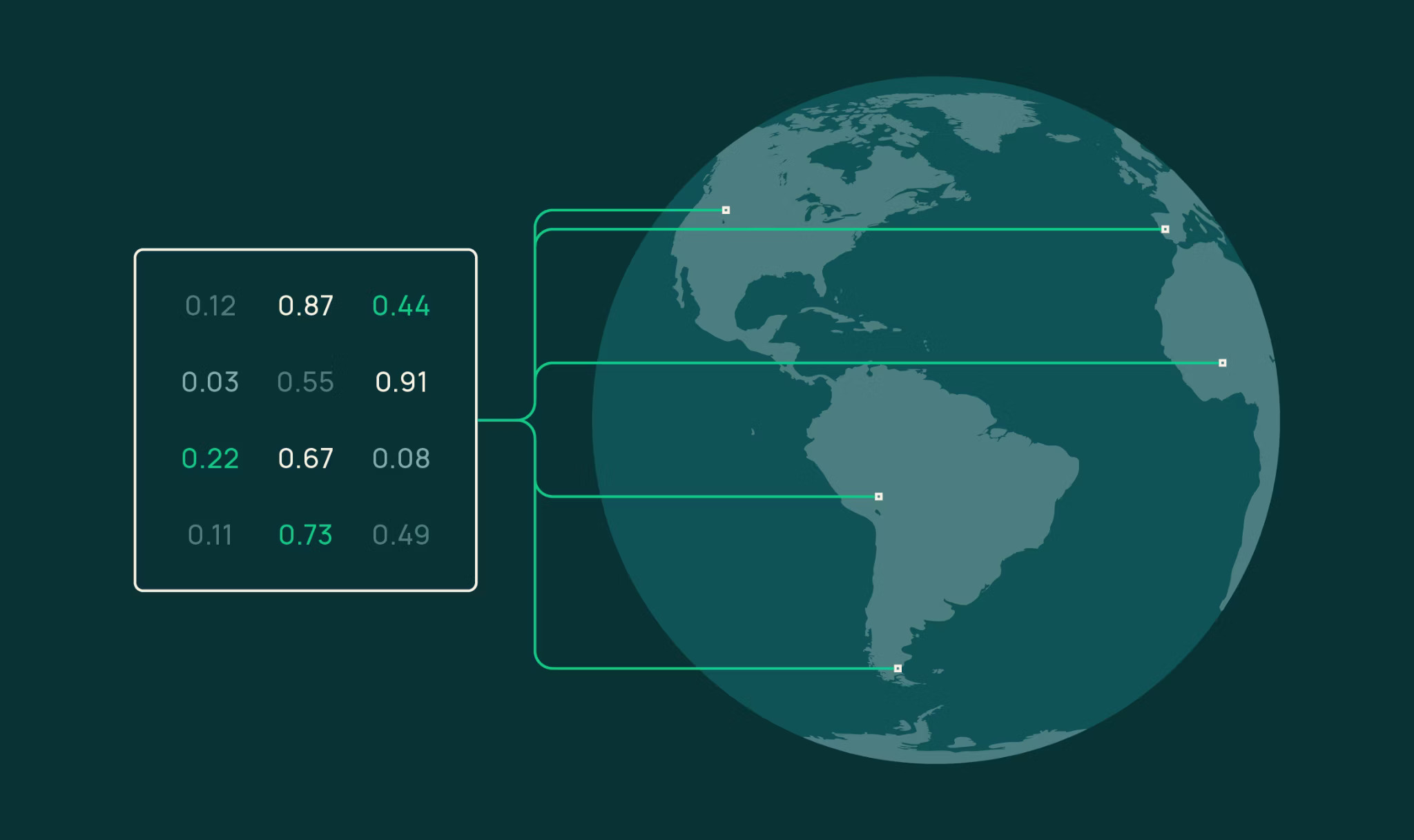
The Allen Institute for AI has announced the launch of OlmoEarth embeddings, a new capability within the OlmoEarth Studio platform designed to facilitate advanced downstream analysis. This update allows researchers and developers to export custom embeddings, providing a bridge between the OlmoEarth environment and external analytical workflows. By enabling the extraction of these high-dimensional vector representations, the platform enhances the utility of Earth-centric AI models, allowing for more granular data exploration and integration into specialized machine learning pipelines. This development underscores a commitment to open-source accessibility and the practical application of large-scale Earth observation models in scientific research.
Key Takeaways
- Introduction of OlmoEarth Embeddings: A new feature allowing for the generation of specialized vector representations within the OlmoEarth ecosystem.
- Custom Export Functionality: Users can now export these embeddings directly from OlmoEarth Studio, moving beyond platform-contained analysis.
- Support for Downstream Analysis: The exported data is specifically formatted to support external research, including clustering, classification, and visualization tasks.
- Enhanced Workflow Integration: This update bridges the gap between raw Earth observation data and actionable insights in third-party analytical tools.
In-Depth Analysis
The Evolution of OlmoEarth Studio
The introduction of OlmoEarth embeddings represents a significant milestone in the evolution of the OlmoEarth Studio. Originally designed as a platform for interacting with Earth-centric AI models, the Studio is transitioning from a purely exploratory environment into a robust data preparation and feature extraction hub. By focusing on embeddings—the mathematical representations of data that capture semantic meaning—OlmoEarth is providing users with the fundamental building blocks of modern machine learning.
The ability to generate these embeddings within a specialized "Studio" environment suggests a streamlined user interface where complex geospatial or environmental data can be processed without requiring extensive local infrastructure. This democratization of high-level feature extraction is critical for researchers who may have the domain expertise in Earth sciences but lack the computational resources to train or run massive transformer-based models from scratch. The Studio acts as the intermediary, handling the heavy lifting of model inference while allowing the user to define the parameters of the data they wish to represent.
Custom Exports and the Power of Downstream Analysis
The core value proposition of this announcement lies in the "custom export" capability. In the context of AI development, embeddings are often trapped within the specific environment where the model resides. By allowing users to export these embeddings, OlmoEarth Studio enables "downstream analysis," a term that encompasses a wide range of secondary analytical tasks. Once exported, these embeddings can be used in various ways:
- Clustering and Pattern Recognition: Researchers can take the exported vectors and apply unsupervised learning techniques to identify similar geographical features or environmental patterns that the model has identified.
- Transfer Learning: The embeddings can serve as the input for smaller, task-specific models, allowing for high performance on niche datasets with minimal additional training.
- Temporal Analysis: By exporting embeddings from different time periods, scientists can track how the mathematical representation of a specific region changes over time, potentially signaling environmental shifts or land-use changes.
This flexibility is essential for the scientific community, as it allows the insights generated by OlmoEarth to be combined with other datasets, such as ground-truth sensor data or socio-economic statistics, which may not be present within the OlmoEarth platform itself.
Bridging the Gap in Earth Observation
Earth observation data is notoriously difficult to work with due to its scale, dimensionality, and the complexity of the physical phenomena it records. OlmoEarth embeddings simplify this complexity by condensing vast amounts of raw data into manageable, high-dimensional vectors. The move to support custom exports indicates a shift toward a more modular AI ecosystem. Instead of a monolithic application where all analysis must happen in one place, AI2 is promoting a workflow where OlmoEarth serves as a sophisticated feature extractor that feeds into a broader ecosystem of scientific tools.
This approach aligns with the broader trends in the AI industry toward "composable AI," where different models and data processing steps can be linked together to solve complex problems. For the Earth science community, this means that the power of large-scale language and vision models (like those in the OLMo family) can be applied directly to pressing environmental challenges with greater precision and less friction.
Industry Impact
The release of OlmoEarth embedding exports has several implications for the AI and Earth science industries:
- Standardization of Earth Data: By providing a consistent way to represent Earth observation data through embeddings, AI2 is helping to create a common language for researchers across different institutions.
- Acceleration of Environmental Research: Reducing the technical barriers to accessing high-quality AI features allows for faster iteration in climate modeling, disaster response, and resource management.
- Open Science Leadership: This move reinforces the Allen Institute for AI’s position as a leader in open-source AI, providing tools that are not just powerful but also interoperable with the wider research community’s existing toolkits.
- Market Competition: As more platforms offer embedding-as-a-service or exportable features, we can expect to see increased competition in the geospatial AI space, leading to better tools and more accessible data for all users.
Frequently Asked Questions
Question: What are OlmoEarth embeddings?
OlmoEarth embeddings are high-dimensional vector representations of Earth-related data generated by the OlmoEarth models. They capture the essential features and semantic meaning of the data, making it easier to perform complex analytical tasks like comparison, search, and classification.
Question: Why is the export feature important for researchers?
The export feature is crucial because it allows researchers to take the data representations generated by OlmoEarth and use them in their own specialized software, custom models, or private datasets. This enables a level of analysis that would be impossible if the data were restricted to the OlmoEarth Studio platform.
Question: What kind of downstream analysis can be performed with these embeddings?
Common downstream tasks include clustering (grouping similar data points), anomaly detection (finding unusual patterns), and using the embeddings as inputs for training smaller, specialized machine learning models for specific tasks like crop yield prediction or deforestation tracking.