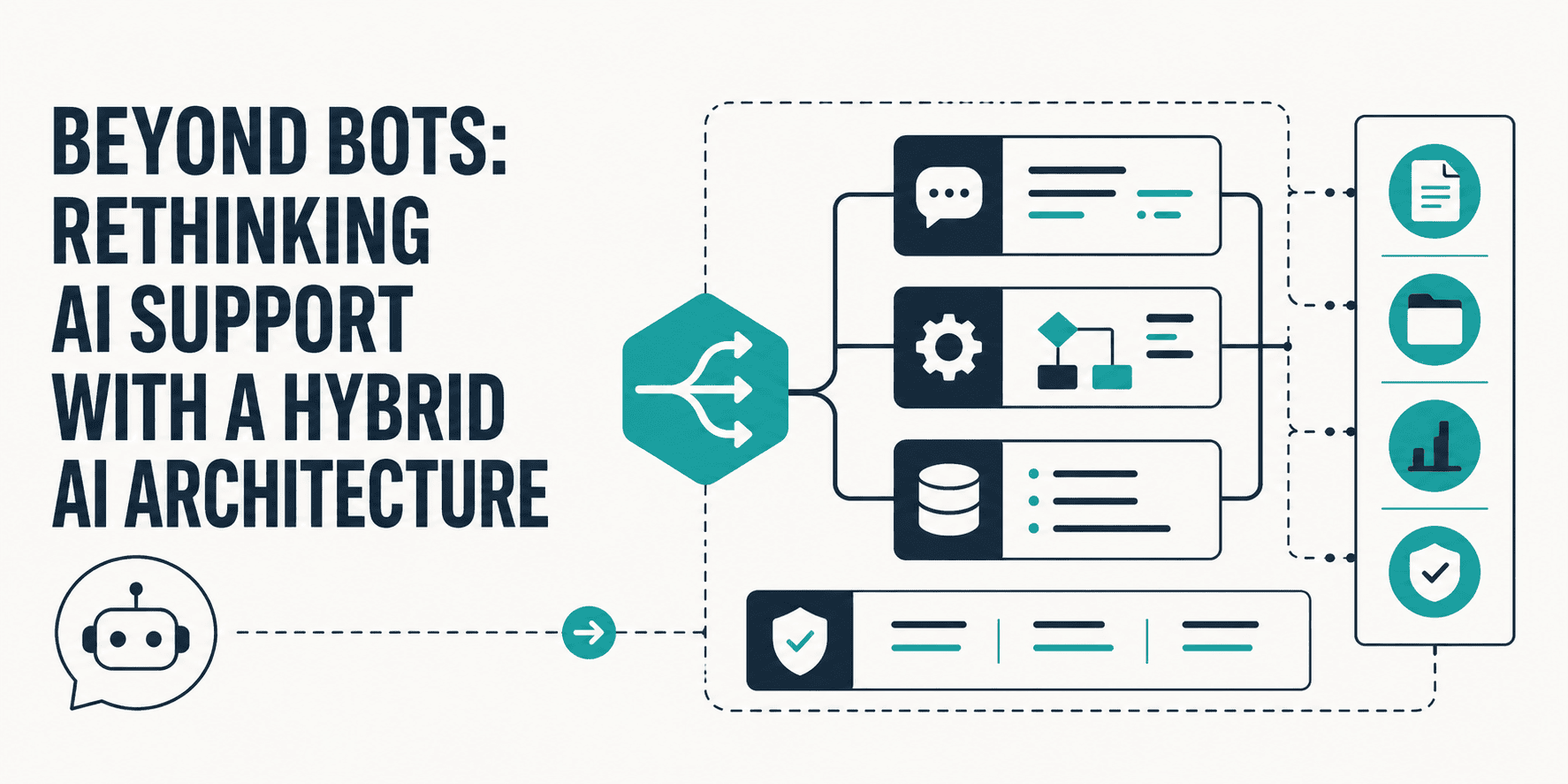
Beyond Bots: How Blending RAG and Fine-Tuning Creates a More Effective Hybrid AI Support Architecture
The landscape of automated customer service is undergoing a significant transformation as organizations move beyond basic chatbots toward a sophisticated hybrid AI architecture. This approach, as highlighted by industry insights, focuses on the strategic blending of Retrieval-Augmented Generation (RAG) and fine-tuning. By integrating these two methodologies, developers can create AI support experiences that are not only more accurate but also more contextually aware and aligned with specific domain requirements. RAG allows the system to pull from vast, up-to-date knowledge bases, while fine-tuning ensures the model understands the specific nuances and tone of the support environment. This synergy addresses the inherent limitations of using either technology in isolation, marking a new era in effective, reliable AI-driven support solutions.
Key Takeaways
- Hybrid Architecture Synergy: The most effective AI support systems are moving away from monolithic models toward a hybrid architecture that combines Retrieval-Augmented Generation (RAG) and fine-tuning.
- Dynamic Knowledge Access: RAG enables AI support tools to access and utilize real-time, external data, ensuring that responses are grounded in the latest available information.
- Domain Specialization: Fine-tuning allows the underlying large language model to adapt to specific brand voices, technical terminologies, and unique organizational requirements.
- Enhanced User Experience: The combination of these technologies results in a support experience that goes 'beyond bots,' offering more precise, helpful, and human-like interactions.
In-Depth Analysis
The Evolution of AI Support Architecture
The transition from traditional, rule-based chatbots to advanced AI support systems represents a fundamental shift in how organizations interact with their users. The concept of 'Beyond Bots' suggests a move toward a more integrated and intelligent framework. At the heart of this evolution is the hybrid AI architecture. Historically, AI support relied heavily on either pre-trained models that lacked specific context or simple retrieval systems that lacked conversational depth. By rethinking this structure, the industry is now focusing on a dual-layered approach. This hybrid model recognizes that a single method is often insufficient for the complexities of modern customer support, which requires both deep specialized knowledge and the ability to process vast amounts of changing data.
Blending RAG and Fine-Tuning
The core of this new architecture lies in the strategic blending of Retrieval-Augmented Generation (RAG) and fine-tuning. These two processes serve distinct but complementary purposes. RAG acts as the 'library' for the AI, allowing it to look up information from external sources—such as documentation, FAQs, and live databases—before generating a response. This ensures that the AI is not limited by its training cutoff date and can provide factually accurate, up-to-date answers.
On the other hand, fine-tuning acts as the 'training' or 'education' of the model. It involves adjusting the model's parameters on a specific dataset to refine its behavior, style, and understanding of a particular domain. When these are blended, the fine-tuned model provides the sophisticated linguistic capabilities and domain-specific intuition, while the RAG component provides the factual grounding. This combination mitigates common issues like 'hallucinations' (where an AI makes up information) because the model is forced to rely on retrieved evidence while communicating in a way that is perfectly tailored to the organization's needs.
Creating Effective Support Experiences
The ultimate goal of rethinking AI support with a hybrid architecture is the creation of more effective user experiences. Effectiveness in this context is measured by the accuracy of the information provided, the relevance of the response to the user's specific query, and the seamlessness of the interaction. A hybrid system can handle complex, multi-turn conversations that require both a deep understanding of the user's intent and precise technical details. By leveraging RAG, the system can cite sources or provide specific steps from a manual, while the fine-tuned element ensures the tone remains professional and helpful. This level of sophistication moves the technology from being a simple automated responder to a genuine support assistant capable of solving intricate problems.
Industry Impact
The shift toward hybrid AI architectures has profound implications for the AI industry and the broader customer service sector. First, it sets a new standard for reliability. As businesses increasingly rely on AI to handle customer-facing roles, the tolerance for errors decreases. The RAG/fine-tuning blend provides a safety net that traditional bots lacked. Second, it democratizes high-quality AI support. Organizations no longer need to build massive models from scratch; instead, they can take existing powerful models, fine-tune them on their specific data, and hook them up to a RAG system.
Furthermore, this architecture encourages a more modular approach to AI development. Companies can update their knowledge bases (the RAG component) without needing to retrain the entire model, leading to significant cost savings and operational efficiency. As this hybrid approach becomes the industry norm, we can expect a significant reduction in user frustration with automated systems, leading to higher customer satisfaction and a more robust integration of AI in daily business operations.
Frequently Asked Questions
Question: Why is a hybrid architecture better than just using a standard chatbot?
Standard chatbots often rely on fixed sets of rules or limited training data, which can lead to outdated or irrelevant answers. A hybrid architecture combines the real-time data retrieval of RAG with the specialized behavioral training of fine-tuning, resulting in responses that are both more accurate and more contextually appropriate for the specific business.
Question: How does RAG specifically improve AI support?
Retrieval-Augmented Generation (RAG) improves support by allowing the AI to access external, authoritative sources of information in real-time. Instead of relying solely on what it 'learned' during its initial training, the AI can search a company's latest manuals or databases to find the exact answer to a user's question, significantly reducing the risk of providing incorrect information.
Question: What role does fine-tuning play in this hybrid model?
Fine-tuning is responsible for the 'personality' and domain expertise of the AI. It involves training the model on a specific set of data—such as past support tickets or brand guidelines—so that it understands the specific language, technical terms, and tone required for that particular industry or company. This ensures the AI sounds professional and understands the nuances of the specific field it is supporting.