Meituan LongCat Team Unveils LongCat-AudioDiT: Advancing Zero-Shot TTS Voice Cloning via Waveform Latent Space Diffusion
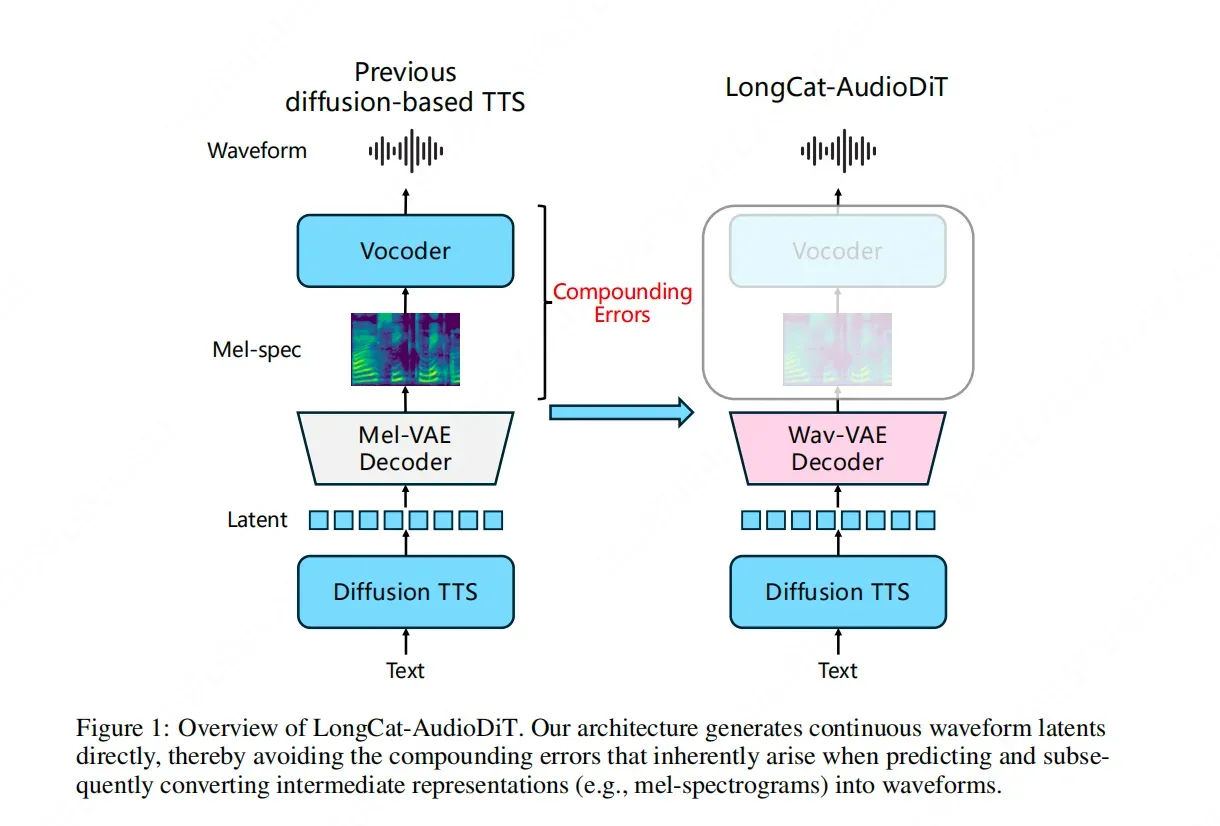
Meituan's LongCat team has officially released LongCat-AudioDiT, a sophisticated model designed to push the boundaries of zero-shot Text-to-Speech (TTS) voice cloning. By fundamentally rethinking the architecture of audio synthesis, the team has abandoned traditional intermediate representations like Mel-spectrograms. Instead, LongCat-AudioDiT operates directly within the waveform latent space using a diffusion-based model. This approach is specifically engineered to eliminate the cascade errors that typically arise during multi-stage data conversion processes. By allowing the AI to learn the inherent patterns and laws of sound directly, the model aims to overcome existing technical bottlenecks in voice cloning, offering a more streamlined and high-fidelity solution for generating realistic synthetic speech from minimal data samples.
Key Takeaways
- Elimination of Intermediate Steps: LongCat-AudioDiT completely removes the need for Mel-spectrograms, which have traditionally served as a middle-man in TTS processes.
- Waveform Latent Space Operation: The model performs Text-to-Speech synthesis directly within the waveform latent space, allowing for a more direct mapping of text to sound.
- Diffusion Model Integration: It utilizes a diffusion-based architecture to model the complexities of human voice and audio patterns.
- Reduction of Cascade Errors: By bypassing data conversion stages, the model prevents the accumulation of errors that often degrade the quality of zero-shot voice cloning.
- Focus on Sound Laws: The system is designed to help AI learn the underlying rules of sound itself rather than relying on approximated visual representations of audio.
In-Depth Analysis
Overcoming the Mel-Spectrogram Bottleneck
In the traditional landscape of Text-to-Speech (TTS) technology, the transition from text to audible sound has historically relied on intermediate representations, most notably the Mel-spectrogram. While effective, this multi-stage process introduces a significant technical bottleneck. Meituan's LongCat team identified that these intermediate steps often lead to "cascade errors"—where inaccuracies in the generation of the spectrogram are amplified during the final conversion to a waveform.
LongCat-AudioDiT represents a paradigm shift by completely abandoning these intermediate representations. By removing the Mel-spectrogram from the equation, the model simplifies the synthesis pipeline. This architectural decision is rooted in the goal of "direct learning," where the AI is tasked with understanding the laws of sound in their most fundamental form. This directness is intended to preserve the nuances of the original voice, which is critical for high-quality zero-shot voice cloning where the model must replicate a voice it has never encountered during training.
Diffusion Models in the Waveform Latent Space
The core innovation of LongCat-AudioDiT lies in its use of a diffusion model operating within the waveform latent space. Diffusion models have gained prominence for their ability to generate high-quality, complex data by iteratively refining noise into a structured output. By applying this logic directly to the waveform latent space, Meituan's model can capture the intricate details of audio without the loss of information that typically occurs when compressing audio into a spectrogram.
Operating in the latent space allows the model to handle the high dimensionality of raw audio waveforms more efficiently while maintaining the structural integrity of the sound. This approach enables the AI to "skip the middle steps" and focus on the inherent patterns of the voice. The result is a system that addresses the root cause of data conversion errors, potentially setting a new upper limit for what is possible in zero-shot voice cloning. The focus is no longer on approximating a visual map of sound, but on mastering the waveform itself.
Industry Impact
The release of LongCat-AudioDiT by Meituan marks a significant milestone in the evolution of generative audio. By successfully implementing a diffusion model that bypasses traditional intermediate representations, the LongCat team has provided a blueprint for reducing technical debt in TTS architectures. For the AI industry, this signifies a move toward more end-to-end, high-fidelity synthesis models that are less prone to the artifacts and distortions associated with legacy conversion methods.
Furthermore, the advancement in zero-shot voice cloning capabilities has broad implications for personalized user experiences, digital content creation, and accessibility. As models become more adept at learning the "laws of sound" directly, the barrier to creating highly convincing and natural-sounding synthetic voices continues to drop. This development places Meituan at the forefront of audio research, demonstrating how fundamental changes in model architecture can solve long-standing issues like cascade errors and fidelity loss in synthetic speech.
Frequently Asked Questions
Question: What makes LongCat-AudioDiT different from traditional TTS models?
Traditional TTS models usually convert text into an intermediate visual representation called a Mel-spectrogram before turning it into sound. LongCat-AudioDiT skips this intermediate step entirely, performing synthesis directly in the waveform latent space to avoid errors.
Question: How does LongCat-AudioDiT reduce errors in voice cloning?
It reduces "cascade errors," which occur when mistakes in one stage of the process (like creating a spectrogram) are passed down and worsened in the next stage. By using a direct diffusion model in the waveform latent space, it eliminates these conversion stages.
Question: What is the benefit of the AI learning the "laws of sound" directly?
By learning the inherent patterns of sound waveforms rather than intermediate representations, the AI can produce more accurate and higher-quality voice clones, especially in zero-shot scenarios where it has very little data to work with.