Google Research Unveils ME-POIs: How Mobility Data Enhances Language Models' Understanding of Physical Places
Google Research has introduced a groundbreaking framework called ME-POIs (Mobility-Enhanced Points of Interest), designed to provide large language models (LLMs) with a sophisticated understanding of physical locations. By integrating dynamic human mobility patterns and temporal activity rhythms, the framework allows AI to move beyond static text descriptions. This innovation enables models to accurately predict real-world attributes such as business opening hours, price levels, and crowd busyness. The research demonstrates that mobility-informed embeddings significantly outperform traditional text-only models like Gemini and trajectory-based models like TrajGPT. This development marks a major step forward in geospatial AI, offering practical applications in urban planning, business intelligence, and real-time navigation services by identifying "dark" businesses and forecasting peak activity with unprecedented precision.
Key Takeaways
- Introduction of ME-POIs: A new framework that integrates dynamic mobility data into language models to improve their understanding of physical locations.
- Temporal Activity Rhythms: The model analyzes how people move in and out of places over time to infer attributes that text alone cannot capture.
- Enhanced Predictive Capabilities: Significant improvements in identifying business hours, price levels, and permanent closures before they are officially reported.
- Superior Performance: The mobility-informed approach outperforms standard text-only embeddings (such as Gemini) and existing trajectory-based models like TrajGPT.
- Real-World Utility: Applications include more accurate busyness forecasting and visit intent classification for search and navigation services.
In-Depth Analysis
Bridging the Gap Between Text and Physical Reality
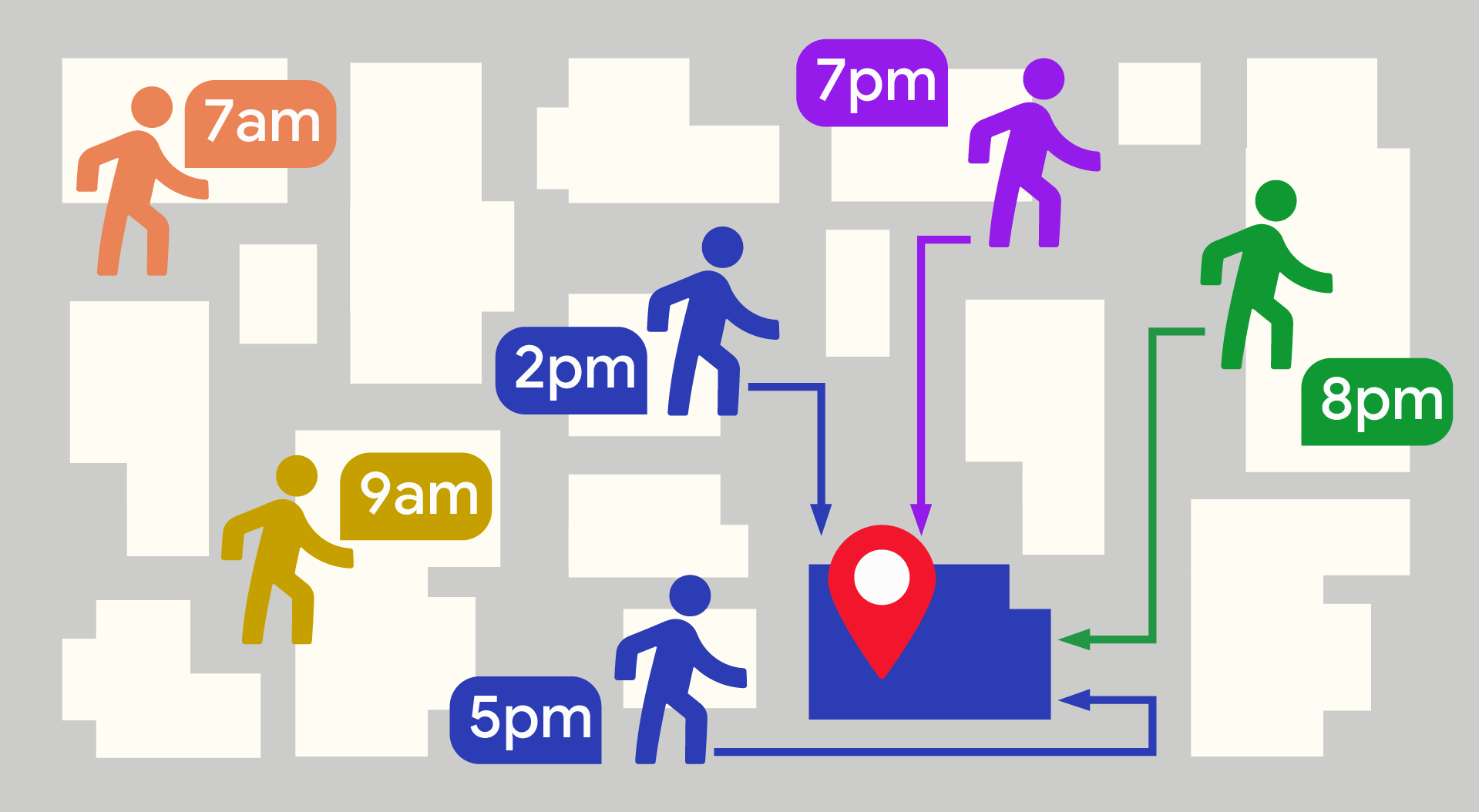
Traditional large language models (LLMs) primarily understand the world through vast amounts of text. While they can describe a "boutique" or a "park" based on training data, they often lack a nuanced understanding of how these places function in the physical world in real-time. Google Research's new ME-POIs framework addresses this limitation by incorporating human mobility patterns—the "pulse" of a location—into the model's embeddings. By treating a point of interest (POI) not just as a set of coordinates or a description, but as a dynamic entity with specific temporal rhythms, the framework allows AI to perceive the "vibe" and operational status of a place through the lens of human activity.
The Power of Mobility-Informed Embeddings
The core innovation lies in the use of mobility-informed embeddings. These embeddings capture the cyclical nature of human behavior, such as the morning rush at a coffee shop or the late-night activity at a pharmacy. The research highlights several critical tasks where this data proves transformative:
- Schedule Inference: While many businesses have online profiles, they are often outdated. ME-POIs can infer exact opening and closing times by observing when foot traffic begins and ends.
- Price-Level Classification: The framework can distinguish between a luxury boutique and a thrift store by analyzing the mobility context—such as the duration of visits and the patterns of the surrounding area—even if the text description is ambiguous.
- Permanent Closure Detection: One of the most challenging aspects of map maintenance is identifying businesses that have "gone dark." ME-POIs can flag potential closures long before an owner updates a profile or a user files a report, simply by detecting a sustained cessation of expected mobility patterns.
Comparative Benchmarking and Technical Superiority
To validate the effectiveness of the ME-POIs framework, Google researchers compared it against several baselines. These included standard text-only embedding models, such as those used in Gemini, and specialized trajectory-based geospatial models like TrajGPT. The results were definitive: mobility patterns add a layer of context that text and simple trajectories cannot replicate. By isolating the value of mobility, the researchers demonstrated that the hybrid approach—combining the semantic power of LLMs with the temporal granularity of mobility data—creates a more robust and accurate representation of the physical world.
Industry Impact
Revolutionizing Geospatial Intelligence
The integration of mobility data into language models has profound implications for the geospatial industry. For companies providing mapping and navigation services, this technology ensures that data remains fresh and accurate without relying solely on manual updates. The ability to detect closures and verify hours automatically reduces the friction for users and increases trust in digital platforms.
Advancing Urban Planning and Business Analytics
Beyond navigation, the ME-POIs framework offers a powerful tool for urban planners and commercial real estate analysts. Understanding the temporal rhythms of different neighborhoods can lead to better infrastructure planning and more informed decisions regarding business placements. For retailers, the ability to forecast busyness and understand visit intent through AI-driven embeddings provides a competitive edge in staffing and inventory management.
The Future of Context-Aware AI
This research signals a shift toward more context-aware AI. As models move from being purely digital assistants to agents that interact with the physical world, the ability to process non-textual, real-world signals like mobility will become essential. This sets a new standard for how AI models are trained, suggesting that the next generation of LLMs will need to be multi-modal in a way that includes spatial and temporal dimensions.
Frequently Asked Questions
Question: How does ME-POIs differ from traditional GPS tracking?
Unlike simple GPS tracking which just records coordinates, ME-POIs uses mobility data to create "embeddings"—mathematical representations that help a language model understand the characteristics and functions of a place. It focuses on the patterns and rhythms of movement rather than just individual locations.
Question: Can this model predict if a business is going to close soon?
Yes, the framework is particularly effective at "permanent closure detection." By identifying when a business "goes dark" (stops showing its typical mobility rhythms), the model can flag it as closed before official records are updated.
Question: Why is mobility data better than text for determining price levels?
Text descriptions can be subjective or marketing-driven. Mobility data provides an objective look at how people interact with a space—such as how long they stay and what other types of places they visit—which often correlates more accurately with the actual price level and category of a business.