
Back to List
EMO: Pretraining Mixture of Experts for Emergent Modularity Research Announced on Hugging Face Blog
Research BreakthroughMixture of ExpertsPretrainingModularity

EMO: Pretraining Mixture of Experts for Emergent Modularity Research Announced on Hugging Face Blog

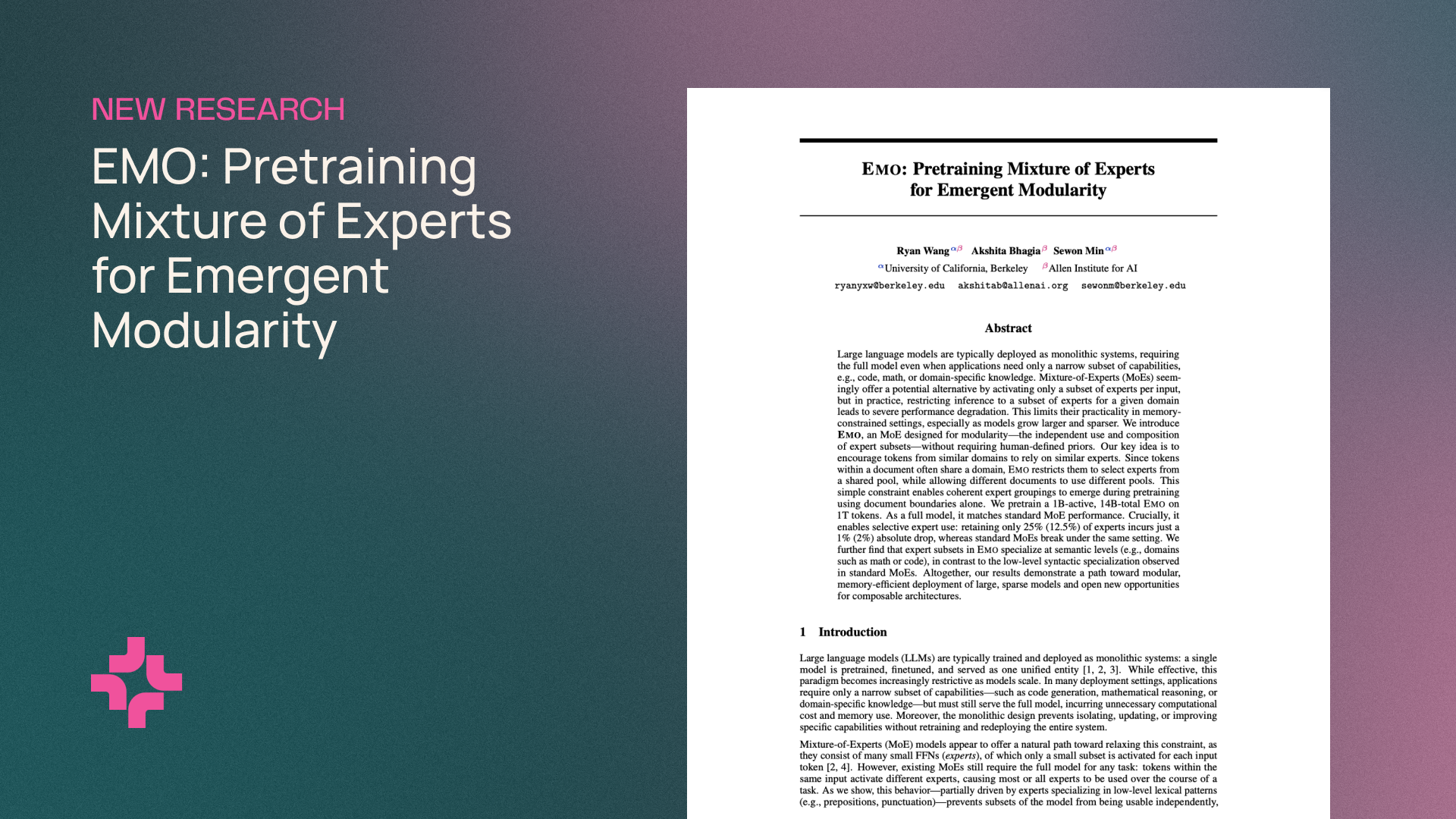
The Hugging Face Blog has published a new research entry titled 'EMO: Pretraining mixture of experts for emergent modularity.' This work, dated May 8, 2026, explores the intersection of Mixture of Experts (MoE) architectures and the development of modularity during the pretraining phase of AI models. While the specific technical data and experimental results are contained within the full blog post, the title indicates a significant focus on how modular structures can emerge naturally within MoE frameworks. This research contributes to the ongoing evolution of efficient, large-scale machine learning models by focusing on the 'EMO' methodology to enhance structural organization during initial training stages.

Hugging Face Blog

Key Takeaways

  • Introduction of 'EMO,' a research project focused on pretraining Mixture of Experts (MoE) models.
  • The primary objective involves achieving 'emergent modularity' within neural network architectures.
  • The research was officially documented and shared via the Hugging Face Blog on May 8, 2026.

In-Depth Analysis

Understanding EMO and Mixture of Experts

The title 'EMO: Pretraining mixture of experts for emergent modularity' highlights a specialized focus on Mixture of Experts (MoE) architectures. In the field of artificial intelligence, MoE is a design paradigm where a model consists of multiple 'experts,' each specializing in different aspects of the data. The EMO research appears to target the pretraining phase, which is the initial stage where a model learns general patterns from a massive dataset. By focusing on this stage, EMO likely proposes a method to better organize or initialize these experts to improve overall model performance and efficiency.

The Role of Emergent Modularity

A critical component of this research is the concept of 'emergent modularity.' In traditional AI development, modularity is often a result of manual architectural constraints. However, 'emergent' modularity suggests that the EMO pretraining process allows the model to naturally organize itself into functional modules without explicit, rigid programming for every sub-task. This approach could potentially lead to AI systems that are more adaptable and easier to fine-tune, as the underlying structure is optimized for specialized processing during the very first steps of its creation.

Industry Impact

The announcement of EMO on a platform as prominent as the Hugging Face Blog signifies its relevance to the broader AI research community. As the industry moves toward increasingly large models, the efficiency of Mixture of Experts (MoE) becomes paramount. Research into emergent modularity helps address the challenges of computational overhead and model complexity. By refining how these models are pretrained, EMO could influence future standards for building scalable, high-performance AI systems that maintain a high degree of functional organization.

Frequently Asked Questions

Question: What is the main focus of the EMO research?

EMO focuses on the pretraining of Mixture of Experts (MoE) models with a specific emphasis on fostering emergent modularity within the model's structure.

Question: Who published the EMO research findings?

The findings were published on the Hugging Face Blog, a central hub for AI research and open-source machine learning developments.

Question: When was this information released?

The research was published on May 8, 2026.
Related News

DFlash: Implementing Block Diffusion for Enhanced Flash Speculative Decoding in Large Language Models
Research Breakthrough

DFlash: Implementing Block Diffusion for Enhanced Flash Speculative Decoding in Large Language Models

DFlash, a new project developed by z-lab, introduces a novel technical framework known as Block Diffusion specifically designed for Flash Speculative Decoding. This approach, highlighted in their recent research paper (arXiv:2602.06036) and trending on GitHub, aims to optimize the inference efficiency of large language models. By focusing on the intersection of block-based diffusion and speculative decoding, DFlash addresses the computational challenges associated with high-speed token generation. The project provides a structured methodology for accelerating model outputs, representing a significant contribution to the open-source AI community's efforts in streamlining model deployment and performance. This analysis explores the core components of DFlash and its potential role in the evolution of speculative decoding techniques.

Microsoft Research Unveils Scalable Pipeline for Building Realistic Electric Transmission Grid Datasets from Open Data
Research Breakthrough

Microsoft Research Unveils Scalable Pipeline for Building Realistic Electric Transmission Grid Datasets from Open Data

Microsoft Research has announced a significant development in energy infrastructure modeling with a new project titled 'Building realistic electric transmission grid dataset at scale: a pipeline from open dataset.' Led by a team of researchers including Andrea Britto Mattos Lima and Baosen Zhang, the initiative focuses on creating a robust pipeline to generate high-fidelity, large-scale synthetic transmission grid data. By utilizing open-source datasets, the research addresses the critical shortage of accessible, realistic grid information necessary for training AI models and conducting power system simulations. This methodology aims to bridge the gap between restricted proprietary data and the need for scalable research tools, potentially accelerating the development of smarter, more resilient energy networks globally.

Anthropic Unveils Natural Language Autoencoders: Translating Claude's Internal Activations into Readable Text
Research Breakthrough

Anthropic Unveils Natural Language Autoencoders: Translating Claude's Internal Activations into Readable Text

Anthropic has announced a major breakthrough in AI interpretability with the introduction of Natural Language Autoencoders (NLAs). This new method allows researchers to convert the internal mathematical activations of AI models—essentially the model's "thoughts"—directly into human-readable English. Unlike previous interpretability tools like sparse autoencoders that required expert analysis, NLAs provide direct insights into the model's reasoning process. Anthropic has already utilized NLAs to observe Claude Opus 4.6 planning rhymes in advance, detect when models like Mythos Preview were aware of safety testing, and identify the specific training data causing unexpected language-switching behaviors. This development marks a significant step forward in ensuring AI safety and reliability by making the internal workings of large language models transparent.