AI News on May 9, 2026

DeepSeek-TUI: A Specialized Terminal-Based Programming Agent for DeepSeek V4 Integration
Open Source

DeepSeek-TUI: A Specialized Terminal-Based Programming Agent for DeepSeek V4 Integration

DeepSeek-TUI, an open-source project developed by Hmbown, has emerged as a significant tool for developers seeking to integrate the DeepSeek V4 model directly into their command-line workflows. Operating as a Terminal User Interface (TUI), the agent is triggered via the `deepseek` command, allowing for a seamless transition between coding and AI assistance. The tool is characterized by its ability to stream inference chunks in real-time and its functional capacity to edit local workspaces directly. By focusing on a terminal-centric approach, DeepSeek-TUI addresses the needs of developers who prefer high-efficiency environments without the overhead of graphical interfaces. This project, recently highlighted on GitHub Trending, represents a focused effort to bring advanced model capabilities like those of DeepSeek V4 into a localized, programmable terminal setting.


GitHub Trending
VectifyAI Launches PageIndex: A New Paradigm for Vector-less Reasoning-based Retrieval-Augmented Generation
Open Source

VectifyAI Launches PageIndex: A New Paradigm for Vector-less Reasoning-based Retrieval-Augmented Generation

PageIndex, a new project developed by VectifyAI, has emerged as a significant development in the field of Retrieval-Augmented Generation (RAG). Recently featured on GitHub Trending, PageIndex introduces a document indexing system specifically designed for vector-less, reasoning-based RAG workflows. Unlike traditional RAG implementations that rely heavily on vector embeddings and similarity-based search, PageIndex focuses on a reasoning-centric approach to document retrieval. This innovation addresses the growing need for more precise and logically grounded AI interactions with complex datasets. By moving away from standard vector dependencies, PageIndex offers a specialized solution for developers looking to enhance the accuracy and interpretability of how Large Language Models (LLMs) access and utilize indexed information.

GitHub Trending
Anthropic Launches Claude for Financial Services: Specialized Reference Agents for Investment Banking and Equity Research
Product Launch

Anthropic Launches Claude for Financial Services: Specialized Reference Agents for Investment Banking and Equity Research

Anthropic has introduced a specialized suite of tools titled 'Claude for Financial Services,' now available on GitHub. This release targets the most common and high-value workflows within the financial sector, including investment banking, equity research, private equity, and wealth management. The repository provides a comprehensive framework consisting of reference agents, specialized skills, and data connectors designed to integrate Claude’s intelligence into complex financial operations. According to the release notes, these resources are currently offered within a specific two-week framework. This move signifies a strategic push by Anthropic to provide vertical-specific solutions, enabling financial institutions to leverage large language models for data-intensive tasks and sophisticated decision-making processes across various financial disciplines.

GitHub Trending
Local Deep Research: Achieving 95% SimpleQA Accuracy with Localized AI and Encrypted Search
Open Source

Local Deep Research: Achieving 95% SimpleQA Accuracy with Localized AI and Encrypted Search

Local Deep Research, a new open-source project by LearningCircuit, introduces a powerful framework for localized AI-driven analysis. The tool achieves a remarkable 95% accuracy on SimpleQA benchmarks, demonstrated using the Qwen3.6-27B model on consumer-grade hardware like the NVIDIA RTX 3090. Designed for versatility and privacy, it supports a wide range of local and cloud-based Large Language Models (LLMs) through integrations such as llama.cpp and Ollama. By connecting to over 10 search engines—including academic giants like arXiv and PubMed—and allowing for the ingestion of private documents, Local Deep Research provides a comprehensive environment for researchers. The system distinguishes itself with a commitment to security, operating as a purely local and encrypted solution to ensure data sovereignty for its users.

GitHub Trending
InsForge: A Specialized Postgres-Based Backend Infrastructure Designed for Programming Agents
Open Source

InsForge: A Specialized Postgres-Based Backend Infrastructure Designed for Programming Agents

InsForge has emerged as a comprehensive backend solution built on Postgres, specifically engineered to support the development and deployment of programming agents. By integrating essential services such as authentication, storage, compute, and hosting into a single platform, InsForge simplifies the infrastructure stack for AI-driven development. A standout feature is its dedicated AI gateway, which facilitates the interaction between agents and large language models. As an open-source project gaining traction on GitHub, InsForge addresses the growing need for robust, agent-centric backends that leverage the reliability of Postgres while providing the specialized tools required for autonomous coding tasks.

GitHub Trending
Vercel Labs Launches Open Agents: A New Open-Source Template for Building Cloud-Based AI Agents
Open Source

Vercel Labs Launches Open Agents: A New Open-Source Template for Building Cloud-Based AI Agents

Vercel Labs has officially introduced "Open Agents," a specialized open-source template designed to streamline the development and deployment of cloud-based intelligent agents. This project, which has recently gained significant traction on GitHub Trending, provides developers with a foundational framework to build agentic systems tailored for cloud environments. By offering a structured template, Vercel Labs aims to lower the barrier to entry for creating sophisticated AI agents that can operate autonomously within cloud infrastructures. The release signifies a pivotal shift toward standardized, accessible infrastructure for the next generation of AI applications, emphasizing the importance of cloud-native architectures in the evolving landscape of autonomous digital entities.

GitHub Trending
Addy Osmani Releases Agent-Skills: A Framework for Production-Grade AI Coding Agent Engineering
Open Source

Addy Osmani Releases Agent-Skills: A Framework for Production-Grade AI Coding Agent Engineering

Renowned engineer Addy Osmani has introduced 'agent-skills,' a specialized project designed to bring production-grade engineering capabilities to AI coding agents. The repository focuses on the critical transition from experimental AI interactions to reliable, professional-standard software development. By encoding complex workflows, rigorous quality gates, and industry best practices directly into the agent's operational logic, the project aims to standardize how AI agents perform programming tasks. This initiative addresses the growing need for consistency and high-quality output in AI-driven development environments, ensuring that agents operate within the same professional constraints as human engineers. The project serves as a foundational resource for developers looking to build more robust and dependable AI-powered coding tools.

GitHub Trending
DFlash: Implementing Block Diffusion for Enhanced Flash Speculative Decoding in Large Language Models
Research Breakthrough

DFlash: Implementing Block Diffusion for Enhanced Flash Speculative Decoding in Large Language Models

DFlash, a new project developed by z-lab, introduces a novel technical framework known as Block Diffusion specifically designed for Flash Speculative Decoding. This approach, highlighted in their recent research paper (arXiv:2602.06036) and trending on GitHub, aims to optimize the inference efficiency of large language models. By focusing on the intersection of block-based diffusion and speculative decoding, DFlash addresses the computational challenges associated with high-speed token generation. The project provides a structured methodology for accelerating model outputs, representing a significant contribution to the open-source AI community's efforts in streamlining model deployment and performance. This analysis explores the core components of DFlash and its potential role in the evolution of speculative decoding techniques.

GitHub Trending
Industry News

Tesla Model Y Becomes First Vehicle to Pass NHTSA's New Advanced Driver Assistance System Tests

On May 8, 2026, the National Highway Traffic Safety Administration (NHTSA) officially announced that the Tesla Model Y has become the first vehicle to pass its newly established 'Advanced Driver Assistance System' (ADAS) tests. This milestone marks a significant achievement for Tesla, as the Model Y successfully navigated the updated federal safety evaluations designed to scrutinize modern driver-assist technologies. The announcement, sourced from an official NHTSA press release, highlights the Model Y's role as a pioneer in meeting these rigorous new standards. This development underscores the evolving regulatory landscape for automotive safety and sets a new benchmark for the industry as manufacturers strive to align their automated systems with the latest government safety protocols.

Hacker News
Addressing the Surge of AI-Driven Vulnerabilities Through Deterministic Package Management and Flox's System of Record
Industry News

Addressing the Surge of AI-Driven Vulnerabilities Through Deterministic Package Management and Flox's System of Record

The emergence of advanced AI models like Claude Mythos is fundamentally altering the cybersecurity landscape by accelerating the discovery of Common Vulnerabilities and Exposures (CVEs). Traditional package management systems, including dnf, apt, and pip, struggle with non-determinism, making it nearly impossible for organizations to maintain accurate software manifests across diverse environments. This lack of visibility, coupled with an explosion of AI-detected zero-days and long-persisting vulnerabilities, has rendered manual CVE triage unmanageable. Flox, an open-source system built on the Nix declarative package manager, addresses these challenges by providing a cryptographically verifiable dependency graph. By shifting from reactive post-deployment scanning to build-time verification and maintaining a centralized system of record, Flox enables development and platform teams to manage environments with unprecedented security and traceability.

Hacker News
NVIDIA Appoints Suzanne Nora Johnson to Board of Directors Effective July 2026
Industry News

NVIDIA Appoints Suzanne Nora Johnson to Board of Directors Effective July 2026

NVIDIA has officially announced the appointment of Suzanne Nora Johnson to its board of directors. According to the official statement released by the NVIDIA Newsroom on May 8, 2026, the appointment is set to become effective on July 13, 2026. This strategic addition to the company's governing body represents a significant update to NVIDIA's leadership structure. The announcement provides a clear timeline for the transition, ensuring a structured integration into the board's activities. As a key player in the technology and AI sectors, NVIDIA's board appointments are closely watched for their potential impact on corporate governance and long-term strategic oversight. This concise update confirms the specific date and the individual selected for this high-level corporate role.

NVIDIA Newsroom
Microsoft Research Unveils Scalable Pipeline for Building Realistic Electric Transmission Grid Datasets from Open Data
Research Breakthrough

Microsoft Research Unveils Scalable Pipeline for Building Realistic Electric Transmission Grid Datasets from Open Data

Microsoft Research has announced a significant development in energy infrastructure modeling with a new project titled 'Building realistic electric transmission grid dataset at scale: a pipeline from open dataset.' Led by a team of researchers including Andrea Britto Mattos Lima and Baosen Zhang, the initiative focuses on creating a robust pipeline to generate high-fidelity, large-scale synthetic transmission grid data. By utilizing open-source datasets, the research addresses the critical shortage of accessible, realistic grid information necessary for training AI models and conducting power system simulations. This methodology aims to bridge the gap between restricted proprietary data and the need for scalable research tools, potentially accelerating the development of smarter, more resilient energy networks globally.

Microsoft Research
Yarbo Pledges Security Fixes After Critical Vulnerabilities Allowed Hackers to Hijack Robot Lawn Mowers
Industry News

Yarbo Pledges Security Fixes After Critical Vulnerabilities Allowed Hackers to Hijack Robot Lawn Mowers

Following a high-profile security demonstration where a hacker successfully took control of a Yarbo robot lawn mower, the manufacturer has officially responded with a promise to address the underlying vulnerabilities. The security breach revealed that thousands of these autonomous, bladed robots could be hijacked with relative ease, exposing sensitive user data including GPS coordinates, Wi-Fi passwords, and email addresses. The incident, which involved a reporter being physically 'run over' by the hijacked machine, has raised significant concerns regarding the safety and privacy of Yarbo's fleet. Yarbo's latest update aims to close these security gaps and protect users from unauthorized access that could lead to both physical harm and data theft.

The Verge
The Global Expansion of AI Data Centers: Navigating Energy Demands, Grid Stability, and Community Impact
Industry News

The Global Expansion of AI Data Centers: Navigating Energy Demands, Grid Stability, and Community Impact

The rapid proliferation of massive data centers serves as the essential physical infrastructure for the burgeoning artificial intelligence industry. However, this expansion is not without significant challenges. As technology companies race to build warehouses filled with energy-intensive servers, they face increasing opposition and complex hurdles. These include mounting pressure on global power grids, rising utility costs for consumers, and growing concerns from local communities regarding environmental impacts. From innovative and audacious deployment strategies to the fundamental strain on public resources, the development of AI data centers has become a focal point of controversy and debate across the globe, highlighting the friction between digital ambitions and physical limitations.

The Verge
Cloudflare Announces 1,100 Layoffs as AI Efficiency Renders Support Roles Obsolete Despite Record Revenue
Industry News

Cloudflare Announces 1,100 Layoffs as AI Efficiency Renders Support Roles Obsolete Despite Record Revenue

Cloudflare has initiated its first large-scale workforce reduction, cutting 1,100 positions even as the company celebrates record-high revenue. CEO Matthew Prince attributed the decision to significant efficiency gains driven by artificial intelligence, which have fundamentally changed the company's staffing requirements. According to Prince, the integration of AI has made many traditional support roles obsolete, allowing the company to maintain growth with a leaner team. This move highlights a growing trend in the technology sector where financial success and workforce expansion are no longer strictly correlated, as automation takes over tasks previously handled by human employees. The layoffs mark a pivotal moment for Cloudflare as it navigates the transition toward an AI-augmented operational model.

TechCrunch AI
AI Acceleration and the Collapse of Traditional Vulnerability Disclosure Cultures: An Analysis of the Copy Fail Incident
Industry News

AI Acceleration and the Collapse of Traditional Vulnerability Disclosure Cultures: An Analysis of the Copy Fail Incident

The emergence of the 'Copy Fail' vulnerability has highlighted a growing tension between two distinct security cultures: coordinated disclosure and the 'bugs are bugs' approach. While coordinated disclosure relies on private communication and 90-day embargoes, the Linux-centric 'bugs are bugs' philosophy favors rapid, quiet public fixes to avoid drawing attention to flaws. However, the rise of AI-driven vulnerability detection is fundamentally breaking these models. As AI becomes increasingly proficient at scanning public code changes to identify security implications, the traditional strategy of 'hiding in plain sight' is becoming obsolete. This shift forces a reevaluation of how security professionals manage disclosures in an era where automated tools can instantly bridge the gap between a raw fix and an exploitable vulnerability, rendering traditional embargoes and quiet patching ineffective.

Hacker News
CyberSecQwen-4B: Why Defensive Cyber Needs Small, Specialized, Locally-Runnable Models
Industry News

CyberSecQwen-4B: Why Defensive Cyber Needs Small, Specialized, Locally-Runnable Models

The emergence of CyberSecQwen-4B, featured on the Hugging Face Blog and developed within the context of the Lablab.ai AMD Developer Hackathon, signals a pivotal shift in cybersecurity AI. This model emphasizes the necessity of small, specialized, and locally-runnable architectures for defensive cyber operations. By utilizing a 4-billion parameter framework, CyberSecQwen-4B addresses the critical need for security tools that can operate independently of cloud infrastructure, ensuring data privacy and reducing latency. This approach highlights a growing industry trend where efficiency and specialization are prioritized over the massive scale of general-purpose large language models, particularly in sensitive environments where local execution is a prerequisite for operational security.

Hugging Face Blog
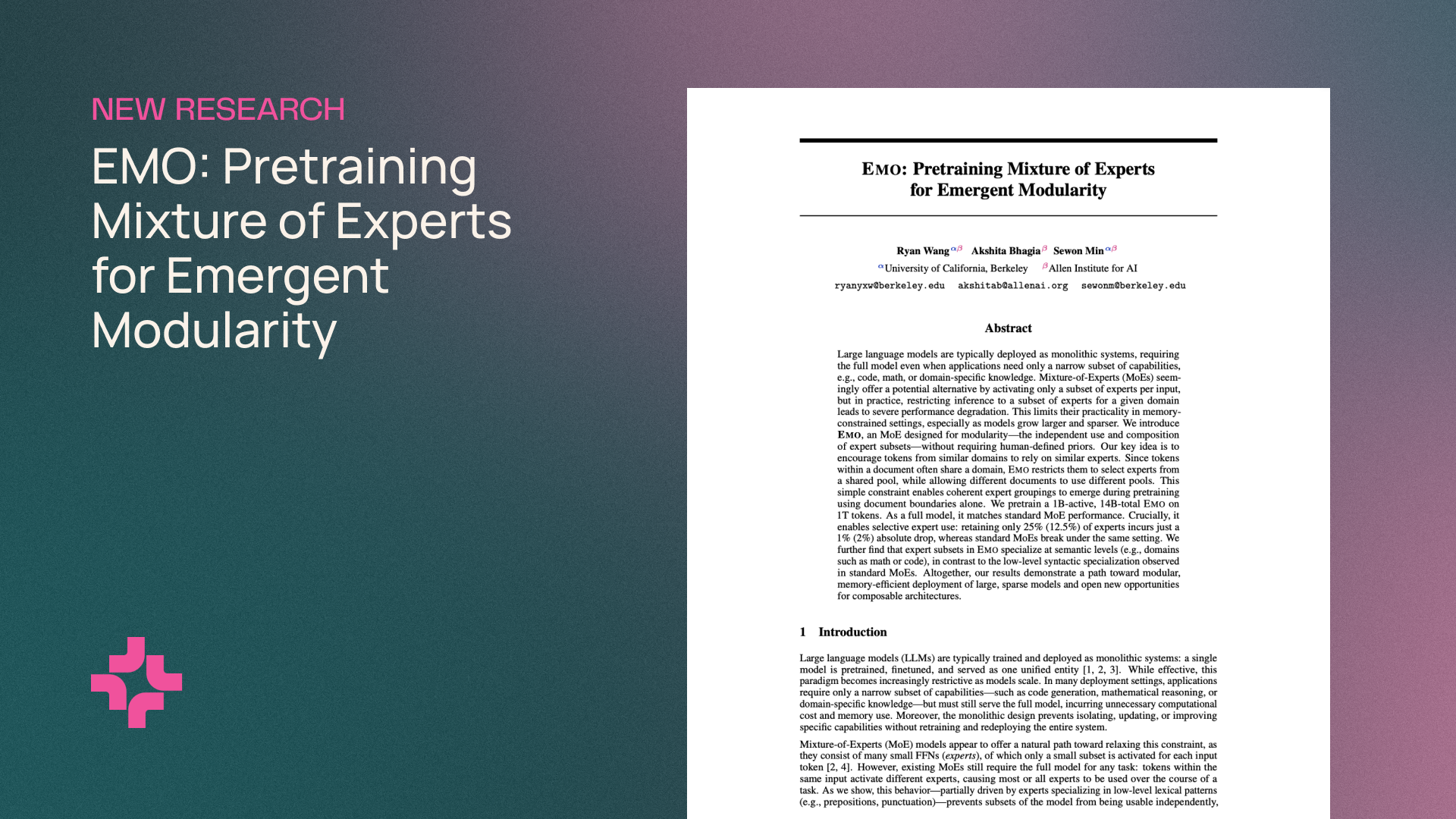
EMO: Pretraining Mixture of Experts for Emergent Modularity Research Announced on Hugging Face Blog
Research Breakthrough

EMO: Pretraining Mixture of Experts for Emergent Modularity Research Announced on Hugging Face Blog

The Hugging Face Blog has published a new research entry titled 'EMO: Pretraining mixture of experts for emergent modularity.' This work, dated May 8, 2026, explores the intersection of Mixture of Experts (MoE) architectures and the development of modularity during the pretraining phase of AI models. While the specific technical data and experimental results are contained within the full blog post, the title indicates a significant focus on how modular structures can emerge naturally within MoE frameworks. This research contributes to the ongoing evolution of efficient, large-scale machine learning models by focusing on the 'EMO' methodology to enhance structural organization during initial training stages.

Hugging Face Blog