
Back to List
ReasoningBank: Google Research Explores New Methods for Enabling AI Agents to Learn from Experience
Research BreakthroughGoogle ResearchGenerative AIAI Agents

ReasoningBank: Google Research Explores New Methods for Enabling AI Agents to Learn from Experience

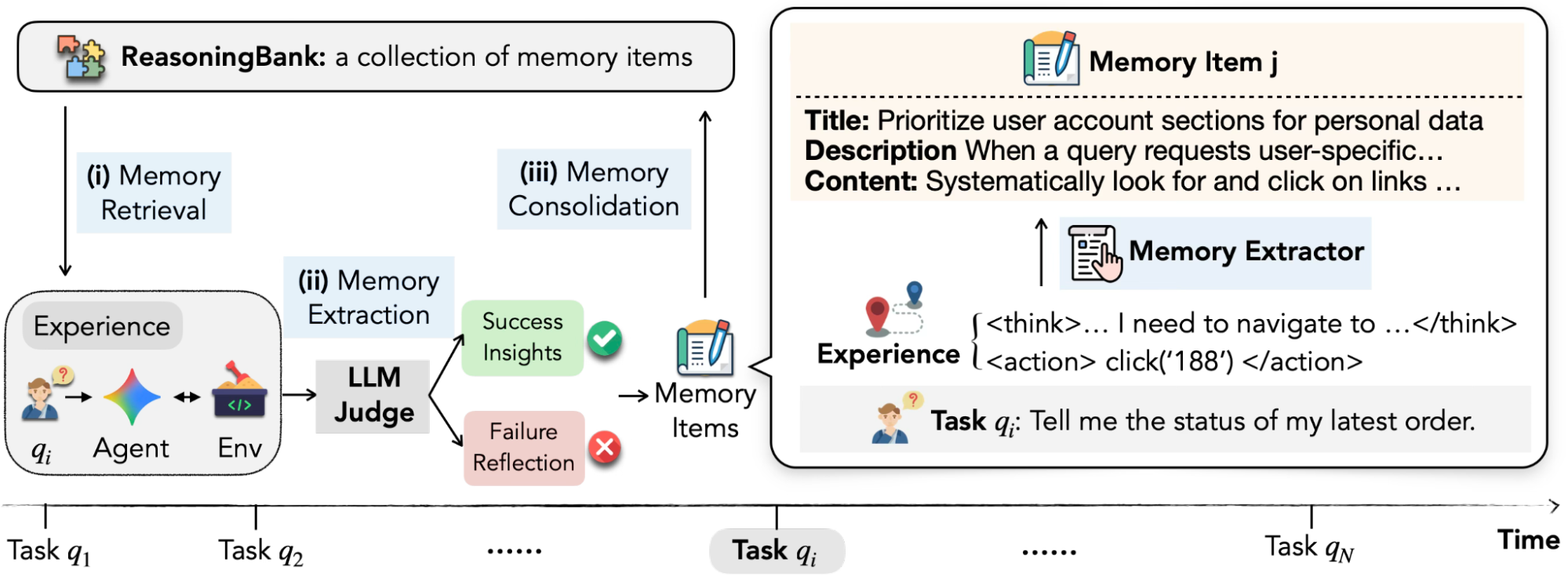
Google Research has introduced ReasoningBank, a development focused on the evolution of generative AI agents. According to the publication, this initiative aims to enable agents to learn more effectively from their experiences. While the specific technical architecture and detailed performance metrics remain within the scope of Google Research's broader generative AI initiatives, the announcement highlights a shift toward more autonomous learning capabilities in artificial intelligence. This development represents a significant step in the field of generative AI, focusing on how agents can refine their reasoning processes over time. The project underscores Google's ongoing commitment to advancing the boundaries of how AI systems interact with and learn from the data and environments they encounter.

Google Research Blog

Key Takeaways

  • Google Research has announced ReasoningBank, a project centered on generative AI.
  • The primary focus of the initiative is enabling AI agents to learn from experience.
  • The project is part of Google's broader research into advancing generative AI capabilities.

In-Depth Analysis

Advancing Generative AI through Experience

ReasoningBank represents a strategic focus by Google Research into the field of generative AI. The core objective of this initiative is to bridge the gap between static model responses and dynamic learning. By focusing on how agents learn from experience, the research suggests a move toward AI systems that do not just process information but adapt based on previous interactions and outcomes.

The Role of Reasoning in AI Agents

The title 'ReasoningBank' implies a repository or a structured framework for reasoning processes. In the context of generative AI, this suggests that Google is looking for ways to make AI agents more reliable and capable of complex task execution. By enabling these agents to learn from their past actions, the research aims to improve the overall efficiency and intelligence of autonomous systems.

Industry Impact

The introduction of ReasoningBank by Google Research signals a significant trend in the AI industry toward 'experiential learning' for models. If agents can successfully learn from experience, the industry may see a reduction in the need for constant manual fine-tuning. This could lead to more robust AI applications in various sectors, where agents become more proficient the more they are utilized, ultimately setting a new standard for generative AI development.

Frequently Asked Questions

Question: What is the main goal of ReasoningBank?

ReasoningBank is designed to enable generative AI agents to learn from their experiences, improving their reasoning and performance over time.

Question: Who is the organization behind this research?

The project is being developed and was published by Google Research.

Question: How does this relate to generative AI?

ReasoningBank is a specific application or framework within the generative AI field that focuses on the learning and reasoning capabilities of AI agents.
Related News

RuView: Transforming Commercial WiFi Signals into Real-Time Human Pose Estimation and Vital Sign Monitoring
Research Breakthrough

RuView: Transforming Commercial WiFi Signals into Real-Time Human Pose Estimation and Vital Sign Monitoring

RuView is an innovative technology developed by ruvnet that leverages standard commercial WiFi signals to perform complex human sensing tasks. By utilizing WiFi DensePose, the system can achieve real-time human pose estimation, life sign monitoring, and presence detection without the need for traditional video cameras or pixel-based sensors. This breakthrough allows for high-fidelity tracking of human activity while maintaining privacy, as it operates entirely through signal processing rather than visual recording. The project, hosted on GitHub, demonstrates the potential of using existing wireless infrastructure for advanced spatial intelligence and health monitoring applications, marking a significant step forward in non-invasive sensing technology.

Soul Player C64: Implementing a Real 25,000 Parameter Transformer on a 1 MHz Commodore 64
Research Breakthrough

Soul Player C64: Implementing a Real 25,000 Parameter Transformer on a 1 MHz Commodore 64

Soul Player C64 is a groundbreaking project that brings modern AI architecture to vintage hardware. It features a 2-layer decoder-only transformer, the same architecture powering ChatGPT and Claude, running on an unmodified 1 MHz Commodore 64. Implemented in hand-written 6502/6510 assembly, the model utilizes ~25,000 int8 parameters and fits entirely on a floppy disk. Despite the hardware limitations, it performs real multi-head causal self-attention, softmax, and RMSNorm. A key technical breakthrough in softmax score normalization allows the model to produce meaningful attention weights on 8-bit hardware. While processing takes approximately 60 seconds per token, the project demonstrates that the fundamental principles of Large Language Models can be scaled down to the most constrained computing environments.

Microsoft Research Explores the Intersection of Artificial Intelligence and Global Environmental Sustainability
Research Breakthrough

Microsoft Research Explores the Intersection of Artificial Intelligence and Global Environmental Sustainability

In a recent podcast episode from Microsoft Research, experts Doug Burger, Amy Luers, and Ishai Menache discuss the critical question of whether artificial intelligence can be leveraged to create a more sustainable world. Published on April 20, 2026, the discussion features insights from leading researchers on the potential role of AI technologies in addressing environmental challenges. The conversation explores the balance between AI's computational demands and its capacity to optimize global systems for sustainability. While the original source provides the framework for this high-level dialogue among industry experts, it highlights Microsoft's ongoing commitment to researching technological solutions for ecological preservation and resource management in an increasingly digital era.