AI News on July 9, 2026

CodexBar: A New Open-Source Tool for Monitoring OpenAI Codex and Claude Code Token Usage Statistics
Open Source

CodexBar: A New Open-Source Tool for Monitoring OpenAI Codex and Claude Code Token Usage Statistics

CodexBar is a specialized open-source utility developed by steipete, designed to provide developers with real-time visibility into their AI programming limits. By integrating directly into the system menu bar, the tool offers a seamless way to track usage statistics for OpenAI Codex and Claude Code. A standout feature of CodexBar is its ability to display these metrics without requiring a traditional login, streamlining the user experience. The project aims to help developers manage their token consumption effectively, encapsulated by its motto: "May your tokens never run out." This tool addresses a growing need in the AI-assisted development ecosystem for better observability of resource constraints and usage quotas.

GitHub Trending
Meetily: The Privacy-First Open-Source AI Meeting Assistant Built with Rust for Local Processing
Open Source

Meetily: The Privacy-First Open-Source AI Meeting Assistant Built with Rust for Local Processing

Meetily (also known as Meetly Ai) has emerged as a leading open-source, self-hosted AI meeting assistant designed for users who prioritize data privacy. Built using the Rust programming language, the platform offers real-time transcription powered by Parakeet and Whisper, delivering speeds up to four times faster than standard implementations. Key features include speaker identification and automated meeting summarization through Ollama integration. By ensuring 100% local processing with no cloud dependency, Meetily addresses the growing demand for secure meeting documentation tools. As a top-ranked tool on GitHub Trending, it provides a robust alternative to cloud-based AI services, allowing organizations to maintain full control over their sensitive conversational data while leveraging advanced AI capabilities.

GitHub Trending
Massive Leak of System Prompts for Next-Gen AI Models Including GPT 5.5 and Claude Fable 5 Discovered on GitHub
Industry News

Massive Leak of System Prompts for Next-Gen AI Models Including GPT 5.5 and Claude Fable 5 Discovered on GitHub

A significant repository titled 'system_prompts_leaks' has been identified on GitHub, containing the extracted system prompts for a wide array of industry-leading artificial intelligence models. The collection, curated by user asgeirtj, features internal instructions for highly anticipated and cutting-edge models from OpenAI, Anthropic, Google, and xAI. Notable inclusions are the system prompts for GPT 5.5 Thinking, Claude Fable 5, and Gemini 3.5 Flash. Beyond standalone models, the leak also covers specialized AI implementations such as Claude Code, Cursor, and Perplexity. This repository serves as a centralized database for the hidden directives that govern AI behavior, safety protocols, and operational personas, offering a rare look into the backend logic of the world's most advanced large language models.

GitHub Trending
AI-Job-Search: A New Framework Built on Claude Code for Automated Career Management
Product Launch

AI-Job-Search: A New Framework Built on Claude Code for Automated Career Management

Developer MadsLorentzen has introduced 'ai-job-search,' an innovative AI-driven framework designed to revolutionize the traditional job application process. Built specifically on the Claude Code platform, this open-source tool allows users to automate the most tedious aspects of job hunting. By forking the repository and inputting a personal profile, users can leverage Claude's advanced reasoning to evaluate potential job roles, generate highly customized resumes, craft personalized cover letters, and conduct comprehensive interview preparation. This development highlights a growing trend in utilizing specialized AI agents to handle complex, multi-step personal productivity tasks, moving beyond simple text generation into structured career workflow automation.

GitHub Trending
Addy Osmani Introduces Agent-Skills: Production-Grade Engineering Capabilities for AI Coding Agents
Open Source

Addy Osmani Introduces Agent-Skills: Production-Grade Engineering Capabilities for AI Coding Agents

Renowned engineer Addy Osmani has launched 'agent-skills,' a specialized project designed to bring production-grade engineering standards to AI coding agents. The project focuses on encoding essential software development elements—including structured workflows, quality gates, and industry best practices—directly into the operational capabilities of AI agents. By moving beyond simple code generation, agent-skills aims to provide a framework that ensures AI-driven development is reliable, consistent, and suitable for enterprise environments. This initiative addresses a critical gap in the current AI landscape by prioritizing the 'how' of software engineering, ensuring that autonomous agents adhere to the same rigorous quality standards as human developers while performing complex coding tasks.

GitHub Trending
RuView: Transforming Ordinary WiFi Signals into Real-Time Spatial Intelligence and Vital Signs Monitoring Without Cameras
Open Source

RuView: Transforming Ordinary WiFi Signals into Real-Time Spatial Intelligence and Vital Signs Monitoring Without Cameras

RuView, a project by ruvnet recently highlighted on GitHub, introduces a paradigm shift in environmental sensing by utilizing standard WiFi signals for spatial intelligence. Unlike traditional monitoring systems that rely on optical sensors, RuView provides real-time presence detection and vital signs monitoring without the use of video pixels. This approach prioritizes user privacy while leveraging existing wireless infrastructure to gather sophisticated data. By interpreting the fluctuations in WiFi signals, the system can detect human presence and monitor biological rhythms, offering a non-intrusive alternative for smart homes, healthcare facilities, and secure environments. The project represents a significant advancement in the field of RF-based sensing and spatial AI.

GitHub Trending
TencentCloud Introduces CubeSandbox: A Specialized Instant and Secure Execution Environment Designed for High-Concurrency AI Agents
Open Source

TencentCloud Introduces CubeSandbox: A Specialized Instant and Secure Execution Environment Designed for High-Concurrency AI Agents

TencentCloud has officially released CubeSandbox, a purpose-built sandbox environment tailored specifically for the evolving needs of AI agents. This new infrastructure focuses on four core pillars: instant startup, high concurrency, robust security, and a lightweight footprint. As AI agents increasingly require isolated environments to execute code and perform tasks, CubeSandbox provides a controlled space that ensures system integrity without sacrificing performance. By optimizing for speed and resource efficiency, TencentCloud aims to solve the common bottlenecks associated with traditional virtualization in AI workflows. The project, currently featured on GitHub Trending, represents a strategic move to provide the foundational tools necessary for developers to build and scale autonomous AI systems safely and efficiently in cloud-native environments.

GitHub Trending
Lovable Reportedly in Talks for $300 Million Funding Round to Reach $13.2 Billion Valuation
Funding

Lovable Reportedly in Talks for $300 Million Funding Round to Reach $13.2 Billion Valuation

AI startup Lovable is reportedly negotiating a new funding round that could see its valuation double to $13.2 billion. The round, estimated at $300 million, is expected to be led by Menlo Ventures, according to reports from Sifted. This potential capital injection underscores the massive scale of investment currently flowing into the artificial intelligence sector. If the deal closes at the reported terms, it would represent a significant milestone for the company, reflecting a 100% increase in its market valuation. The involvement of Menlo Ventures as the lead investor further highlights the high-stakes competition among venture capital firms to back leading AI entities in an increasingly crowded and high-valued market.

TechCrunch AI
Meta Developing 'Super Sensing' Smart Glasses Featuring Continuous Recording and AI Integration
Industry News

Meta Developing 'Super Sensing' Smart Glasses Featuring Continuous Recording and AI Integration

Meta is reportedly venturing into the next generation of AI wearables with a prototype for "super sensing" smart glasses. According to reports from the Financial Times, these always-aware devices are designed to continuously record audio and capture photographic images at intervals of just a few seconds. This constant stream of data is intended to feed into Meta AI, allowing users to interact with the assistant by asking questions about their captured environment and experiences. While the project represents a significant leap in ambient computing and multimodal AI, the move toward always-on recording capabilities highlights a transformative shift in how wearable technology interacts with the physical world and user privacy.

The Verge
Industry News

Bun Runtime Undergoes Major Rust Rewrite Following Anthropic Acquisition to Enhance Stability

Bun, the high-performance JavaScript runtime and toolkit, is undergoing a significant architectural transition from Zig to Rust. Following its acquisition by Anthropic in December 2025, the development team has prioritized addressing critical stability issues that emerged as the project scaled to 22 million monthly downloads. The rewrite, assisted by the pre-release Claude Fable 5 AI model, aims to eliminate complex memory safety vulnerabilities, such as heap-use-after-free crashes found in its Node.js API implementations. Originally built in Zig to achieve rapid development and low-level performance, Bun has become a foundational tool for platforms like Vercel and DigitalOcean. This move to Rust represents a strategic shift toward long-term reliability for the ambitious project, which encompasses a transpiler, bundler, and package manager within a single unified runtime.

Hacker News
OpenAI Audit Reveals Significant Flaws in SWE-Bench Pro Coding Benchmark with 30 Percent of Tasks Estimated Broken
Research Breakthrough

OpenAI Audit Reveals Significant Flaws in SWE-Bench Pro Coding Benchmark with 30 Percent of Tasks Estimated Broken

OpenAI has released a research publication detailing a comprehensive audit of SWE-Bench Pro, a benchmark designed to measure agentic coding capabilities in AI models. The investigation found that approximately 30% of the tasks in the benchmark are broken or flawed. This audit follows previous findings of design and contamination issues in SWE-bench Verified. OpenAI emphasizes that accurate evaluations are essential for safety and deployment decisions under their Preparedness Framework. Despite frontier models showing a rapid pass rate increase from 23.3% to 80.3% over an eight-month period on the 731-task public split, the audit suggests these results may provide a false understanding of model capabilities. The review process utilized a datapoint analysis pipeline, investigator-agents, and independent reviews by five software engineers to identify these fundamental evaluation flaws.

Hacker News
Samsung Galaxy Unpacked 2026: How to Secure a $30 Credit for the Upcoming Galaxy Z Fold Series
Product Launch

Samsung Galaxy Unpacked 2026: How to Secure a $30 Credit for the Upcoming Galaxy Z Fold Series

Samsung has officially announced its next Galaxy Unpacked event, scheduled for July 22, 2026. With the evocative tagline "A new shape unfolds," the tech giant is preparing to unveil the latest iterations of its foldable smartphone lineup, specifically the updated Galaxy Z Fold models. To generate early momentum and reward loyal consumers, Samsung is offering a $30 credit to those who reserve the upcoming devices before their official debut. This strategic move allows potential buyers to secure a discount on the next generation of foldable technology even before the full product specifications are revealed. The reservation process is currently open, marking the beginning of the high-stakes launch cycle for Samsung's 2026 flagship foldable devices.

The Verge
SpaceXAI Launches Grok 4.5: Elon Musk Unveils New Opus-Class AI Model Promising Efficiency and Lower Costs
Product Launch

SpaceXAI Launches Grok 4.5: Elon Musk Unveils New Opus-Class AI Model Promising Efficiency and Lower Costs

SpaceXAI has officially released Grok 4.5, the latest iteration of its artificial intelligence model, on Wednesday. Elon Musk has characterized this new version as an "Opus-class model," a designation that suggests a high level of performance and capability within the industry. According to the announcement, Grok 4.5 is positioned as a more cost-effective and efficient alternative to other powerful AI models currently dominating the market. This release represents a strategic move by Musk's tech company to provide high-tier AI capabilities while addressing the growing demand for resource optimization. The launch highlights SpaceXAI's commitment to competing with established AI leaders by focusing on the balance between advanced performance and operational efficiency.

TechCrunch AI
General Intuition Leverages Millions of Hours of Video Game Data to Train Foundation Models for Physical AI
Industry News

General Intuition Leverages Millions of Hours of Video Game Data to Train Foundation Models for Physical AI

General Intuition, an innovative robotics startup, is pioneering a new approach to training physical AI by utilizing millions of hours of video game data. The company's strategy focuses on developing foundation models that enable the creation of smarter robots while significantly reducing the need for real-world data collection. By shifting the training ground from the physical world to virtual environments, General Intuition aims to overcome the traditional bottlenecks of robotics development. This methodology is designed to trigger a "ChatGPT moment" for the industry, potentially transforming how robots learn and interact with their surroundings. The use of extensive virtual datasets allows for the development of versatile AI models that can be applied to physical tasks with minimal real-world intervention, marking a significant shift in the field of robotics and artificial intelligence.

TechCrunch AI
Google Photos Introduces AI-Powered Video Remix Tool for Cinematic Relighting and Background Swaps
Product Launch

Google Photos Introduces AI-Powered Video Remix Tool for Cinematic Relighting and Background Swaps

Google Photos has unveiled a new AI-driven feature called "Video Remix," designed to significantly enhance the video editing capabilities available to its users. This tool leverages artificial intelligence to perform advanced visual modifications, including cinematic relighting to brighten dark footage, the ability to swap out plain backgrounds for more engaging alternatives, and the application of various artistic styles to video clips. By integrating these sophisticated features, Google Photos aims to simplify the video editing process, allowing users to achieve professional-looking results directly within the app. The update highlights Google's continued focus on bringing generative and corrective AI tools to its mainstream consumer platforms, making complex video transformations accessible to everyone.

TechCrunch AI
SpaceXAI Unveils Grok 4.5: A High-Performance Model Optimized for Coding, Agentic Tasks, and Engineering
Industry News

SpaceXAI Unveils Grok 4.5: A High-Performance Model Optimized for Coding, Agentic Tasks, and Engineering

SpaceXAI has officially launched Grok 4.5, its most advanced and intelligent model to date. Specifically engineered to excel in coding, agentic tasks, and complex knowledge work, Grok 4.5 was developed in collaboration with Cursor to ensure real-world engineering utility. The model was trained on a massive scale using tens of thousands of NVIDIA GB300 GPUs, utilizing specialized datasets across science, math, and engineering. Benchmark results indicate that Grok 4.5 is a top-tier competitor, showing strong performance in evaluations such as DeepSWE, Terminal Bench 2.1, and SWE Bench Pro. While it trails slightly behind models like Fable and GPT 5.5 in certain metrics, it demonstrates significant leads over others like Opus 4.7 and GLM 5.2, positioning it as a powerful tool for developers and researchers.

Hacker News
Why Video Games May Be the Key to AGI: General Intuition's Spatial Data Strategy
Industry News

Why Video Games May Be the Key to AGI: General Intuition's Spatial Data Strategy

Current Large Language Models (LLMs) such as ChatGPT and Claude face a significant hurdle in the quest for Artificial General Intelligence (AGI): a lack of spatial and temporal understanding. While these models excel at processing and generating text, they struggle to comprehend how objects move through space and time. General Intuition, a specialized AI firm, argues that video game data—rather than standard internet text—holds the key to bridging this gap. By leveraging the structured environments of gaming, developers can provide AI with the essential skills needed for generalized intelligence, potentially moving beyond the limitations of text-only training sets.

TechCrunch AI
NVIDIA and Hugging Face Announce 'Data for Agents' Initiative for Open-Source AI Development
Industry News

NVIDIA and Hugging Face Announce 'Data for Agents' Initiative for Open-Source AI Development

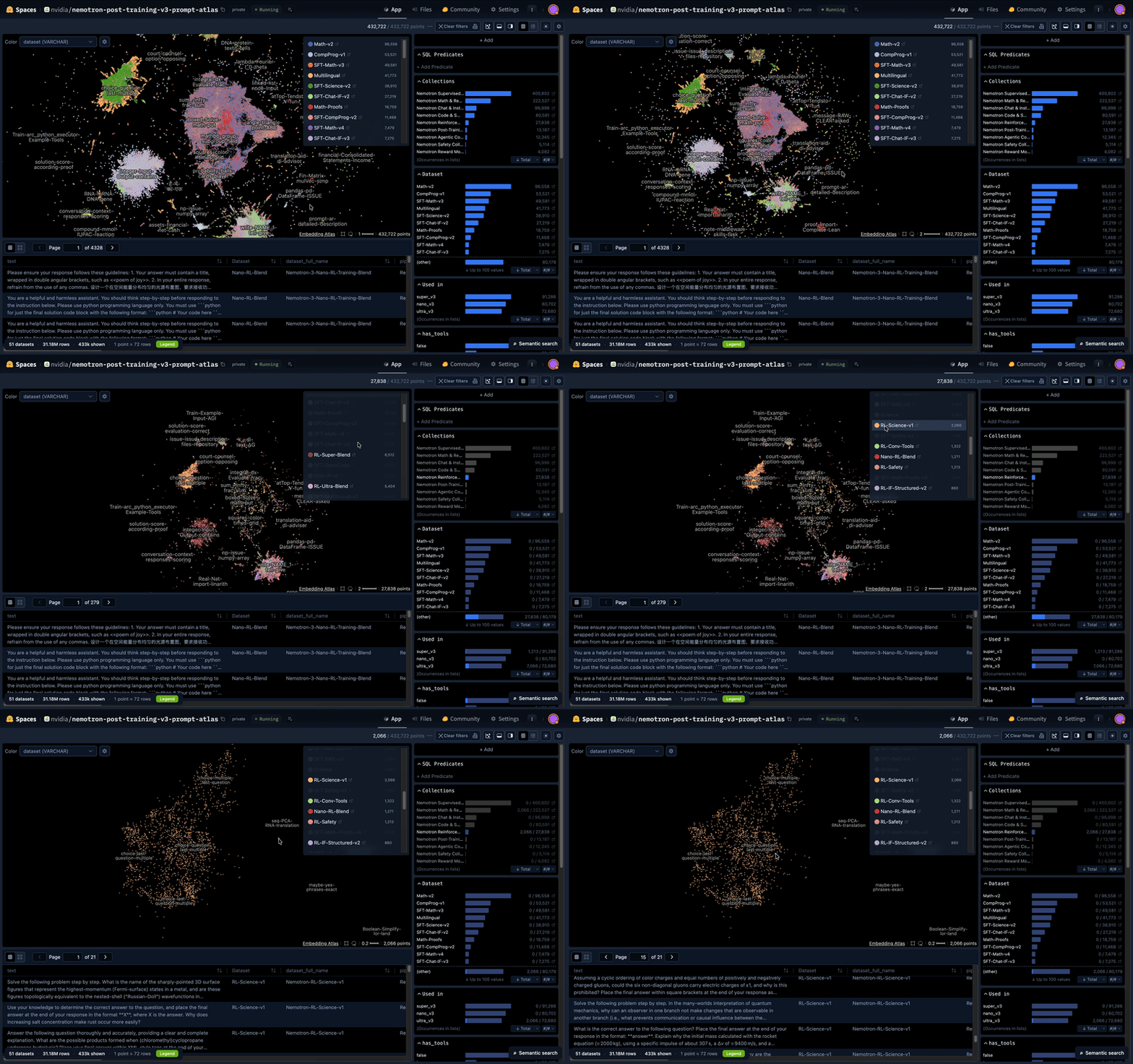
On July 8, 2026, NVIDIA and Hugging Face officially released a collaborative announcement titled 'Data for Agents.' Published on the Hugging Face Blog, this initiative focuses on the provision of open data specifically curated for the development and training of AI agents. The collaboration represents a strategic alignment between the world's leading AI hardware provider and the primary hub for open-source machine learning. While specific dataset specifications were not detailed in the initial announcement summary, the project aims to address the growing demand for specialized data structures required to build autonomous systems capable of complex reasoning and task execution. This move signals a significant step toward standardizing the data layer of the agentic AI ecosystem.

Hugging Face Blog
Meta Implements Privacy Safeguards for AI Glasses While Expanding Broader Data Collection Initiatives
Industry News

Meta Implements Privacy Safeguards for AI Glasses While Expanding Broader Data Collection Initiatives

Meta is introducing a new safeguard for its AI-powered glasses specifically designed to prevent users from secretly recording others. This update aims to mitigate the "creepy" reputation often associated with wearable camera technology. However, this privacy-focused hardware update stands in stark contrast to Meta's overarching AI strategy. According to recent reports, the company is simultaneously expanding the volume of personal data its AI products collect and utilize. This dual approach creates a complex narrative: while the physical device becomes more privacy-conscious regarding third parties, the backend ecosystem becomes more data-intensive regarding the user. The development highlights the ongoing tension between consumer-facing privacy features and the data-hungry requirements of modern artificial intelligence development within major tech corporations.

TechCrunch AI
OpenAI Launches GPT-Live-1: A New Real-Time Voice Model for ChatGPT Enhancing Conversational Intelligence
Product Launch

OpenAI Launches GPT-Live-1: A New Real-Time Voice Model for ChatGPT Enhancing Conversational Intelligence

OpenAI has officially introduced GPT-Live-1, a next-generation voice model designed to function with the fluidity of a phone call. Replacing the previous Advanced Voice system as the default for ChatGPT, GPT-Live-1 integrates real-time processing capabilities with enhanced intelligence. This transition marks a significant shift in how users interact with AI, moving toward more natural, low-latency verbal communication. The update aims to provide a more seamless and intelligent user experience by combining high-level reasoning with immediate response times, effectively setting a new standard for voice-based artificial intelligence interactions within the ChatGPT ecosystem.

Tech in Asia
OpenAI Launches GPT-Live-1: Transforming ChatGPT Voice Mode into a More Human-Like Conversational Experience
Product Launch

OpenAI Launches GPT-Live-1: Transforming ChatGPT Voice Mode into a More Human-Like Conversational Experience

OpenAI has announced a major overhaul of ChatGPT's voice capabilities with the introduction of a new model called GPT-Live-1. This update is specifically designed to make interactions feel more like "talking to another person" by addressing common friction points in AI communication. Key improvements include a significant reduction in unnecessary interruptions and the ability for the AI to intelligently wait for a user to finish their thought if they pause mid-sentence. OpenAI research lead Kundan Kumar describes the model as a pivotal step in the company's efforts to create more fluid and intuitive voice interactions. By focusing on the nuances of human speech patterns, GPT-Live-1 aims to provide a more seamless and less disruptive user experience compared to previous iterations of the voice mode.

The Verge
OpenAI Unveils New Voice Models Featuring Simultaneous Speaking and Listening for Enhanced Live Translation
Product Launch

OpenAI Unveils New Voice Models Featuring Simultaneous Speaking and Listening for Enhanced Live Translation

OpenAI has announced the release of its latest voice models, marking a significant step forward in achieving natural, real-time human-AI interaction. The core innovation of these models is their ability to speak and listen simultaneously, a departure from traditional voice interfaces that require sequential turn-taking. According to OpenAI, this dual-processing capability is a fundamental requirement for effective live translation, allowing the AI to process incoming speech while providing immediate vocal output. This development aims to make live conversations with AI feel more fluid and human-like, addressing a major technical hurdle in the field of conversational artificial intelligence and real-time linguistic bridging.

TechCrunch AI
Microsoft Research Unveils Flint: A New Visualization Language Designed for the AI Agent Era
Product Launch

Microsoft Research Unveils Flint: A New Visualization Language Designed for the AI Agent Era

Microsoft Research has introduced Flint, an open-source visualization intermediate language specifically designed to bridge the gap between AI agents and high-quality data visualization. Recognizing that existing libraries like Vega-Lite or ECharts are often too verbose for LLMs to generate reliably, Flint provides a compact, semantic-type-based specification. This allows AI agents to produce polished, expressive charts from simple instructions while the Flint compiler handles complex design decisions like scaling, layout, and formatting. The project includes a dedicated TypeScript library and an MCP server, enabling seamless integration into agentic workflows. By shifting the focus from low-level code generation to high-level intent, Flint aims to solve the 'last-mile' problem of human-agent interaction in data analytics.

Microsoft Research