AI News on March 31, 2026

Claude-Howto: A Visual and Example-Driven Guide for Mastering Claude Code and AI Agents
Open Source

Claude-Howto: A Visual and Example-Driven Guide for Mastering Claude Code and AI Agents

The 'claude-howto' repository, authored by luongnv89 and featured on GitHub Trending, serves as a comprehensive resource for developers looking to master Claude Code. This guide distinguishes itself through a visual and example-driven approach, moving from foundational concepts to the implementation of advanced AI agents. It provides highly practical, ready-to-use templates designed for immediate integration. By focusing on visual aids and concrete examples, the project aims to simplify the learning curve for Claude's ecosystem, offering a structured pathway for users to transition from basic interactions to complex agentic workflows. The repository represents a significant community-driven effort to document and standardize best practices for utilizing Claude's coding capabilities effectively.

GitHub Trending
OpenBB Platform: Empowering Financial Analysts, Quantitative Researchers, and AI Agents with Open Data
Open Source

OpenBB Platform: Empowering Financial Analysts, Quantitative Researchers, and AI Agents with Open Data

OpenBB has emerged as a pivotal financial data platform specifically engineered to serve the needs of modern financial professionals and automated systems. By providing a robust infrastructure for analysts, quantitative researchers, and AI agents, the platform bridges the gap between complex financial datasets and actionable insights. As an open-source initiative gaining significant traction on GitHub, OpenBB focuses on democratizing access to high-quality financial information. The platform's architecture is designed to support both human-led research and the growing demand for AI-driven financial modeling, positioning itself as a foundational tool for the next generation of quantitative finance and algorithmic decision-making.

GitHub Trending
Microsoft Unveils VibeVoice: A New Open-Source Frontier in Advanced Speech Artificial Intelligence Technology
Open Source

Microsoft Unveils VibeVoice: A New Open-Source Frontier in Advanced Speech Artificial Intelligence Technology

Microsoft has officially introduced VibeVoice, a cutting-edge open-source speech AI project. Positioned as a significant contribution to the frontier of voice technology, VibeVoice aims to provide developers and researchers with advanced tools for speech-related applications. While specific technical specifications and architectural details remain hosted on its dedicated project page and GitHub repository, the release underscores Microsoft's commitment to open-source AI development. The project represents a new milestone in speech synthesis and processing, offering a transparent platform for innovation in the rapidly evolving field of audio artificial intelligence. As an open-source initiative, it invites the global developer community to explore and build upon Microsoft's latest advancements in vocal AI modeling.

GitHub Trending
Deep-Live-Cam 2.1: Achieving Real-Time Face Swapping and Video Deepfakes Using a Single Image
Open Source

Deep-Live-Cam 2.1: Achieving Real-Time Face Swapping and Video Deepfakes Using a Single Image

Deep-Live-Cam 2.1 has emerged as a significant development in the field of digital manipulation, offering users the ability to perform real-time face swapping and one-click video deepfakes. The core functionality of this tool lies in its efficiency, requiring only a single source image to execute complex facial replacements across live or recorded video formats. Developed by hacksider and gaining traction on GitHub, the project highlights the increasing accessibility of deepfake technology. By simplifying the process to a 'one-click' operation, Deep-Live-Cam 2.1 lowers the technical barrier for creating synthetic media, raising important considerations regarding the ease of generating highly realistic digital alterations from minimal source data.

GitHub Trending
Claude Code Best Practices: Essential Guide for Optimizing AI-Driven Development Workflows
Technical Tutorial

Claude Code Best Practices: Essential Guide for Optimizing AI-Driven Development Workflows

The newly released documentation titled 'Claude Code Best Practices' provides a foundational framework for developers looking to master the Claude Code environment. Published on GitHub by author shanraisshan, the guide emphasizes the philosophy that 'practice makes perfect' when interacting with Claude's coding capabilities. Updated as of March 30, 2026, to version 2.1.87, the resource serves as a specialized repository for technical excellence. While the initial release focuses on the core principles of effective implementation, it establishes a baseline for how developers should structure their interactions with the AI to achieve high-quality code outputs. This documentation is positioned as a critical resource for those utilizing Claude's evolving toolset in professional software development environments.

GitHub Trending
Oh-My-ClaudeCode: A New Multi-Agent Orchestration Solution Designed for Team-Based Claude Code Workflows
Open Source

Oh-My-ClaudeCode: A New Multi-Agent Orchestration Solution Designed for Team-Based Claude Code Workflows

The open-source community has introduced 'oh-my-claudecode,' a specialized multi-agent orchestration framework designed specifically for teams utilizing Claude Code. Developed by Yeachan-Heo and featured on GitHub Trending, this project aims to streamline collaborative AI development by providing a structured approach to managing multiple AI agents. While the initial documentation is concise, the project emphasizes its role as a team-oriented solution for orchestrating Claude's coding capabilities. Supporting multiple languages including English and Korean, the repository marks a significant step toward making Claude Code more accessible and manageable for professional development teams seeking to integrate advanced AI orchestration into their existing workflows.

GitHub Trending
New Quinnipiac Poll Reveals 15% of Americans Are Willing to Report to an AI Supervisor
Industry News

New Quinnipiac Poll Reveals 15% of Americans Are Willing to Report to an AI Supervisor

A recent national poll conducted by Quinnipiac University has uncovered a significant shift in workplace attitudes regarding artificial intelligence. According to the survey results, 15% of Americans expressed a willingness to work in a role where their direct supervisor is an AI program. This potential AI 'boss' would be responsible for core management duties, including assigning specific tasks and managing employee schedules. While the majority of the workforce remains hesitant about algorithmic management, this data point highlights a growing niche of acceptance for automated leadership structures. The findings provide a rare glimpse into how U.S. workers perceive the integration of AI into the traditional corporate hierarchy and the evolving dynamics of human-computer interaction in professional environments.

TechCrunch AI
Amazon Big Spring Sale 2026: Top Gadget Deals for Seasonal Cleaning and Home Maintenance
Product Launch

Amazon Big Spring Sale 2026: Top Gadget Deals for Seasonal Cleaning and Home Maintenance

The Amazon Big Spring Sale is currently underway, offering a wide array of discounts specifically curated for the spring season. A significant portion of the event focuses on home maintenance and tidying gadgets, ranging from Verge-approved robot vacuums to various cleaning tools and air purifiers. While robot vacuums represent a major category of the sale, the event encompasses a broader selection of technology designed to streamline household chores. This seasonal promotion highlights Amazon's strategic focus on timely consumer needs, providing shoppers with opportunities to upgrade their home cleaning kits with high-tech solutions at reduced price points. The sale features a variety of tools vetted for quality, aiming to simplify the traditional spring cleaning process through automation and specialized hardware.

The Verge
LiteLLM Severs Ties with Delve Following Major Security Breach and Credential-Stealing Malware Incident
Industry News

LiteLLM Severs Ties with Delve Following Major Security Breach and Credential-Stealing Malware Incident

LiteLLM, a prominent AI gateway startup, has officially terminated its relationship with the security compliance firm Delve. This strategic move follows a severe security incident occurring last week, where LiteLLM fell victim to devastating credential-stealing malware. Prior to the breach, LiteLLM had utilized Delve's services to obtain two critical security compliance certifications. The incident has raised significant concerns regarding the efficacy of compliance-led security measures and the vulnerabilities inherent in third-party security partnerships. As the AI industry prioritizes data integrity, this separation marks a pivotal moment for LiteLLM as it navigates the aftermath of the attack and seeks to fortify its infrastructure against future malicious threats.

TechCrunch AI
Rising AI Adoption in the United States Met with Declining Public Trust and Transparency Concerns
Industry News

Rising AI Adoption in the United States Met with Declining Public Trust and Transparency Concerns

A recent Quinnipiac poll reveals a growing paradox in the American technology landscape: while more citizens are integrating artificial intelligence tools into their daily lives, trust in the results generated by these systems is simultaneously declining. The data highlights a significant gap between the utility of AI and the public's confidence in its reliability. Most Americans expressed deep-seated concerns regarding the lack of transparency in AI operations and the urgent need for more robust regulation. This shift in sentiment suggests that as AI becomes more ubiquitous, users are becoming increasingly skeptical of its broader societal impact and the integrity of the information it provides, posing a challenge for developers and policymakers alike.

TechCrunch AI
Interactive Learning Platform for Claude Code Launched by Ahmed Nagdy Featuring Terminal Simulators and Config Builders
Technical Tutorial

Interactive Learning Platform for Claude Code Launched by Ahmed Nagdy Featuring Terminal Simulators and Config Builders

Developer Ahmed Nagdy has introduced a new interactive learning platform designed to help users master Claude Code through hands-on practice rather than passive reading. The platform offers 11 comprehensive modules ranging from beginner to advanced levels, covering essential topics such as slash commands, memory management via CLAUDE.md, and project setup. Key features include a browser-based terminal simulator that requires no API keys or local installation, an interactive config builder for generating project files, and knowledge-verification quizzes. By providing a sandbox environment and automated tools, the site aims to streamline the onboarding process for developers looking to integrate Claude Code into their workflows efficiently.

Hacker News
Mistral AI Expands Modality Strategy with the Launch of Voxtral TTS for Open Frontier Intelligence
Product Launch

Mistral AI Expands Modality Strategy with the Launch of Voxtral TTS for Open Frontier Intelligence

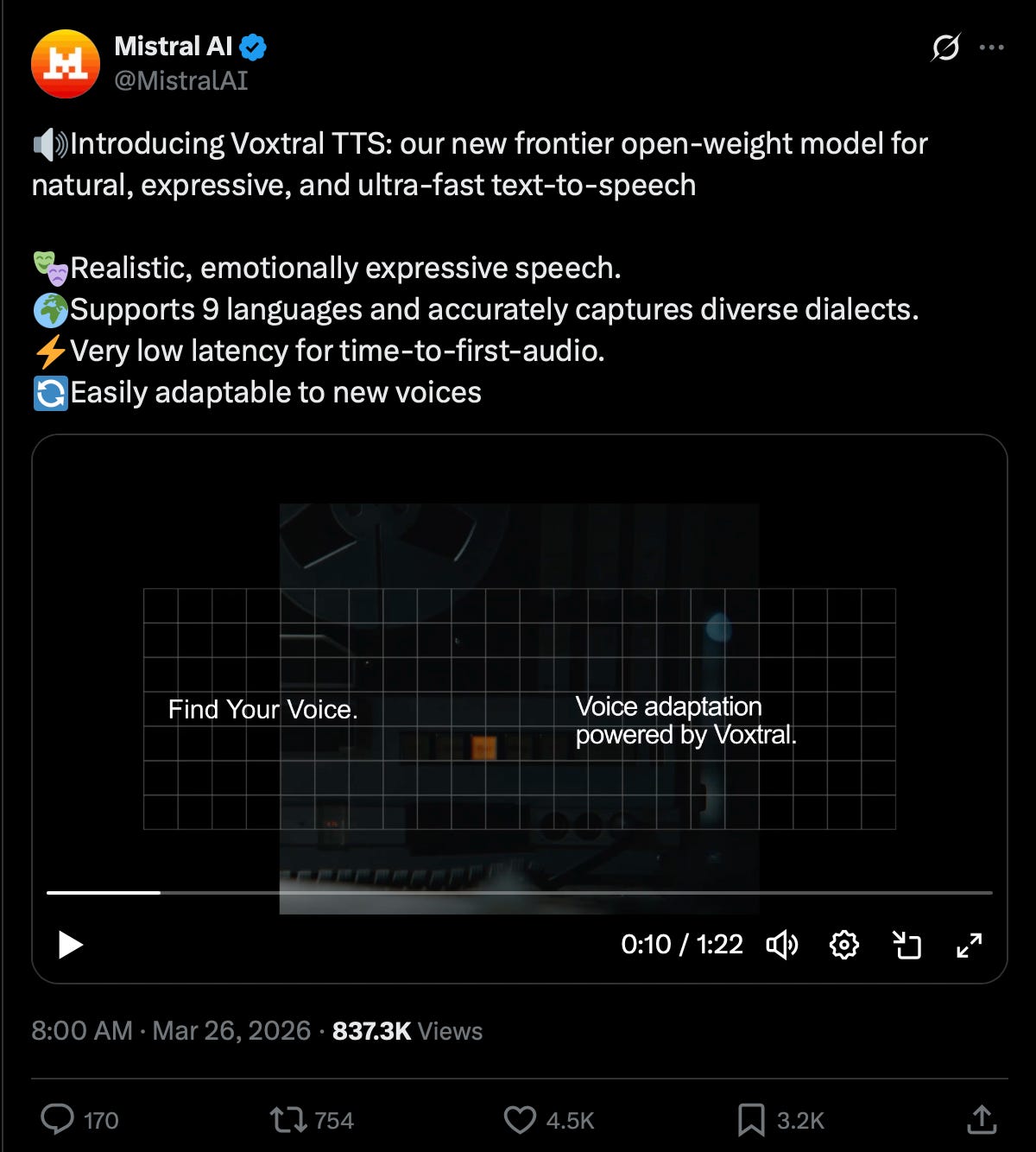
Mistral AI, a prominent leader among frontier model laboratories, has officially announced the release of Voxtral TTS. This new Text-to-Speech model represents a significant milestone in the company's overarching strategy to provide open frontier intelligence across various modalities. Featured in a discussion with Pavan Kumar Reddy and Guillaume Lample, the launch highlights Mistral's commitment to expanding beyond text-based models. While the announcement also touches upon upcoming developments such as Forge, Leanstral, and the future of Mistral 4, the primary focus remains on the integration of high-quality speech synthesis into their open-source ecosystem, reinforcing their position in the competitive AI landscape.

Latent Space
Project Sistine: How Researchers Transformed a MacBook Into a Touchscreen Using $1 of Hardware
Research Breakthrough

Project Sistine: How Researchers Transformed a MacBook Into a Touchscreen Using $1 of Hardware

A team of researchers, including Anish Athalye, Kevin, Guillermo, and Logan, developed a proof-of-concept system called "Project Sistine" that adds touchscreen functionality to a MacBook for approximately $1. By utilizing a simple mirror setup and computer vision, the system detects finger movements and reflections on the screen. The project, completed in just 16 hours, leverages the optical phenomenon where surfaces viewed at an angle appear shiny, allowing the software to identify a touch event when a finger meets its own reflection. Using a bill of materials consisting of a small mirror, a paper plate, a door hinge, and hot glue, the team successfully miniaturized the concept of 'ShinyTouch' to work with a laptop's built-in webcam.

Hacker News
Product Launch

AnchorGrid Launches Specialized AI Door Detection API to Solve Construction Document OCR Challenges

AnchorGrid has introduced a specialized API endpoint designed to address the limitations of traditional OCR in construction documents by specifically detecting doors in architectural floor-plan PDFs. The service, accessible via the POST /v1/drawings/detection/doors endpoint, allows developers to upload documents and receive precise bounding box coordinates for doors within the PDF coordinate space. The system operates asynchronously, with processing times ranging from 2 to 4 minutes on the free tier, depending on document complexity and page count. While the free tier offers standard processing, Pro and Enterprise plans utilize dedicated GPU infrastructure for faster results. This release marks a significant step in automating the extraction of structural elements from complex technical drawings.

Hacker News
The Rise of AI Health Tools: Evaluating the Efficacy of New Offerings from Microsoft and Amazon
Product Launch

The Rise of AI Health Tools: Evaluating the Efficacy of New Offerings from Microsoft and Amazon

The landscape of digital healthcare is shifting rapidly as major technology firms integrate large language models (LLMs) into personal health management. Microsoft recently introduced Copilot Health, a dedicated feature within its Copilot app designed to allow users to sync their medical records and receive answers to specific health-related inquiries. This move follows a similar expansion by Amazon, which recently broadened access to its LLM-based 'Health AI' tool. Previously exclusive to One Medical members, Amazon's tool is now reaching a wider audience. As these AI health tools become more prevalent and accessible than ever before, critical questions remain regarding their clinical accuracy, the reliability of their outputs, and how effectively they actually serve the medical needs of the general public.

MIT Technology Review - AI