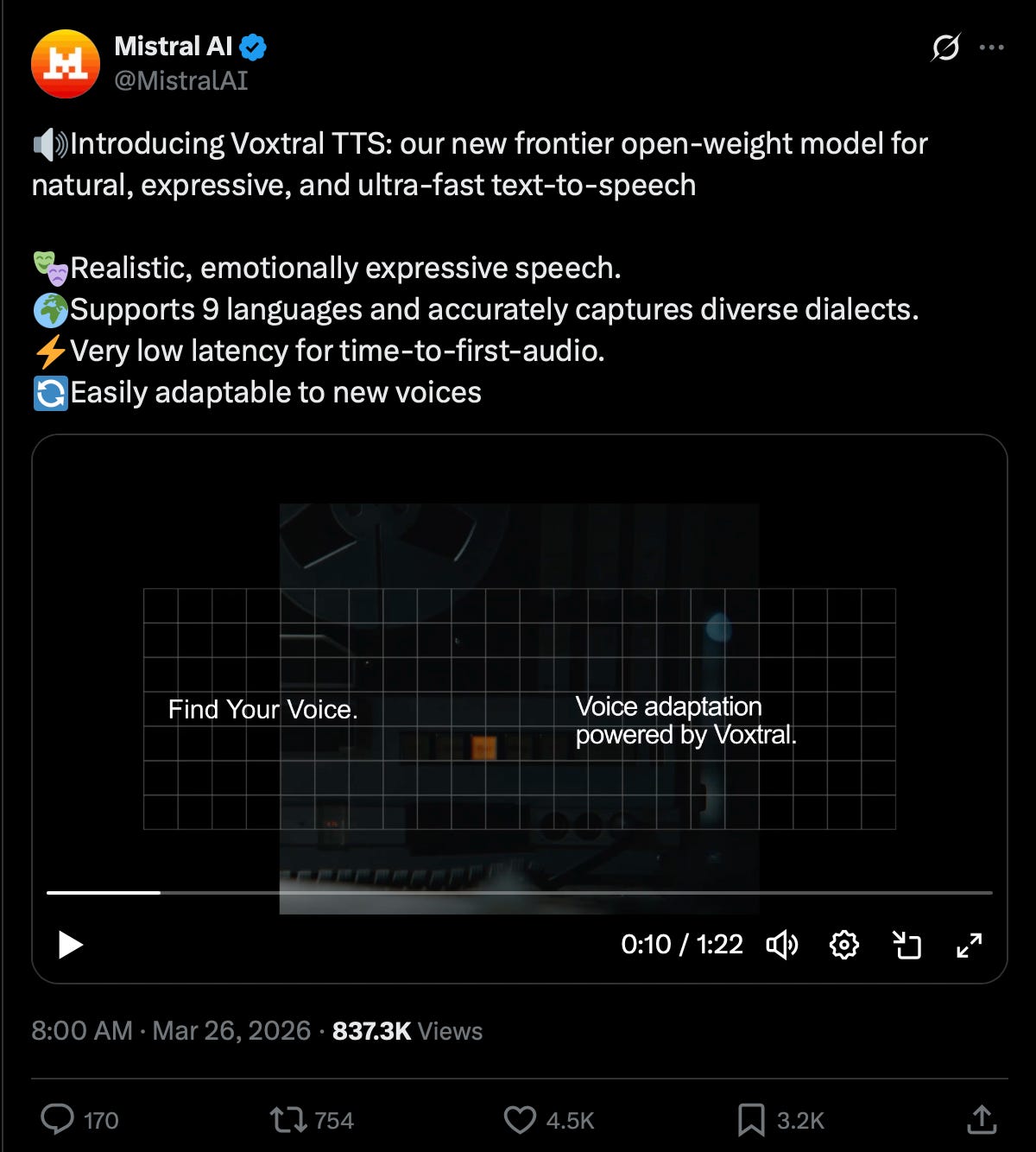
Mistral AI Expands Modality Strategy with the Launch of Voxtral TTS for Open Frontier Intelligence
Mistral AI, a prominent leader among frontier model laboratories, has officially announced the release of Voxtral TTS. This new Text-to-Speech model represents a significant milestone in the company's overarching strategy to provide open frontier intelligence across various modalities. Featured in a discussion with Pavan Kumar Reddy and Guillaume Lample, the launch highlights Mistral's commitment to expanding beyond text-based models. While the announcement also touches upon upcoming developments such as Forge, Leanstral, and the future of Mistral 4, the primary focus remains on the integration of high-quality speech synthesis into their open-source ecosystem, reinforcing their position in the competitive AI landscape.
Key Takeaways
- New Product Launch: Mistral has officially released Voxtral TTS, a dedicated Text-to-Speech model.
- Multimodal Strategy: The launch is a key component of Mistral's goal to offer open frontier intelligence across every modality.
- Industry Leadership: Mistral continues to position itself as a leading frontier model lab alongside major global competitors.
- Future Roadmap: The announcement hints at upcoming projects including Forge, Leanstral, and the highly anticipated Mistral 4.
In-Depth Analysis
The Launch of Voxtral TTS
Mistral AI has introduced Voxtral TTS, marking the company's formal entry into the speech synthesis domain. As a frontier model lab known for its high-performance language models, this move into Text-to-Speech (TTS) signifies a diversification of their technical portfolio. Voxtral TTS is designed to align with Mistral's philosophy of providing powerful, accessible intelligence, moving the needle from purely text-based interactions to more immersive audio experiences.
Strategic Shift Toward Multimodality
The introduction of Voxtral TTS is described as a strategic step toward offering "open frontier intelligence for every modality." By expanding into audio, Mistral is addressing the growing demand for multimodal AI systems that can see, hear, and speak. This strategy suggests that Mistral aims to provide a comprehensive suite of open-source tools that allow developers to build complex, multi-sensory applications without relying on closed-source proprietary ecosystems.
Looking Ahead: Forge, Leanstral, and Mistral 4
Beyond the immediate release of Voxtral TTS, the roadmap for Mistral includes several key developments. Discussions involving Pavan Kumar Reddy and Guillaume Lample highlight "Forge" and "Leanstral" as upcoming components of the Mistral ecosystem. Furthermore, the industry is closely watching the progression toward Mistral 4, which is expected to represent the next generation of the lab's frontier intelligence capabilities.
Industry Impact
The release of Voxtral TTS by Mistral has significant implications for the AI industry, particularly within the open-source community. By providing a frontier-level TTS model, Mistral is lowering the barrier to entry for high-quality speech synthesis, which has traditionally been dominated by a few large-scale providers. This move encourages competition and innovation in voice-enabled AI assistants, accessibility tools, and content creation platforms. Furthermore, Mistral's commitment to multimodality reinforces the trend that the future of AI lies in integrated systems that can process and generate data across multiple formats seamlessly.
Frequently Asked Questions
Question: What is Voxtral TTS?
Voxtral TTS is the latest Text-to-Speech model released by Mistral AI, designed to provide high-quality speech synthesis as part of their open frontier intelligence strategy.
Question: What does the launch of Voxtral TTS mean for Mistral's strategy?
It marks a significant step in Mistral's transition toward multimodality, moving beyond text to ensure they offer open-source intelligence solutions for various types of data, including audio.
Question: What other projects are mentioned alongside Voxtral TTS?
The announcement also references Forge, Leanstral, and the future development of Mistral 4 as part of the company's upcoming roadmap.