Radar
Radar by Skyhook: The Comprehensive Open-Source Kubernetes UI for Multi-Cluster Visibility
Radar by Skyhook is an open-source Kubernetes UI (Apache 2.0) providing real-time topology, extended event timelines, and image inspection. Available as a single binary or cloud service, it streamlines cluster management, GitOps visibility, and fleet-wide troubleshooting for platform engineers.
2026-05-05
4.0K
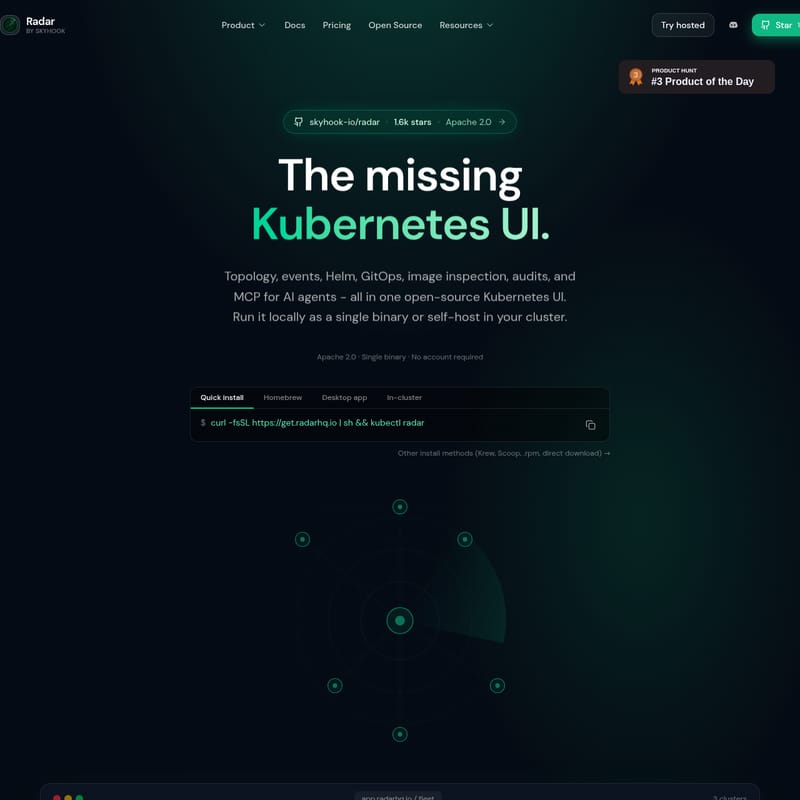
Radar Product Information
Radar by Skyhook: The Definitive Kubernetes UI for Visibility and Fleet Management
In the complex world of container orchestration, Kubernetes is often described as easy to query but incredibly hard to truly understand. While kubectl remains the primary tool for on-call engineers, it often falls short during multi-cluster incidents involving dozens of regions and clouds. Enter Radar by Skyhook, the missing Kubernetes UI designed to provide centralized visibility, real-time troubleshooting, and comprehensive cluster auditing in a single, open-source package.
What is Radar by Skyhook?
Radar is an open-source, Apache 2.0-licensed Kubernetes UI engine built by Skyhook. It serves as a unified platform for monitoring and managing your Kubernetes ecosystem. Unlike fragmented tools that require multiple browser tabs and complex kubeconfig hunting, Radar ships as a single ~30MB binary that can be run locally or self-hosted within your cluster.
Whether you are using the Radar OSS version or the enhanced Radar Cloud service, the goal remains the same: to provide a high-fidelity, live resource graph and a streamlined interface that makes Kubernetes data actionable for platform engineering teams. With over 1.6k stars on GitHub, Radar has quickly become a favorite for those seeking a more intuitive alternative to tools like Lens or k9s.
Core Features of the Radar Kubernetes UI
Radar by Skyhook is packed with features designed to solve the most common pain points in cluster management.
Live Topology and Resource Graphs
Radar provides a live resource graph laid out via ELK.js, offering a clear visualization of your cluster's topology. This includes every Deployment, Service, and Ingress. Utilizing Server-Sent Events (SSE) for real-time updates, the topology view allows you to see east-west traffic, ingress flows, and TLS certificate health at a glance.
Extended Event Timeline
One of the biggest limitations of standard Kubernetes is the default 1-hour event retention TTL (Time To Live). Radar solves this by capturing and displaying every Kubernetes event and delta, allowing you to rewind the timeline far past the standard one-hour limit to understand exactly what happened during a 2:00 AM incident.
Integrated Image Filesystem Browser
Traditionally, inspecting a container's filesystem requires kubectl exec or docker commands. Radar changes this by allowing you to browse any container image filesystem directly within the UI. This deep visibility helps engineers verify configurations and file structures without manual shell access.
Comprehensive Cluster Audits
Maintain your cluster's health with Radar's built-in Cluster Audit tool. It performs 30 best-practice checks, all labeled by framework, to ensure your environment is secure and optimized. This includes monitoring for failing pods, expiring certificates, and drifted packages.
AI Readiness via MCP
Radar is built for the future of engineering. It features an MCP (Model Context Protocol) server, allowing AI agents like Claude, Cursor, and Copilot to safely interact with your cluster data in a token-optimized environment.
GitOps and Helm Visibility
Radar offers native support for ArgoCD and Flux, providing clear visibility into the sync state of your applications. For those using Helm, Radar displays every release, revision, and value file, enabling one-click rollbacks and revision comparisons.
Real-World Use Cases
1. Troubleshooting Without "Kubectl Roulette"
When an alert fires for a crashing pod in a forgotten namespace, Radar allows you to search across every cluster instantly. You can jump to logs, rewind the event timeline, and share direct links with your team, eliminating the need to grep through endless pod lists.
2. Fleet Management at Scale
Platform teams often juggle five or more tools to debug a single incident. Radar simplifies this by providing a single bar to search any resource by name, label, or kind across the entire fleet. You can compare workload versions side-by-side without switching kubeconfigs or browser tabs.
3. Automated Notifications and Alerts
With Radar Cloud, you can route notifications to where your team lives—Slack, PagerDuty, or MS Teams. These alerts are triggered by correlations rather than raw signal, reducing noise and preventing alert fatigue.
How to Use Radar by Skyhook
Getting started with Radar is straightforward, with multiple installation paths to fit your existing stack.
Step 1: Installation
You can install the Radar binary (under 30MB) using several methods:
- Homebrew:
brew install radar(via Skyhook-io tap) - Curl:
curl -fsSL https://get.radarhq.io | sh - Kubernetes: Use the Helm chart for in-cluster deployment.
- Other: Support for Krew, Scoop, .rpm, and direct downloads is also available.
Step 2: Open Your Cluster
- Local Mode: Simply run the binary; it will read your local kubeconfig and open the UI, functioning similarly to k9s but with a rich graphical interface.
- In-Cluster Mode: Deploy via Helm to serve the UI through an ingress. This allows your entire team to access the dashboard without individual kubeconfigs.
Step 3: Explore and Visualize
Once connected, you can immediately access the topology view, event timeline, and audit pages. The UI is designed with keyboard shortcuts and an intuitive layout to help you start auditing and monitoring your resources in seconds.
Radar OSS vs. Radar Cloud
While Radar OSS provides the full power of the UI for individual clusters, Radar Cloud is designed for organizations managing a multi-cluster fleet.
"Radar Cloud exists for the things a single binary can’t reasonably do—fleet aggregation, persistent retention, routed alerts, and SSO—not because the OSS is crippled."
| Feature | Radar OSS | Radar Cloud | | :--- | :--- | :--- | | License | Apache 2.0 | Hosted/SaaS | | Topology & Events | Included | Included | | Fleet Aggregation | No | Yes | | SSO (Google/SAML) | No | Yes | | Audit Logs | Local | Centralized | | Routed Alerts | No | Slack/PagerDuty |
FAQ
Q: Is Radar by Skyhook truly open source?
A: Yes, the full product is open source under the Apache 2.0 license. You can find the code at github.com/skyhook-io/radar.
Q: Do I need an account to use the OSS version? A: No account is required to run the Radar single binary locally or in your cluster.
Q: How does Radar compare to Lens? A: Many users have switched from Lens to Radar because Radar is lightweight, starts in seconds, and provides unique features like the 30-check cluster audit and the extended event timeline.
Q: Can I use Radar with my existing GitOps workflow? A: Absolutely. Radar has native support for both ArgoCD and Flux, allowing you to see the state of your GitOps resources alongside your actual Kubernetes objects.
Q: What are the system requirements? A: Radar is a single, lightweight binary (~30MB) that runs on most modern systems and supports standard Kubernetes clusters.