Monid 2.0
Monid: The Agent-Native Router for Tool Calls, Autonomous Discovery, and Seamless Multi-Provider API Integration.
Monid is an innovative agent-native router designed to simplify how AI agents execute tool calls. By offering autonomous endpoint discovery across 200+ tools and 30+ providers, Monid eliminates the need for managing individual subscriptions or API keys. Agents can search for tools via natural language, pay per call from a single shared balance, and receive normalized, structured JSON results. Compatible with any MCP-capable agent, Monid streamlines workflows for e-commerce, B2B sales, and content creation by allowing agents to independently route calls and deliver insights 10x faster.
2026-05-10
136.0K
Monid 2.0 Product Information
Monid: The Agent-Native Router for Tool Calls and Autonomous Discovery
In the rapidly evolving landscape of artificial intelligence, the efficiency of an agent is often limited by its ability to access and interact with external tools. Monid emerges as the definitive solution to this challenge, serving as an agent-native router for tool calls. By providing a centralized infrastructure where agents can autonomously discover, execute, and pay for the exact tools they need, Monid is revolutionizing the way developers and teams build autonomous workflows.
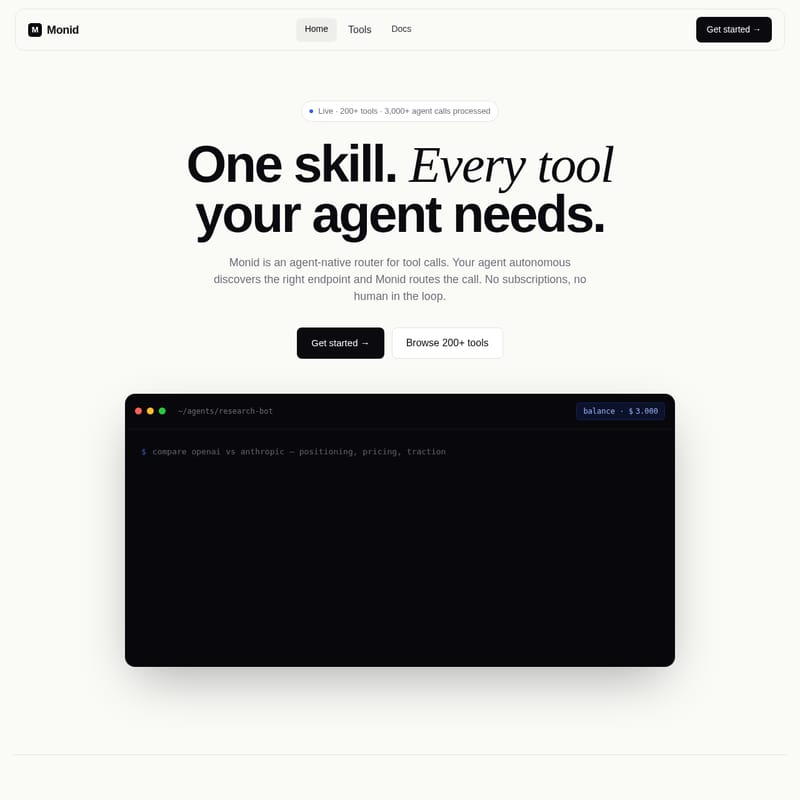
With over 3,000 agent calls already processed and a library of 200+ tools, Monid represents the next generation of AI infrastructure. It is designed to be "One skill. Every tool your agent needs."
What’s Monid?
Monid is a specialized, agent-native router created to manage the complexity of tool calls for AI agents. Traditionally, developers have had to manually wire every API, manage dozens of subscriptions, and handle varied response formats. Monid changes this by allowing your agent to autonomously discover the right endpoint while Monid routes the call, manages the transaction, and normalizes the data.
At its core, Monid functions as a bridge between your agent and a vast registry of over 200 tools across more than 30 providers. It is a drop-in skill for any MCP-capable agent (Model Context Protocol), ensuring that your agent stays autonomous without requiring a human in the loop for every new API integration.
The Core Philosophy of Monid
"Stop wiring APIs. Let your agent do it."
By treating tool calls as a routed service, Monid ensures that agents are not tethered to a single provider or a rigid set of instructions. Instead, they can query the Monid registry to find the best tool for the task at hand, whether it is researching market trends, enriching B2B leads, or monitoring social media reviews.
Key Features of Monid
Monid is packed with features designed to optimize agent performance and reduce developer overhead. Below are the standout features that make it the preferred choice for agent-driven organizations:
1. Autonomous Endpoint Discovery
Your agent no longer needs a predefined list of APIs. By querying the Monid registry with natural language, the agent can find matching providers, compare pricing, and understand structured input schemas on the fly.
2. Pay-Per-Call Pricing Model
Say goodbye to the "subscription cliff." With Monid, there are no monthly fees for individual tools. You maintain one shared balance, and Monid meters usage on a per-call basis. You only pay for what your agent actually executes.
3. Unified Balance Management
Managing 30+ different provider accounts is a logistical nightmare. Monid provides one balance for every tool and every provider, simplifying the financial aspect of running complex AI agents.
4. Normalized JSON Responses
API quirks and inconsistent data formats can break an agent's logic. Monid delivers JSON-typed responses that are normalized across providers. This allows your agent to compare results and route tasks by quality rather than struggling with API formatting.
5. Seamless MCP Integration
Monid is built to work wherever your agent does. It can be installed as a skill or connected as a remote MCP server, making it compatible with web chats, IDEs, terminals, and frameworks like Claude Code or OpenClaw.
Use Case Scenarios
Monid is already being utilized by teams to replace stacks of manual subscriptions with automated, agent-led workflows. Here are four primary use cases where Monid excels:
E-commerce Growth Ops
Finding Direct-to-Consumer (DTC) trends usually requires hours of manual scrolling across Instagram, TikTok, and Amazon. With Monid, growth teams can use one prompt to trigger an agent that researches every channel. The agent chooses the right tools via Monid and turns market signals into insights automatically.
- Result: 10× faster trend research and zero manual checkouts for individual tools.
Content Creators and Fitness Influencers
Staying ahead of viral trends is critical for creators. Agents using Monid can pull top-performing posts from Reddit and Instagram in a specific niche and draft repurposed content automatically while the creator focuses on other tasks.
- Result: Content creators get an average of 14 hours a week back while their agent runs in the background.
B2B Sales and Solo Founders
Monid acts as a research SDR that costs less than a cup of coffee. An agent can qualify inbound leads, enrich contact information using tools like LinkedIn and Apollo, and draft a personalized first reply.
- Result: This setup is 9× cheaper than the seat-based tools it replaces, calculated per qualified lead.
Local Services and Review Ops
For restaurants and clinics, a single bad review can be damaging if not addressed immediately. Monid allows agents to route reviews from Google, Yelp, and Facebook into a centralized system that flags 1-star ratings in real time.
- Result: Alerts land in Slack with full context in less than one hour from the time the review was posted.
How to Use Monid
Setting up Monid is designed to be a frictionless experience for both the developer and the AI agent. Follow these steps to get started:
Step 01: Installation
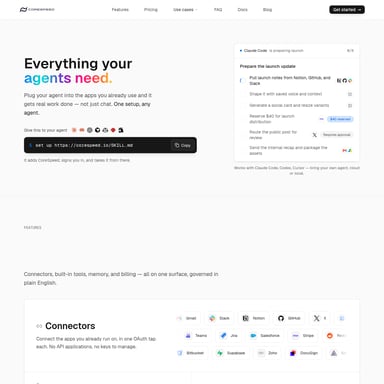
You can install Monid as a skill or connect it as an MCP server. For most agents, you can simply tell your agent to set up the skill via the following command:
set up https://monid.ai/skill.md
Once installed, your agent has immediate access to 200+ tools.
Step 02: Top Up Your Balance
Navigate to the Monid dashboard to top up your balance. This single balance will be used to pay for all tool calls across all providers. New users can often start with $1 in free credit to test the platform.
Step 03: Agent Discovery and Execution
Your agent can now begin its work. The process follows a structured three-step technical flow:
- Discover: The agent queries the registry (e.g.,
monid.search()) to find candidate endpoints and pricing. - Pay-Per-Call: The agent executes the request through Monid. The system meters the usage and debits the shared balance (e.g., a call might cost $0.0013).
- Deliver: Monid returns a structured, normalized JSON response for the agent to process.
Example Command:
"Find news of OpenAI from this week, use Monid"
- The agent calls
monid.discover("openai news + social mentions"). - It runs a Google News scraper and a Tweet scraper via Monid.
- The total cost is debited (e.g., $0.012), and the delivered results are ready for analysis.
FAQ
Do I need API keys for each provider?
No. One of the primary advantages of Monid is that it handles the provider connections. You only need to interface with Monid, and it routes the calls to the various providers on your behalf.
How is pricing structured?
Monid uses an on-demand, pay-per-call model. There are no monthly subscriptions. You maintain a single balance, and each call's cost is debited from that balance based on the provider's rate.
A provider failed. Do I get charged?
Monid meters usage based on successful executions. We provide a clean response and handle the metering to ensure you are paying for the value delivered to your agent.
Which agent frameworks are supported?
Monid works everywhere your agent does. It is compatible with any MCP-capable agent, including Claude Code, OpenClaw, web-based chats, and terminal-integrated agents.
What about rate limits?
Monid acts as the router and management layer, helping to normalize the experience across 30+ providers. By using Monid, you benefit from our infrastructure designed to handle tool calls efficiently across the entire registry.