Computable GPU Index (CGI) provides a transparent, open-source reference rate for GPU compute by aggregating on-demand rental prices into a single, verifiable USD value.
FinanceAggregating fragmented GPU rental rates…Providing real-time index valuesSupporting independent reproduction of…Integrating with AI agents
Estimated monthly visits
1K
Data period:
Listed on AIToolly
What Is Computable GPU Index (CGI)? Product Overview
What the product does and how it is positioned
Computable GPU Index (CGI) serves as a standardized reference rate for the GPU compute market, providing a USD price per GPU-hour for various hardware models.
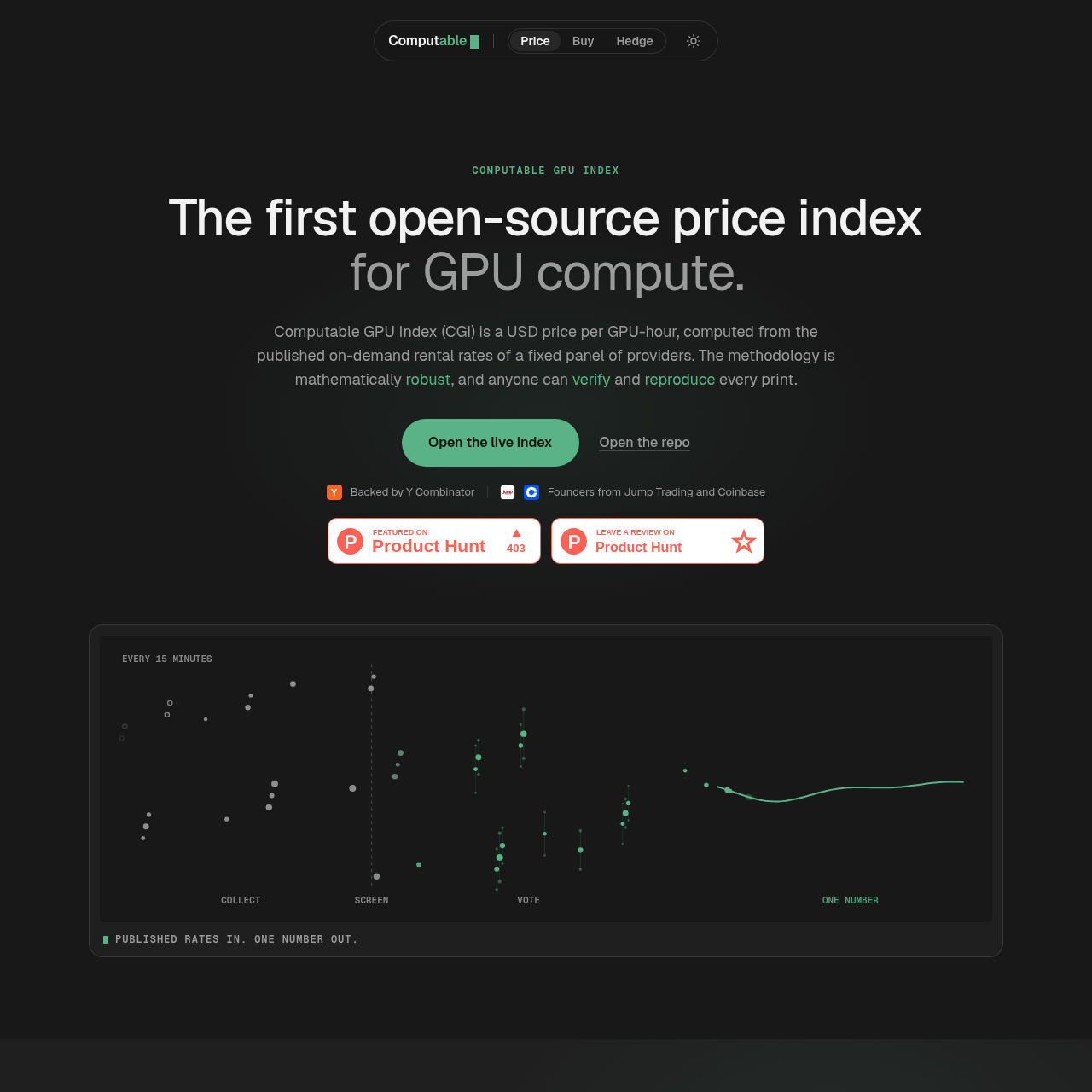
The system aggregates published on-demand rental rates from a fixed panel of providers to generate a single, mathematically robust index value every 15 minutes.
Designed for transparency and reliability, the index allows anyone to verify and reproduce published figures using open-source code and historical data records.
What Can You Use Computable GPU Index (CGI) For?
Source-supported ways to use the product
Market Price Analysis
Users can track historical price trends for specific GPU models like the H100 or B200 to inform procurement and budgeting decisions.
AI Agent Integration
Developers can connect AI agents to the live index via the Model Context Protocol to provide real-time compute pricing data for automated workflows.
How to Use Computable GPU Index (CGI)
The documented workflow, where available
1
Data Collection
The system automatically collects published on-demand rental rates from a fixed panel of providers every 15 minutes.
2
Rate Screening
The pipeline filters the collected data to ensure only on-demand rates from the designated panel are included in the calculation.
3
Weighted Voting
Each provider in the panel casts weighted votes based on their current published rental prices.
4
Index Calculation
The system calculates an interquantile mean, averaging the central band of votes while excluding the outer thirds to help reduce outliers from skewing the result.
Robust Index Calculation Methodology
The CGI utilizes an interquantile mean to ensure the resulting price index remains resistant to outliers and potential manipulation. By focusing on the central band of provider votes, the methodology is intended to reduce a small group of providers from significantly dragging the index toward extreme highs or lows.
This approach is designed to be fault-tolerant; even if a specific data source becomes unavailable or reports incorrect data, the index remains stable due to its reliance on a fixed panel and the exclusion of tail-end values.
Exclusion of outer thirds of votes to maintain index stability.
Use of weighted votes from a fixed panel of industry providers.
Automated 15-minute update cycle for real-time market accuracy.
Publicly accessible calculation parameters for full transparency.
What to Test Before Choosing Computable GPU Index (CGI)
Checks to run with your own material and workflow
Confirm the specific GPU SKUs currently tracked by the index, such as H100, H200, or B300.
Verify the list of providers included in the fixed panel used for data collection.
Check the GitHub repository to ensure the reproduction script functions correctly with current data points.
Review the MCP documentation to confirm compatibility with specific AI agent frameworks.
Computable GPU Index (CGI) Sources and Last Checked