Rankfender v3.0 favicon

Rankfender v3.0

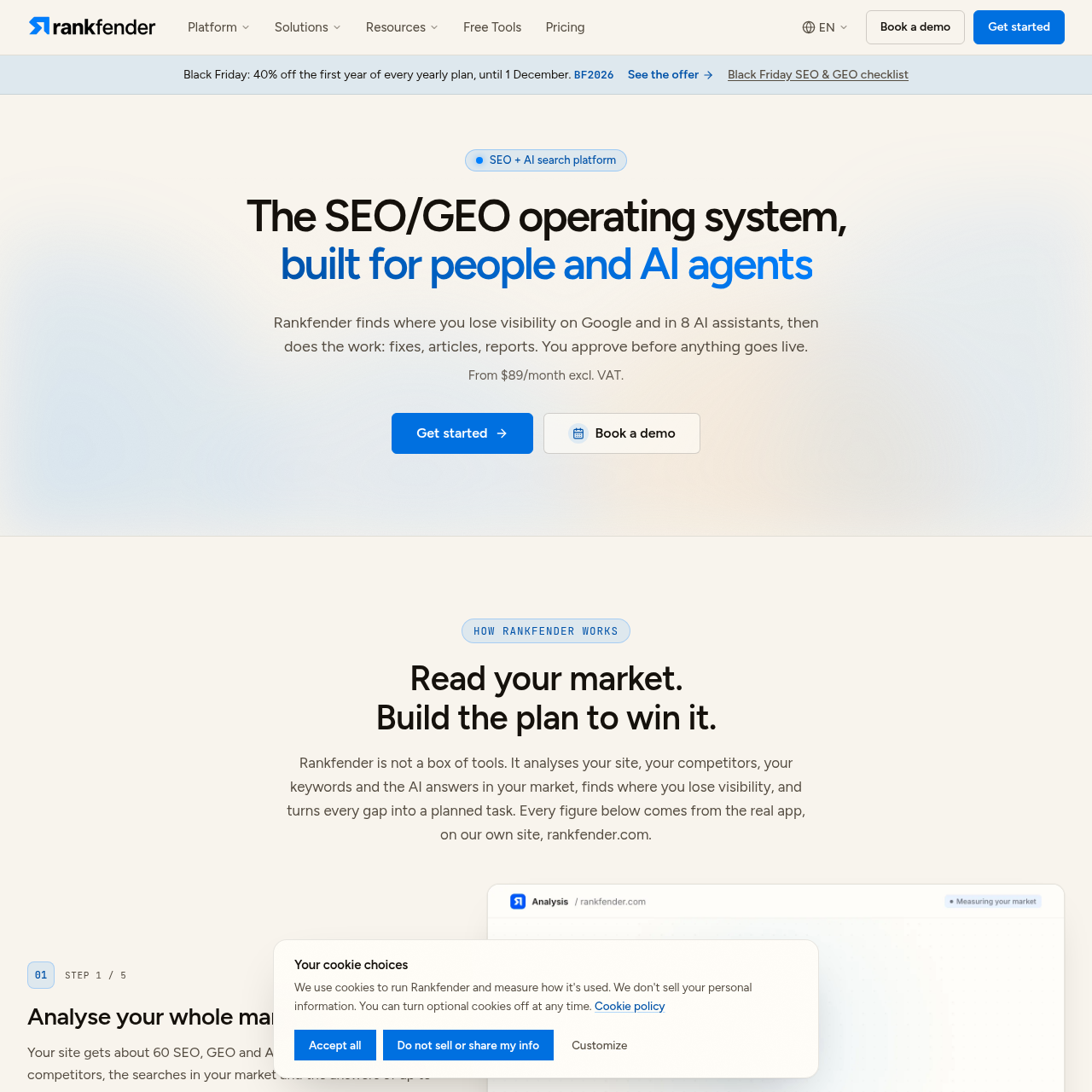
Rankfender v3.0 is an SEO and generative engine optimization platform that audits search health, tracks brand visibility across eight AI assistants, and writes content.

SEOTracking on-demand Google desktop…Evaluating competitor keyword gaps, top…Writing articles in 28 languages with…Assigning tasks from gap analyses to…
Rankfender v3.0 product interface screenshot
Listed on AIToolly

What Is Rankfender v3.0? Product Overview

What the product does and how it is positioned

Rankfender v3.0 combines traditional search engine optimization with generative engine optimization (GEO) and answer engine optimization (AEO). The system evaluates website crawlability, llms.txt files, and structured data, while monitoring how conversational models like ChatGPT, Claude, and Gemini present brands in response to user queries.

The platform translates identified visibility and competitor gaps into operational planning tasks. Users can generate structured, multi-language content, run automated sanity checks through a publish gate, and push finalized articles directly to WordPress or other web stacks through webhooks and APIs.

What Can You Use Rankfender v3.0 For?

Source-supported ways to use the product

Brand AI Visibility Tracking

Marketing leads can monitor mentions, tone, positions, and source citations across conversational AI assistants to detect when competitors are recommended instead of their brand.

Content Gap Resolution

Content teams can analyze competitor keyword deficits and generate localized, sourced articles that publish directly to connected CMS installations.

Agency Client Reporting

Agencies can manage multi-domain search audits and distribute progress through branded PDF summaries and temporary web share links.

How to Use Rankfender v3.0

The documented workflow, where available

  1. 1

    Analyze Market and Audit Site

    Run the SEO and GEO audit to evaluate technical site health, AI crawler accessibility, schema configurations, and presence across conversational assistants.

  2. 2

    Identify Competitor Gaps

    Review competitor keyword positions, top-performing pages, backlink discrepancies, and AI responses to pinpoint areas where market rivals gain visibility.

  3. 3

    Plan Optimization Tasks

    Convert missing keywords, competitor advantages, and technical audit fixes into scheduled tasks on the integrated project board and calendar.

  4. 4

    Generate and Publish Content

    Produce sourced articles in chosen languages, pass them through the pre-publish verification gate, and push content to WordPress or custom webhooks.

  5. 5

    Track Progress and Distribute Reports

    Review recurring AI assistant checks alongside Google Search Console metrics, exporting the findings as branded PDF, CSV, or shareable web links.

AI Visibility and Generative Engine Auditing

Rankfender assesses brand representation within generative artificial intelligence systems by querying official APIs for models such as ChatGPT, Claude, Gemini, DeepSeek, Grok, Llama, Mistral, and Perplexity. The audit diagnoses whether an assistant mentions the brand, notes the sentiment and position of the mention, and identifies alternative brands suggested in the response.

The platform evaluates technical generative engine readiness via roughly 60 automated checks. It analyzes whether web crawlers utilized by AI models are permitted or blocked, verifies llms.txt configurations, inspects schema graph types, and checks search visibility metrics against connected Google Search Console and Bing Webmaster Tools data.

  • Monitors mention frequency, source citations, and response sentiment across up to eight AI models
  • Audits technical crawler parameters, schema architectures, and llms.txt directives
  • Surfaces competitors named in conversational answer prompts alongside root causes

What to Test Before Choosing Rankfender v3.0

Checks to run with your own material and workflow

  • Confirm whether your publishing stack supports WordPress or can integrate articles using webhooks or a read-only content API.
  • Verify that the on-demand Google ranking lookup meets your operational tracking needs compared to continuous scheduled rank trackers.
  • Check which AI assistants are included in your selected plan tier, as prompt frequencies and monitored engines scale with tier level.
  • Review the schema markup types and crawler configuration guidelines used by the platform to ensure compatibility with your current technical architecture.

Rankfender v3.0 Sources and Last Checked

What was checked and when

Last checked
Category
SEO

Rankfender v3.0 Frequently Asked Questions

Answers based on the source-checked product record

Which AI assistants does Rankfender monitor?

Rankfender queries ChatGPT, Claude, Gemini, Perplexity, DeepSeek, Grok, Llama, and Mistral through official APIs, tracking mention frequency, position, tone, and cited sources.

How does Rankfender handle content publishing to external websites?

The platform provides a dedicated WordPress plugin that populates fields for major SEO plugins, while non-WordPress systems receive articles through webhooks or a read-only content API.

Does Rankfender offer scheduled daily Google rank tracking?

Rankings on Google desktop results up to position 30 are verified on demand rather than through automated continuous daily tracking schedules across markets.

What is the function of the RAISA SEO Agent?

RAISA evaluates workspace and project performance data to suggest actionable steps, including keyword additions and audit launches, executing tasks only after user confirmation.

Is there a free trial period available before subscribing?

Rankfender operates on paid subscription plans without a free trial period, though prospective users can test visibility with a standalone checker tool or schedule a platform demonstration.

Explore other recently added tools in the same category.