HarnessRouter
HarnessRouter: The Unified API for High-Performance AI Agent Backends and Tool Orchestration
HarnessRouter is a Y Combinator-backed platform designed to simplify the integration of AI agents into your application. With a single API, developers can deploy leading agents like Codex, Claude Code, and Hermes, eliminating the need for months of backend development.
2026-07-26
--K
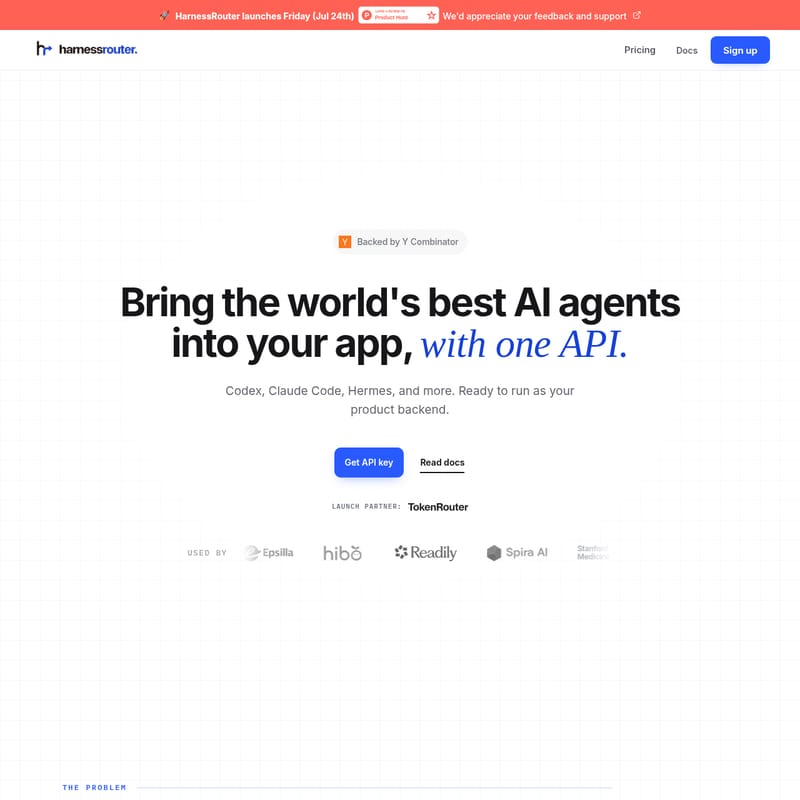
HarnessRouter Product Information
HarnessRouter: The Ultimate AI Agent Backend for Rapid Application Development
In the rapidly evolving landscape of artificial intelligence, building a robust AI agent backend has traditionally been a process that takes months of dedicated engineering. HarnessRouter, a platform backed by Y Combinator, officially launches this Friday, July 24th, to solve this exact problem. By providing a unified API, HarnessRouter allows developers to bring the world's best AI agents—such as Codex, Claude Code, and Hermes—directly into their products in a matter of minutes.
Whether you are a developer at a prestigious institution like Stanford Medicine or a startup founder, the HarnessRouter API offers a production-ready infrastructure that handles the complexities of agent runtime, orchestration, and maintenance so you can focus on shipping features.
What's HarnessRouter?
HarnessRouter is a comprehensive execution layer and backend-as-a-service for AI agents. At its core, it is designed to replace the fragmented and time-consuming process of building custom backends for AI-driven applications. HarnessRouter provides a single, streamlined API that connects your application to elite agents like Codex, Claude Code, and Hermes, with others like Pi and dedicated Coding agents coming soon.
Defining the "Harness"
To understand HarnessRouter, one must understand the concept of a "harness." In the context of this platform, a harness is the essential execution layer that surrounds an AI model. It includes:
- Instructions and Model Policy: Defining how the model behaves.
- Tools and MCP: Enabling the model to interact with external systems.
- Skills and Runtime: Providing the necessary logic for task execution.
- Sandbox and Permissions: Ensuring a secure environment for every run.
- Guardrails and Output Contracts: Guaranteeing that the model returns structured artifacts rather than just plain text.
By managing these components, HarnessRouter transforms a standard AI model into a functional agent capable of performing real-world work and generating tangible results like code, documents, and media.
The Problem: The High Cost of Building AI Backends
Before HarnessRouter, building a backend for a coding agent or an autonomous AI feature was a monumental task. Developers often faced a massive backlog of infrastructure requirements, including:
- Sandbox per run: Creating isolated environments for security.
- Agent Runtime: Managing the lifecycle of the AI agent.
- Tool Orchestration: Coordinating multiple tools for a single task.
- Files & Artifacts: Handling the storage and retrieval of generated data.
- Sessions & Streaming: Maintaining persistent interactions and real-time updates.
- Retries & Timeouts: Ensuring reliability in unstable network conditions.
- Permissions & Cost Controls: Managing access rights and API spend.
Without HarnessRouter, the upgrades, fixes, and maintenance for these systems never stop, draining resources away from the core product experience.
Features of HarnessRouter
HarnessRouter is packed with features designed to give developers full control over their AI agents while removing the operational burden.
One API, Multiple Agents
With a single integration, you gain access to a variety of specialized agents:
- Codex: Optimized for generating code, apps, and images.
- Claude Code: Specialized in managing files, documents, and complex coding tasks.
- Hermes: An autonomous agent capable of utilizing any frontier model.
Full Execution Control and Tracing
HarnessRouter provides deep visibility into agent behavior. Users can trace every task, step by step, allowing for granular debugging and optimization. The platform includes an Execution Overview and an Event Timeline that tracks user messages, tool calls, and agent responses in real-time.
Production-Ready Infrastructure
- Secure Sandbox: Every execution happens in a controlled environment.
- Automated Maintenance: The HarnessRouter team takes care of all upgrades and fixes.
- Scalable Backend: Designed to serve as your primary product backend with high reliability.
How to Use HarnessRouter
Building your AI-powered application with HarnessRouter is a straightforward three-step process designed for maximum efficiency.
- Drop it into your coding agent: Start by integrating the HarnessRouter configuration into your existing development environment.
- Describe your idea: Use natural language to define what you want your AI feature to do. For example: "Build a founder launch-video app: users drop a logo and an idea, get a launch video."
- Add your API key securely: Configure your server environment with your unique
HR_KEY(e.g.,sk-hr-••••••••).
Once these steps are complete, you are ready to SHIP your product to users.
Use Case Scenarios
HarnessRouter is versatile enough to power a wide array of AI-driven features across various industries. Some prominent use cases include:
- Website and Site Builders: Automatically generate layouts and code for web pages.
- Digital Employees: Automate routine operations and planning tasks.
- Model Evaluation: Use the harness to test and benchmark different AI models.
- Legal and Data Analysis: Process complex documents and extract actionable insights.
- Creative Media: Generate film, ads, and social media content autonomously. For instance, the Cinematic Product Launch Video Generator harness can take a prompt and generate a premium MP4 video in minutes.
- App Development: Build functional applications where the AI acts as the primary backend engine.
FAQ
What exactly is a harness? A harness is the execution layer around a model: instructions, model policy, tools and MCP, skills, runtime and sandbox, permissions and guardrails, plus the output contract. It is what lets a model do work and return artifacts instead of only replying with text.
Why not just use Codex or Claude directly? While individual models are powerful, they lack the necessary infrastructure (sandboxes, tool orchestration, session management) required to function as a reliable product backend. HarnessRouter provides this missing layer.
How much does it cost? Pricing information is available on the HarnessRouter website. The platform is designed to provide cost controls to help manage your AI spend effectively.
Do I need to understand agents to use this? No. HarnessRouter is built to be accessible. You can describe your request, and the platform handles the agent complexities for you.
Am I locked into one harness? No. You can configure each harness when you need to and switch between different agents like Codex or Claude Code through the same unified API.
What exactly comes back to my app? Instead of just text, HarnessRouter returns structured artifacts, such as code files, documents, or processed media, based on the output contract defined in the harness.