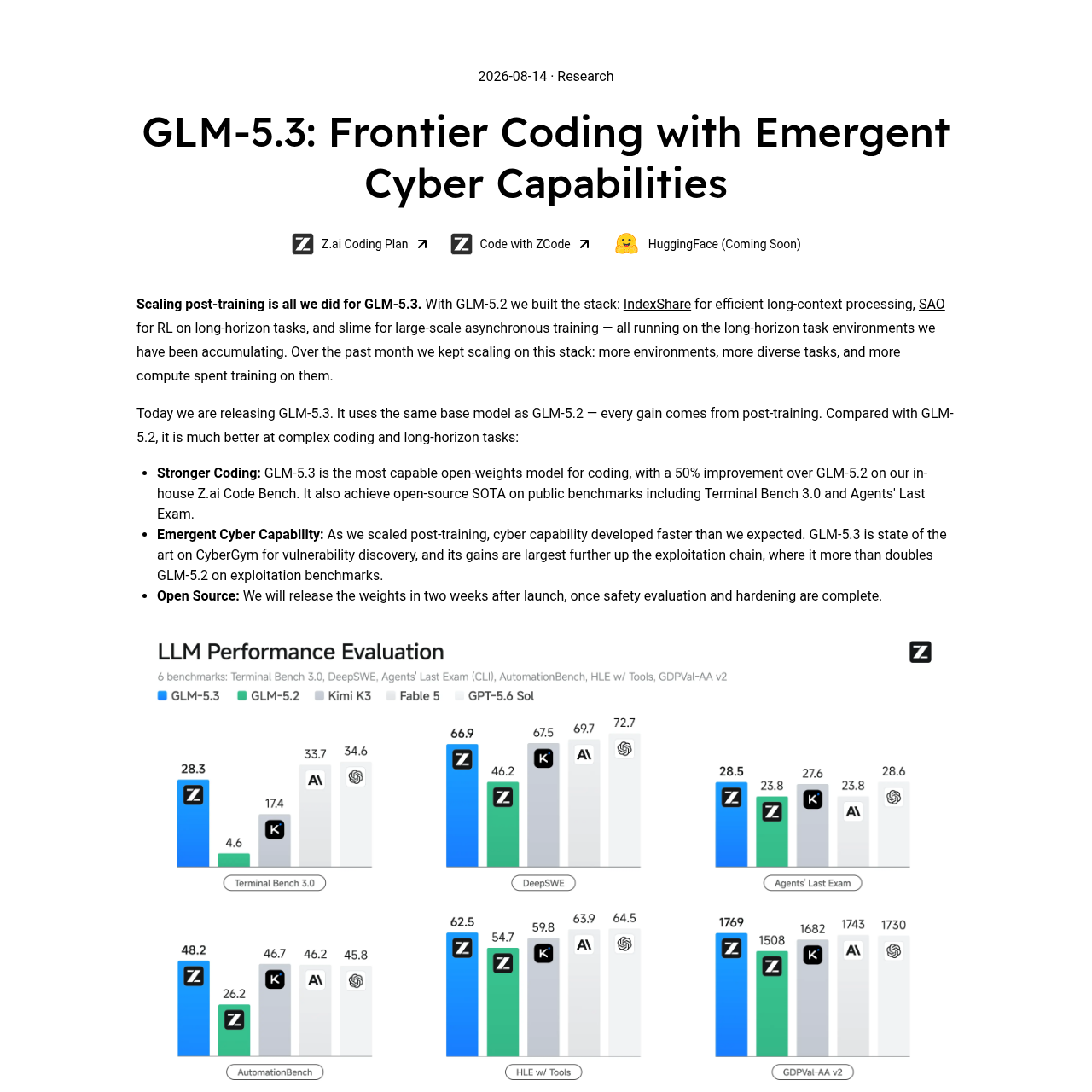
GLM-5.3 is an open-weights model optimized through scaled post-training, delivering enhanced performance in complex coding, long-horizon agentic tasks, and automated vulnerability discovery.
Code & ITComplex coding and software engineering…Vulnerability discovery and multi-stage…Long-horizon task planning and executionPost-Training Scaling
Estimated monthly visits
20M
Data period:
Listed on AIToolly
What Is GLM-5.3? Product Overview
What the product does and how it is positioned
GLM-5.3 is a specialized model built upon the GLM-5.2 base, focusing on advancements in coding and cyber security capabilities. By scaling post-training on a wide array of long-horizon environments, the model demonstrates improved reasoning and task completion rates.
The model utilizes the slime framework for reinforcement learning, which allows for efficient training and rollout consistency. It is designed to handle complex engineering workflows, including diagnosing system bottlenecks and implementing optimizations autonomously.
What Can You Use GLM-5.3 For?
Source-supported ways to use the product
Automated Vulnerability Research
The model identifies and reasons about security vulnerabilities across various stages of exploitation, as demonstrated by its performance on CyberGym and ExploitBench.
Complex Engineering Workflows
The model autonomously diagnoses system bottlenecks, implements optimizations, and executes experiments within compute-heavy production environments.
The Slime RL Framework
The slime framework serves as the backbone for GLM-5.3, enabling the scaling of reinforcement learning through a unified dataflow architecture. By keeping training, rollout, and data buffers integrated, it allows for the seamless addition of new environments without requiring a rebuild of the training stack.
Supports dynamic teacher switching and prefetching to reduce resource consumption.
Improves end-to-end RL training throughput by more than 2.3x through workload-aware heuristics.
Maintains high training-rollout consistency with log probability differences controlled at the 1e-7 level.
What to Test Before Choosing GLM-5.3
Checks to run with your own material and workflow
Confirm that the application configuration has thinking.type set to enabled, as disabled mode is no longer supported.
Verify that reasoning_effort is set to low, high, or max, with max recommended for complex coding tasks.
Answers based on the source-checked product record
What is the primary difference between GLM-5.3 and GLM-5.2?+
GLM-5.3 uses the same base model as GLM-5.2, but achieves superior performance in coding and long-horizon tasks through extensive post-training scaling.
Are the model weights for GLM-5.3 currently available?+
The model weights are scheduled for public release two weeks after the initial launch, following the completion of safety evaluations and hardening.
How should I configure my API requests for GLM-5.3?+
You must set thinking.type to enabled and choose a reasoning_effort level of low, high, or max, as disabling the thinking parameter is not supported.
What is the Z.ai Security Disclosure Ledger?+
It is a public record maintained by Z.ai that tracks vulnerabilities identified by the model, including their severity, status, and disclosure history.
Can GLM-5.3 be used for tasks other than coding?+
Yes, the model is designed for general agentic tasks and vulnerability discovery, demonstrating emergent cyber capabilities alongside its coding proficiency.
More Code & IT AI tools
Explore other recently added tools in the same category.