Filament by Galaxy favicon

Filament by Galaxy

Filament by Galaxy is an open-source data movement engine engineered to transfer records from databases, APIs, streams, and object storage into analytical sinks with CRC32-C verification and pluggable backends.

Code & ITHashing records on both read and write…Routing data from databases, APIs,…Writing pipeline data to Snowflake,…Swapping backends
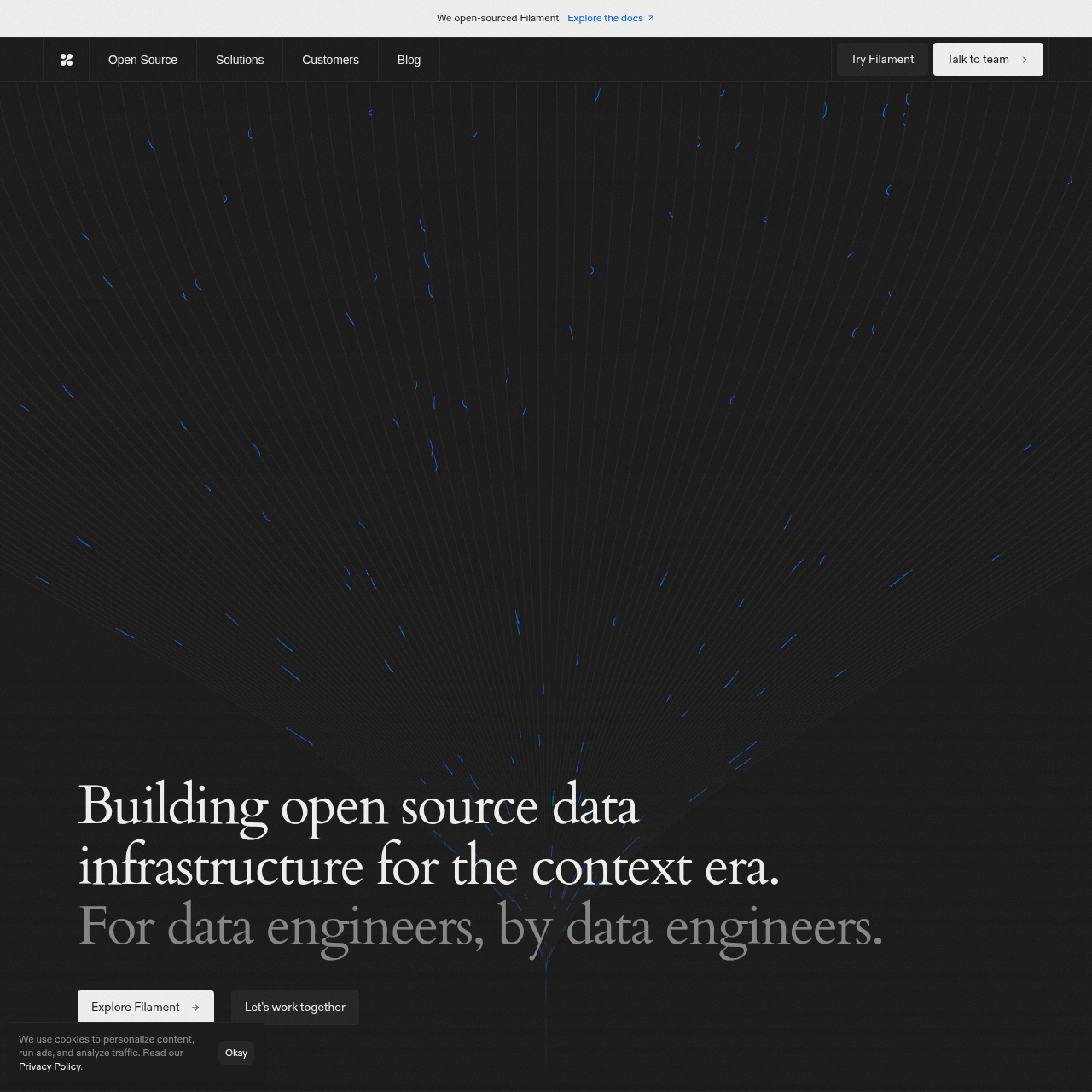
Filament by Galaxy product interface screenshot
Listed on AIToolly

What Is Filament by Galaxy? Product Overview

What the product does and how it is positioned

Filament by Galaxy is an open-source data movement engine designed for data engineers to move information across diverse infrastructure. The system routes data from sources such as databases, APIs, event streams, and object storage through a single pipeline into target destinations including Snowflake, BigQuery, ClickHouse, and Iceberg.

The engine features a pluggable architecture where backends for state, events, and secrets can be configured and swapped without altering existing pipelines. For data integrity, Filament applies CRC32-C hashing across all records during read and write cycles, failing batches if counts, byte volumes, or checksums do not align.

What Can You Use Filament by Galaxy For?

Source-supported ways to use the product

High-Throughput Analytical Ingestion

Moving tabular records from operational databases and object storage files into analytical sinks such as Snowflake, BigQuery, ClickHouse, or Iceberg.

Integrity-Verified Data Replication

Replicating data from APIs and streaming sources while enforcing batch-level validation via CRC32-C checksums, byte totals, and record counts.

Engine Architecture and Data Integrity

Filament implements a data movement pipeline designed to handle ingestion from databases, APIs, event streams, and object storage into target data warehouses and lakehouses.

To protect data integrity across transfers, the engine hashes every record on read and write using CRC32-C. Batches automatically fail if record counts, total bytes, or calculated checksums do not match between endpoints.

The platform is built with a pluggable design allowing operators to select and swap backends for state management, event coordination, and secret storage without modifying pipeline configurations.

  • Hashes all records on read and write cycles using CRC32-C checksums
  • Enforces batch failure when record counts, byte counts, or checksums mismatch
  • Decouples pipeline definitions from state, events, and secret backends
  • Connects source inputs to destinations including Snowflake, BigQuery, ClickHouse, and Iceberg

What to Test Before Choosing Filament by Galaxy

Checks to run with your own material and workflow

  • Verify that candidate source systems match Filament's documented inputs, such as databases, APIs, event streams, or object storage files.
  • Confirm destination compatibility with target sinks such as Snowflake, BigQuery, ClickHouse, or Apache Iceberg.
  • Check that operational workflows can handle batch failures triggered when record counts, byte counts, or CRC32-C checksums do not match.
  • Review backend requirements for state, events, and secrets to ensure compatibility with Filament's pluggable architecture.

Filament by Galaxy Sources and Last Checked

What was checked and when

Last checked
Category
Code & IT

Filament by Galaxy Frequently Asked Questions

Answers based on the source-checked product record

What type of product is Filament by Galaxy?

Filament is an open-source data movement engine created by Galaxy for data engineers to move records across infrastructure pipelines.

What data sources can be connected to a Filament pipeline?

Filament supports data ingestion from databases, application programming interfaces, event streams, and files stored in object storage.

Which destination sinks are documented for Filament?

Filament supports landing data into analytical sinks including Snowflake, BigQuery, ClickHouse, and Apache Iceberg through its pipelines.

How does Filament verify data integrity during data movement?

Filament hashes every record on read and write using CRC32-C, automatically failing batches unless record counts, byte totals, and checksums match.

How does Filament handle pipeline state, events, and secrets?

Filament features a pluggable architecture that allows users to choose and swap backends for state, events, and secrets without changing pipelines.

Explore other recently added tools in the same category.