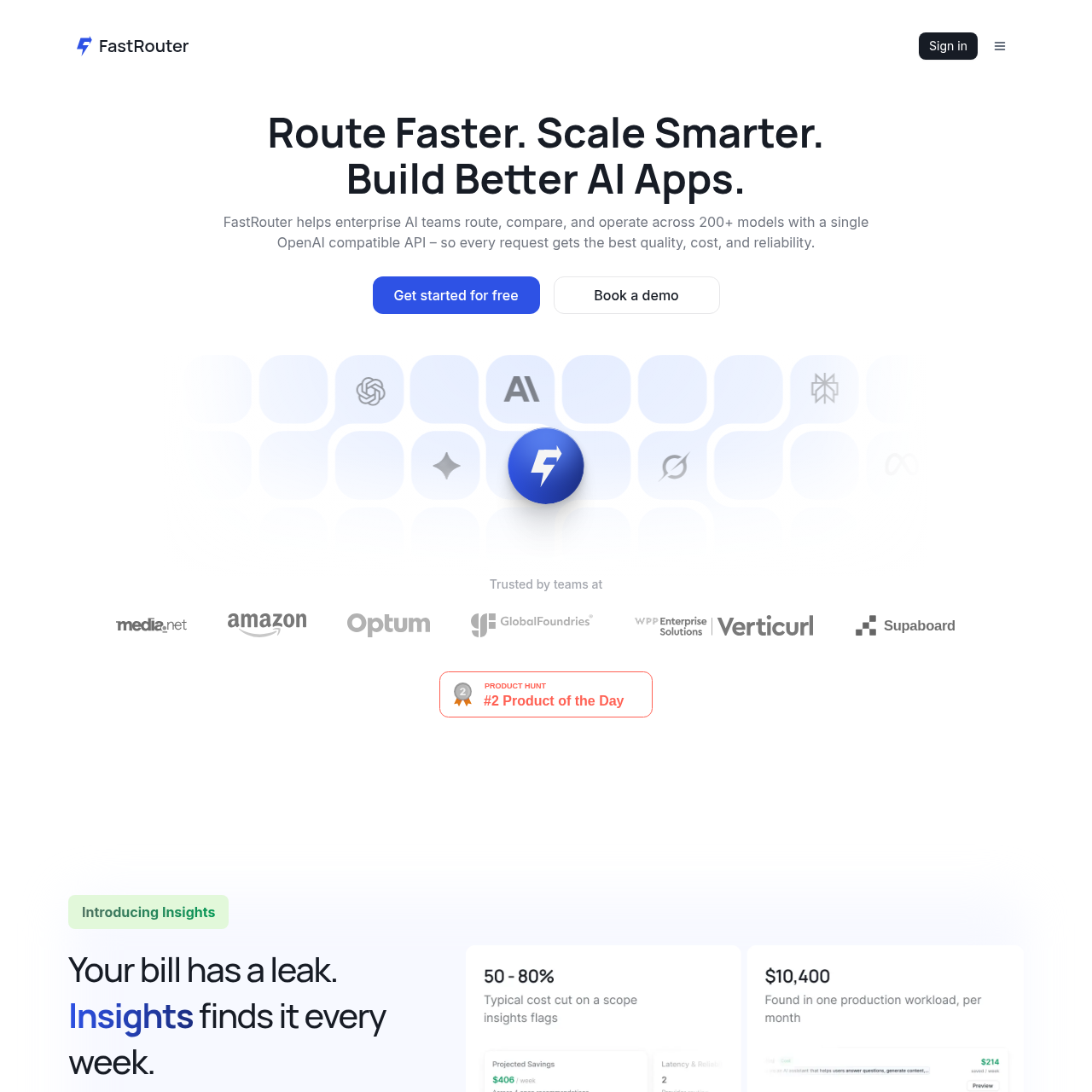
FastRouter.ai is an OpenAI-compatible AI gateway and observability platform that enables teams to route, compare, and manage traffic across more than 200 AI models with automated failover and cost controls.
Code & ITDirecting prompts to 200+ models via a…Automating failover across multiple AI…Executing prompt and response caching,…Validating prompt inputs and model…
Listed on AIToolly
What Is FastRouter.ai? Product Overview
What the product does and how it is positioned
FastRouter.ai functions as an operational proxy and management gateway for artificial intelligence systems, delivering compatibility with standard OpenAI API clients across more than 200 models. The system enables developers to integrate foundation models spanning text, image, video, speech, and embeddings without requiring modifications to client application code.
In addition to routing, the platform incorporates multi-provider resilience, detailed traffic observability, and centralized governance. Engineering organizations can track latency, error distributions, and expenditures across providers while implementing spending caps, role-based controls, and input-output guardrails.
What Can You Use FastRouter.ai For?
Source-supported ways to use the product
Model Benchmarking and Experimentation
The official customer story reports using FastRouter to test, compare, and evaluate multiple emerging models side-by-side to determine cost-performance balance for specific business use cases.
High-Availability Production Failover
Engineering teams route production traffic through virtual model aliases and fallback lists to maintain continuous application uptime during provider outages or capacity bottlenecks.
Team Spend and Access Governance
Organizations enforce project-specific API key limits, member roles, and safety guardrails to regulate multi-team model consumption and prevent unexpected billing spikes.
Intelligent Routing and Failover Architecture
FastRouter centralizes access to multiple model providers through an OpenAI-compatible proxy interface. When incoming requests arrive, the routing layer can direct traffic according to predefined objectives such as latency minimization, cost optimization, or throughput capacity.
To mitigate provider outages, the gateway supports multi-provider redundancy and automated failover. Administrators can define fallback model hierarchies and virtual model aliases, allowing traffic to redirect to healthy alternative providers without modifying application application code.
Automatic rerouting to secondary providers when upstream services experience downtime or rate limits
Automated routing logic designed to direct prompts to cost-efficient models matching required output quality
Virtual model lists and aliases that decouple application endpoints from specific underlying providers
AI Workload Observability and Governance Controls
The platform provides operational visibility across model deployments by tracking latency, error rates, and costs within centralized dashboards. The Insights tool inspects routed traffic to present actionable recommendations, highlighting specific requests and projected savings.
Governance capabilities enable organizations to regulate AI adoption across multiple projects and contributors. Role-based access controls and provisioning keys enforce boundaries, while input and output guardrails evaluate prompts and completions for consistency and policy compliance.
Unified dashboards and request-level activity logs for latency, error, and cost monitoring
Project-level and API key budget caps to help reduce unexpected billing spikes
Configurable guardrails for validating inputs and outputs against compliance rules
Self-hosted deployment options enabling on-network data isolation for enterprise environments
What to Test Before Choosing FastRouter.ai
Checks to run with your own material and workflow
Confirm that your target models and modalities are included among the 200+ supported providers and formats.
Verify whether your application architecture requires self-hosting on private cloud infrastructure or cloud gateway access.
Check that the fallback models and virtual model list configurations meet your organization's availability requirements.
Review role-based access control and API key spending limits against your team's governance policies.
Answers based on the source-checked product record
What API standard does FastRouter use for model integration?+
FastRouter provides an OpenAI-compatible API, allowing developers to connect existing OpenAI SDKs and integrations to over 200 supported models across multiple providers without major code refactoring.
How does FastRouter handle provider downtime and errors?+
FastRouter includes automated retries across providers, prioritized fallback lists, and virtual model aliases to automatically reroute requests to healthy providers when primary models fail.
Can FastRouter be deployed on private infrastructure?+
FastRouter offers a self-hosted option on its Enterprise plan, allowing organizations to run the gateway inside their own cloud environment so prompts, responses, logs, and API keys remain within their network.
What modalities and data formats are supported by the gateway?+
The platform supports multiple AI modalities across providers, including text, image, video, embeddings, and speech workloads.
What governance and cost management tools does FastRouter provide?+
The platform provides role-based access controls, project and API key spend caps, input and output guardrails, and Insights reports that analyze traffic to identify cost-saving adjustments.
More Code & IT AI tools
Explore other recently added tools in the same category.