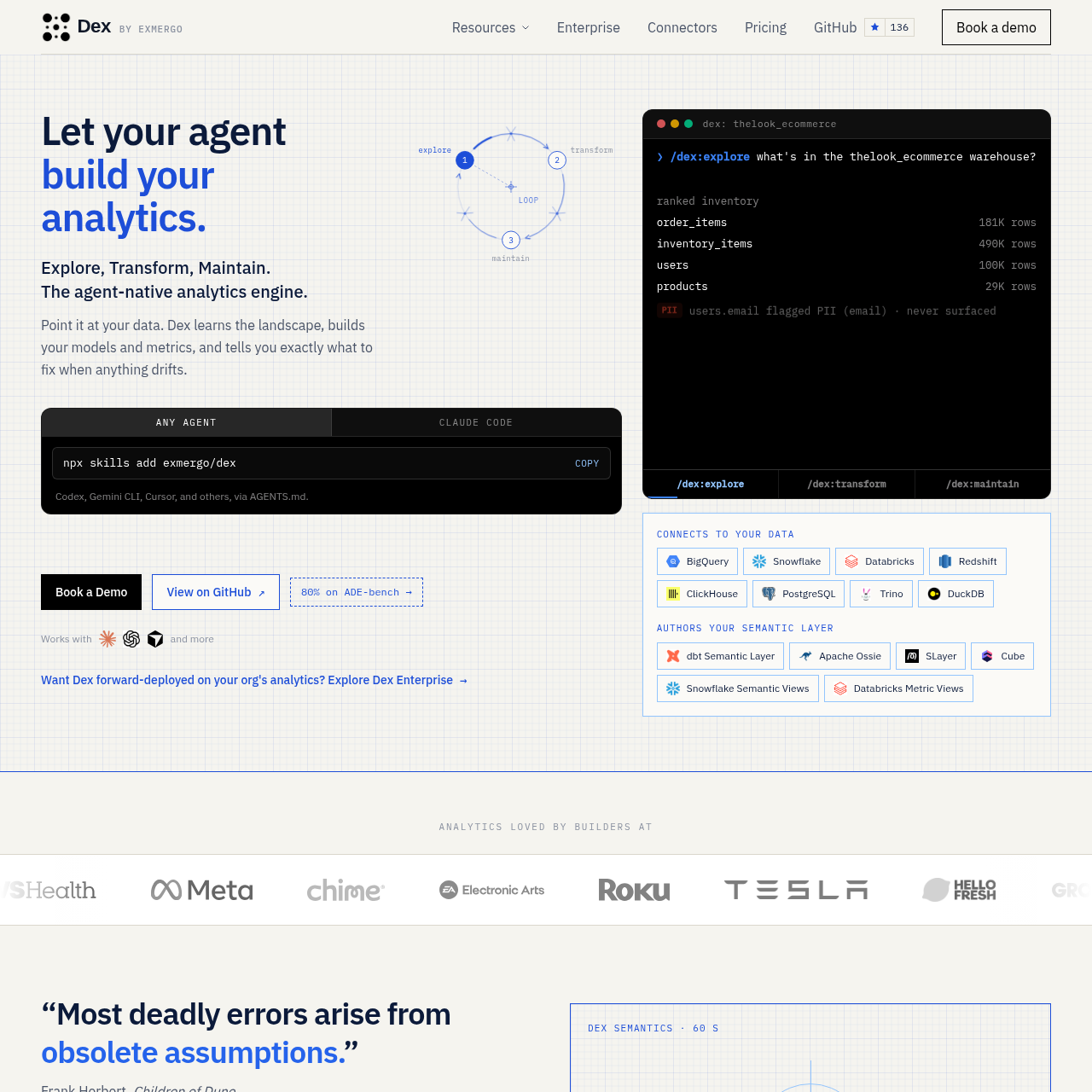
Dex is an agent-native analytics engine for exploring, transforming, and maintaining data warehouse analytics with read-only access, local context, and scan cost controls.
Code & ITAutomated profiling of data columns and…PII flaggingLocal caching of data structuresGeneration of dependency-aware dbt SQL…
Listed on AIToolly
What Is Dex Semantics? Product Overview
What the product does and how it is positioned
Dex functions as an analytics interface for AI coding agents, facilitating data exploration, model construction, and ongoing system maintenance. It utilizes a read-only architecture to profile data sources, flag personally identifiable information, and cache structures locally, so that raw data and credentials remain separate from the LLM context.
The system includes guardrails designed to manage resource consumption by enforcing dry-run estimations for data scan volume before operations run. It provides tools for defining semantic layers and models, while offering maintenance capabilities to monitor for schema, grain, and semantic changes over time.
What Can You Use Dex Semantics For?
Source-supported ways to use the product
Data Exploration and Profiling
AI agents utilize exploration tools to profile columns, infer table relationships, and generate a draft map of the data warehouse.
Semantic Layer Authoring
Developers use the system to generate dependency-aware SQL models and semantic layer definitions compatible with frameworks like dbt and Cube.
How to Use Dex Semantics
The documented workflow, where available
1
Explore
The agent identifies and profiles data sources to build a local map, flagging PII and inferring table relationships.
2
Transform
The agent generates models and semantic definitions based on specific data requirements while validating against dev targets.
3
Maintain
The system checks established data snapshots to detect and propose fixes for schema, grain, and semantic drift.
Data Security and Privacy Architecture
The system is designed to interact with data warehouses without compromising the underlying security of the raw data. By operating with a strictly read-only approach, the engine is designed so that raw rows and specific sensitive values are not copied out of the source environment.
Security is maintained by keeping credentials local to the user's agent and so that they are never included in the context window sent to the LLM. Only bounded summaries, schema information, and statistics are cached locally to facilitate agentic understanding.
Read-only access is intended to reduce modification of source data
Automatic flagging of PII is intended to reduce exposure to models
Credentials remain on the client-side, never reaching the LLM
Local caching stores only aggregates and metadata
What to Test Before Choosing Dex Semantics
Checks to run with your own material and workflow
Confirm that the target data warehouse platform is supported in the official connector list.
Verify the integration requirements for the specific AI coding agent being used to ensure compatibility.
Answers based on the source-checked product record
What data platforms does Dex support?+
Dex connects to several major data warehouses including BigQuery, Snowflake, Databricks, Redshift, ClickHouse, PostgreSQL, Trino, and DuckDB.
How does Dex handle data privacy?+
Dex operates with read-only access, storing only bounded summaries and aggregates locally, while keeping credentials and raw data separate from LLM contexts.
Can Dex identify drift in analytics?+
Yes, the maintenance module detects schema, grain, and semantic drift by comparing current data against previously established project snapshots.
Does Dex control costs during agent interactions?+
Dex enforces cost guards by requiring dry-run estimations for data scans before allowing the agent to execute queries or transformations.
What semantic layers are supported?+
Dex supports authoring for dbt Semantic Layer, Apache Ossie, SLayer, Cube, Snowflake Semantic Views, and Databricks Metric Views.
More Code & IT AI tools
Explore other recently added tools in the same category.