Daemons by Charlie Labs
Charlie Labs Daemons: Always-On Proactive AI Processes for Slack, Linear, and GitHub
Charlie Labs provides Daemons—always-on AI processes that manage repetitive tasks proactively. Using simple Markdown files, these Daemons handle roles across GitHub, Linear, and Slack without human prompts.
2026-06-20
--K
Daemons by Charlie Labs Product Information
Charlie Labs Daemons: Always-On AI Processes for Seamless Team Productivity
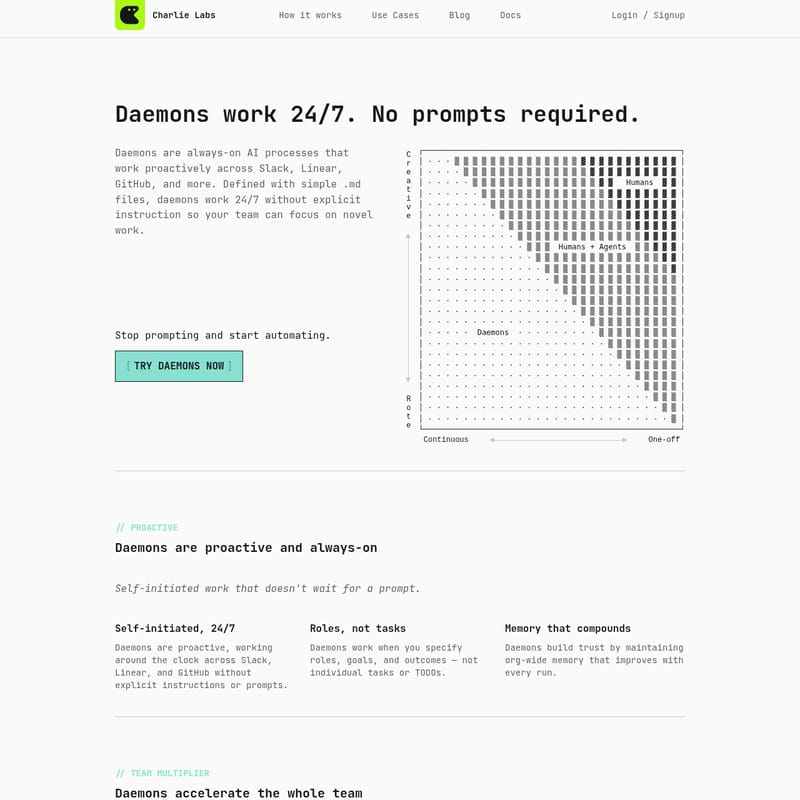
In the modern development landscape, teams are often bogged down by rote, repetitive tasks that distract from high-level creative work. Charlie Labs introduces a revolutionary solution with Daemons: always-on AI processes that work 24/7 without requiring manual prompts. By integrating seamlessly with tools like Slack, Linear, and GitHub, Charlie Labs Daemons allow your team to shift their focus from maintenance to innovation.
What is Charlie Labs?
Charlie Labs is the platform behind Daemons, which are self-initiated AI agents designed to handle ongoing responsibilities rather than one-off tasks. Unlike traditional AI tools that wait for a user prompt to act, a Charlie Labs daemon is proactive. It operates based on predefined roles and goals specified in simple Markdown (.md) files.
These daemons act as a continuous layer of support, sitting at the intersection of "Rote" and "Continuous" work. While humans focus on high-stakes creative tasks and traditional AI agents help with one-off accelerations, Charlie Labs Daemons ensure that the background operations of a project—the recurring loops, the maintenance, and the organization—never falter.
How Charlie Labs Daemons Work
At the core of the Charlie Labs ecosystem is the DAEMON.md file. This open-format specification allows developers to define a daemon’s role once and let it run indefinitely. These files live directly in your repository, making them portable and easy to manage with standard version control.
The Structure of a DAEMON.md File
A daemon's behavior is dictated by two main sections within the Markdown file:
1. Frontmatter
Located between --- fences, the frontmatter contains declarative fields that define the daemon's identity and triggers:
- Name and Purpose: Clearly states what the daemon is and why it exists.
- Watch Conditions: Specifies events that wake the daemon (e.g., when a pull request is opened or a Linear issue is created).
- Routines: Lists the specific actions the daemon should perform.
- Deny Rules: Explicitly defines what the daemon is forbidden from doing (e.g., merging PRs or deleting files).
- Schedule: Uses cron syntax to define regular "sweeps" to catch missed items.
2. Content
The Markdown text below the frontmatter provides the "how" of the operation:
- Policy: Sets the tone and logic, such as focusing on short feedback or matching the existing author's voice.
- Output Format: Dictates how findings or suggestions should be presented.
- Limits and Escalation: Defines rate limits to prevent overwhelming the team and sets rules for when a human should be notified.
Key Features of Charlie Labs
Proactive and Self-Initiated
Charlie Labs Daemons do not wait for instructions. They are always-on and self-initiated, working around the clock across your favorite platforms. Once a role is defined, the daemon takes ownership of the outcome, ensuring nothing slips through the cracks.
A True Team Multiplier
Adding a daemon to a repository provides immediate benefits for the entire team. There is no complex rollout or onboarding required. Furthermore, Charlie Labs utilizes team-based billing with a shared token budget. This ensures that every person's allocation is spent on novel, creative work while the daemons handle the background noise.
Memory That Compounds
One of the standout features of Charlie Labs is that daemons build trust through compounding memory. They maintain an org-wide context that improves with every run. A daemon that has been active for three months is significantly sharper and more aligned with team conventions than it was on day one.
Cleans Up After Agents
While AI agents increase productivity, they often leave behind maintenance work. Charlie Labs Daemons act as the cleanup crew, keeping dependencies patched, documentation updated, and operational quality high, so the team is never held back by technical debt.
Use Case Examples
Charlie Labs offers a variety of pre-defined roles through its Daemon Library, each targeting a specific pain point in the development lifecycle.
1. Project Manager
This daemon ensures that your Linear issues are always up to date. It can automatically label issues, find missing context, and ensure that priorities are aligned without human intervention.
2. Bug Triage
Working across Sentry, GitHub, and Linear, the Bug Triage daemon ensures every bug is complete, assigned, and analyzed. It can append missing context to issue bodies and post root cause analysis (RCA) comments with supporting evidence.
3. Codebase Maintainer
This daemon keeps the codebase secure and current. It watches for security advisories and merged pull requests to update outdated dependencies, patch vulnerabilities, and remove dead code. It operates under strict "Deny" rules to ensure it never modifies business logic.
4. Librarian
The Librarian daemon keeps repository documentation accurate. It detects stale docs based on recent code changes and updates them, ensuring that onboarding for new team members is never a "wild goose chase."
How to Use Charlie Labs Daemons
To start automating with Charlie Labs, follow these general steps based on the provided documentation:
- Define the Role: Create a
.mdfile (e.g.,DAEMON.md) in your repository. - Set the Frontmatter: Define the name, purpose, and what events the daemon should
watch(e.g.,when a pull request is merged). - Specify Routines and Deny Rules: Detail exactly what the daemon should do and what it is strictly prohibited from doing to build trust.
- Establish Policy: Write out the operational guidelines in the Markdown body, such as "Match tone and style of existing docs."
- Deploy: Once the file is in your repo, the Charlie Labs platform activates the daemon, and it begins working 24/7.
FAQ
Q: Do Charlie Labs Daemons require prompts? A: No. Unlike traditional AI agents, daemons are proactive and work 24/7 based on defined roles in Markdown files without needing explicit instructions for every task.
Q: What platforms do they support? A: Currently, Charlie Labs Daemons work across Slack, Linear, GitHub, and can even integrate with data from Sentry and Datadog.
Q: How does the billing work? A: Charlie Labs uses team-based billing where a shared token budget covers all daemon work, allowing the team to focus on creative tasks.
Q: Can I control what the daemon modifies?
A: Yes. Using the deny field in the DAEMON.md file, you can strictly limit the daemon’s actions, such as preventing it from pushing to protected branches or changing business logic.
Q: Is the daemon format proprietary? A: No. Charlie Labs uses an open Markdown format, making the daemon definitions portable across any provider that supports the specification.