Brief
Brief: The AI Navigation Layer for Teams and Agents to Align Vision with Impact
Brief is a navigation platform that aligns AI agents and product teams by integrating business context into coding workflows, ensuring 95% decision compliance and reducing costs per merge-ready task by 68%.
2026-06-04
--K
Brief Product Information
Brief: The Navigator for AI Agents and Product Teams
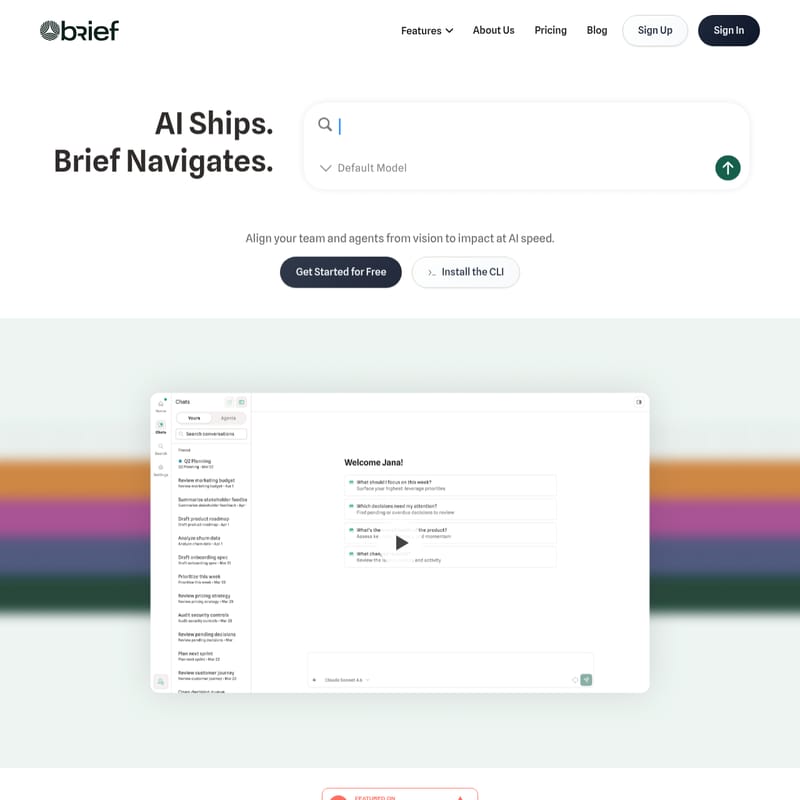
In the modern development landscape, the mantra is clear: AI Ships. Brief Navigates. As organizations increasingly rely on artificial intelligence to accelerate their development cycles, a critical gap has emerged between strategic vision and technical execution. Brief bridges this gap, serving as the essential navigation layer that ensures every builder—whether human or AI—is aligned with the product's core decisions, constraints, and goals.
Without proper context, AI agents often build "the wrong thing," leading to wasted tokens and endless rewrites. Brief solves this by providing a unified Product Graph that tracks the "why" behind every feature, ensuring that your team and your AI agents move from vision to impact at AI speed.
What is Brief?
Brief is your dedicated navigator through the complex product development process. It is designed to ensure that every decision is informed, every builder is aligned, and no team ships blind. By capturing institutional knowledge from the tools your team already uses, Brief creates a continuous thread of context that guides both engineers and AI agents.
At its core, Brief is comprised of three primary components:
- The Web App: This serves as your command center. Within the web app, you can view your comprehensive Product Graph, search through past decisions, and gain a high-level view of your project's trajectory.
- MCP Server + CLI: This is the engine that navigates your AI agents. By installing the CLI, agents like Cursor, Claude Code, and Windsurf receive the precise context they need to build correctly the first time.
- Integrations: Brief captures the journey of your product by pulling decisions from where they naturally happen, including Linear, Jira, Notion, Slack, and GitHub.
Key Features of Brief
Brief is packed with features designed to maximize the efficiency of your AI-driven development workflow. By focusing on alignment and context, Brief delivers measurable improvements to engineering output.
The Product Graph
Brief automatically maps decisions to a searchable, linked, and always current Product Graph. This graph ensures that the reasoning behind a technical tradeoff or a strategic priority is never lost. It transforms static documentation into a living map of your product's evolution.
High-Performance AI Alignment
Data shows that Brief dramatically improves the performance of AI agents:
- 95% Decision Compliance: When agents have access to Brief, compliance with team decisions jumps to 95%, compared to just 46% when using the codebase alone.
- Merge-Ready Tasks: In testing, agents using Brief produced 8 out of 8 merge-ready tasks, whereas agents without product context only achieved 2 out of 8.
- Cost Efficiency: Brief results in a -68% cost reduction per merge-ready task, effectively paying for itself by ensuring work is shipped rather than rewritten.
Seamless Tool Integration
Your team doesn't need to change their workflow to benefit from Brief. It watches for decisions in Slack, extracts requirements from Jira or Linear, and notes documentation updates in Notion. It then maps these insights to the Product Graph automatically.
How Brief Works
Understanding how to use Brief is simple, as it integrates directly into your existing ecosystem. The process follows a three-step cycle: Capture, Connect, and Navigate.
Step 1: Capture
Brief reads your existing tools (Linear, Jira, Notion, Slack, GitHub) and extracts key decisions as they happen. There is no manual entry required; the system identifies the "product truth" from your team's natural communication and project management activities.
Step 2: Connect
These captured decisions are then used to build your Product Graph. This creates a network of information where every decision is searchable and linked to the broader product vision. It ensures that context is not just stored, but organized for maximum utility.
Step 3: Navigate
This is where the magic happens for developers and AI agents. Your team can query Brief directly from their IDE using the CLI or MCP Server. Whether they are using Cursor, Claude Code, or Windsurf, the agents get aligned instantly with the product context they need to build the right thing the first time.
Use Cases for Brief
Brief is versatile enough to support various roles within a technology organization, from founders and engineering leaders to the AI agents themselves.
Scaling Your Judgment
As a leader, your context is everywhere—strategic priorities, technical tradeoffs, and customer insights. However, you cannot be in every room or every Slack thread. Brief captures your thinking and navigates your team to the right answers in your absence, allowing you to scale your judgment across the entire organization.
Aligning Your AI Agents
AI is capable of building almost anything, but without context, it often builds the wrong thing. Brief acts as the guardrail for your AI agents, providing them with the "product truth" they need. By feeding agents the specific decisions and constraints relevant to a task, Brief prevents the "telephone game" where requirements get lost in translation.
Maximizing Return on Invested Tokens (ROIT)
In the age of AI, engineering leaders now allocate tokens much like they used to allocate engineers. Brief ensures a high Return on Invested Tokens (ROIT) by reducing the amount of wandering and rework. Every token spent on an AI agent is more likely to result in shipped code because the agent is working with full context from the start.
Frequently Asked Questions (FAQ)
Is this another project management tool?
No. Brief is not meant to replace tools like Linear or Jira. Instead, it works alongside them. While project management tools track what is being done, Brief captures the why and the context behind it, turning that information into a navigable graph for your team and AI agents.
How is this different from documentation?
Traditional documentation is often static, fragmented, and quickly becomes outdated. Brief is dynamic. It captures decisions as they happen across multiple platforms and creates a linked Product Graph that is always current and searchable by both humans and AI.
Do I need to change my workflow?
No. One of the primary benefits of Brief is that your team continues to work in the tools they already use. Brief extracts the necessary context in the background, ensuring there is no friction or need for new manual processes.
What AI assistants does Brief work with?
Brief is designed to navigate the most popular AI coding assistants, including Cursor, Claude Code, and Windsurf, via its MCP Server and CLI integrations.
How long does it take to see value?
Value is immediate. As soon as Brief begins capturing decisions and connecting them in your Product Graph, your AI agents gain a higher level of decision compliance, leading to fewer rewrites and more merge-ready tasks from day one.
"Working with AI felt like playing telephone. I'd describe what I needed, the AI would build something technically correct, but also wrong. Brief keeps the AI connected to our product, so I get what I actually wanted." — Josh Sirota, Founder, Eragon
Stop building blind. Align your team and agents from vision to impact at AI speed with Brief. Get Started for Free today.