Auriko
Auriko: A Comprehensive Trading Desk for AI Inference and Cost-Optimized LLM Routing Platform
Auriko is a complete inference platform acting as a trading desk for AI, offering cache-aware LLM routing, a unified API, and deep cost optimization to reduce inference expenses and improve performance.
2026-07-11
1.0K
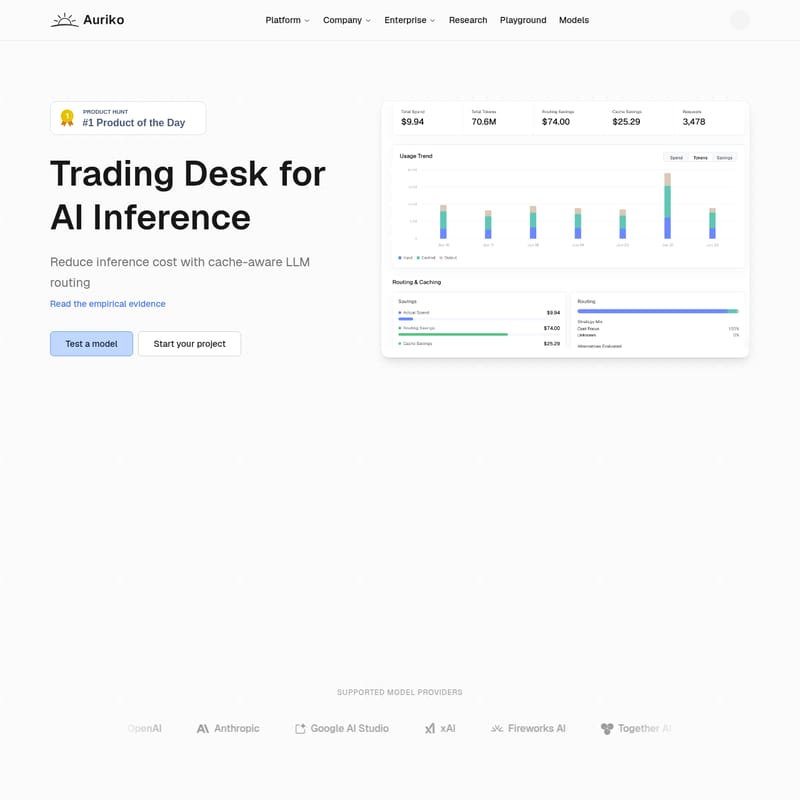
Auriko Product Information
Auriko: The Comprehensive Trading Desk for AI Inference
In the rapidly evolving landscape of artificial intelligence, managing multiple models and providers while maintaining cost-efficiency is a significant challenge. Auriko emerges as the definitive Trading Desk for AI Inference, offering a complete platform designed to reduce inference costs and streamline the deployment of large language models (LLMs). By utilizing cache-aware LLM routing and predictive signals, Auriko provides everything a development team needs to move from prototype to production with confidence and reliability.
What’s Auriko?
Auriko is a sophisticated inference platform that serves as a central hub for managing AI model requests. Described as a "Trading Desk for AI Inference," it functions by intelligently routing requests across various providers to ensure the best balance between cost, performance, and latency. Auriko is built for enterprises and researchers who require a robust infrastructure to handle diverse AI workloads. Whether you are using OpenAI, Anthropic, or open-source models through providers like DeepSeek and Together AI, Auriko provides a unified layer that optimizes every request through its data-driven engine.
Key Features of the Auriko Platform
Unified API and Provider Compatibility
One of the standout features of Auriko is its Unified API. This allows developers to access every supported model and provider through a single interface. Auriko uses an OpenAI-compatible drop-in, which means you can switch to Auriko without a complete overhaul of your existing codebase. This unified approach allows you to preserve provider-specific features while benefiting from the orchestration capabilities of the Auriko ecosystem.
Supported model providers include:
- OpenAI and Anthropic
- Google AI Studio and xAI
- Fireworks AI and Together AI
- DeepSeek and DeepInfra
- MiniMax and Moonshot AI
- Z.AI and SiliconFlow
Deep Cost Optimization
Auriko goes far beyond basic headline price comparisons. The platform features deep cost optimization by modeling how specific workloads interact with each provider's unique pricing structures and prompt-caching mechanics. By understanding these mechanics, Auriko can route each specific request to the lowest-cost provider available at that moment, significantly reducing the overall inference cost.
Predictive Signals and Quantitative Data
To drive its intelligent routing, Auriko utilizes Predictive Signals. This involves a quantitative data engine that monitors real-time signals on provider performance, health, and cache behavior. By analyzing your usage patterns, Auriko can perform cache-cost modeling and performance tuning, ensuring that your AI inference is always running on the most efficient path possible.
Advanced Routing Strategies
With Auriko, you aren't stuck with a one-size-fits-all approach. You can use built-in defaults or define your own routing strategy. You can optimize for several factors:
- TTFT (Time to First Token): Minimize initial response latency.
- Constraints: Set specific requirements such as P95 TPS ≥ 50 or Input Cost ≤ $2 / 1M tokens.
- ZDR Providers: Limit routing to Zero Data Retention providers only.
- Fallback and Structured Output: Enable automatic fallback options and ensure compatibility with structured output requirements.
Global Deployment and Reliability
Auriko ensures your applications are responsive worldwide through a globally distributed edge network. This network is optimized for state-of-the-art latency. Furthermore, Auriko provides Automatic Failover; if one provider experiences downtime, Auriko delivers continuous uptime by backing every request with redundancy, ensuring your production environment never misses a beat.
Key Orchestration and Capacity Intelligence
Managing API keys can be a logistical hurdle. Auriko simplifies this through its Key Orchestration engine. You can Bring Your Own Key (BYOK), use platform-managed keys, or utilize a hybrid approach. This is paired with Capacity Intelligence, which allows you to run inference with full awareness of capacity across providers. Users can even access Auriko’s global capacity reserve for on-demand needs.
Budget Controls
Financial oversight is integrated directly into the Auriko platform. You can set strict spending limits and alerts at the workspace level or the individual API key level. This ensures that development, staging, and production environments (e.g., a $1,000 budget for production or $200 for staging) stay within their allocated financial boundaries.
How to Use Auriko
Integrating Auriko into your AI ecosystem is designed to be seamless, taking only a few minutes. Because it is compatible with major SDKs like OpenAI Agents, LangChain, and the Vercel AI SDK, the transition is straightforward.
Integration Example (Python)
To begin using Auriko with the OpenAI Python client, you simply need to change the api_key and the base_url. Here is a basic implementation:
import os
from openai import OpenAI

client = OpenAI(
 api_key=os.environ["AURIKO_API_KEY"],
 base_url="https://api.auriko.ai/v1",
)

response = client.chat.completions.create(
 model="deepseek-v4-pro",
 messages=[{"role": "user", "content": "Hello!"}],
 extra_body={"gateway": {"routing": {
 "optimize": "cost-focus",
 "max_ttft_ms": 800,
 "ttft_percentile": "p50",
 "data_policy": "zdr",
 }}}
)
By adding the extra_body parameters, you can instruct the Auriko gateway to focus on specific optimizations like cost-focus or set specific latency targets like max_ttft_ms.
Ecosystem Compatibility
Auriko is built to work with the tools you already use, including:
- Claude Agent SDK and Google ADK
- LlamaIndex and CrewAI
- Claude Code, Hermes, and OpenClaw
Use Case
Moving from Prototype to Production
Startups often begin by using a single provider for their prototype. However, as they scale, the inference cost can become prohibitive, and reliance on a single provider introduces a point of failure. By using Auriko, the startup can use the Unified API to immediately tap into multiple providers. They can set a routing strategy that prioritizes cost during non-peak hours and switches to high-performance providers (optimizing for TTFT) during peak usage, all while maintaining Automatic Failover for 100% uptime.
Enterprise Budget Management
For large enterprises managing multiple teams, Auriko provides the necessary Budget Controls. The platform allows administrators to set different limits for the Research, Development, and Production departments, ensuring that experimental LLM usage doesn't drain the resources intended for customer-facing applications.
FAQ
Q: What is a Trading Desk for AI Inference? A: It is a platform like Auriko that manages and routes your AI requests across multiple providers to optimize for the best price, speed, and reliability, much like a financial trading desk optimizes asset placement.
Q: Can I use my own API keys with Auriko? A: Yes, Auriko supports a "Bring Your Own Key" (BYOK) model, as well as managed platform keys, orchestrated through the Auriko engine.
Q: Is Auriko compatible with the OpenAI SDK? A: Yes, Auriko is designed as an OpenAI-compatible drop-in, allowing you to use existing OpenAI clients by simply updating the base URL and API key.
Q: How does Auriko handle provider downtime? A: Auriko features Automatic Failover, which automatically redirects requests to a healthy provider if the primary one fails, ensuring continuous service availability.
Q: Does Auriko support data privacy requirements?
A: Yes, you can set a data_policy to "zdr" (Zero Data Retention) within your routing configuration to ensure your data is handled by providers that meet specific privacy standards.
Auriko: Ship faster. Spend less. Stay reliable.