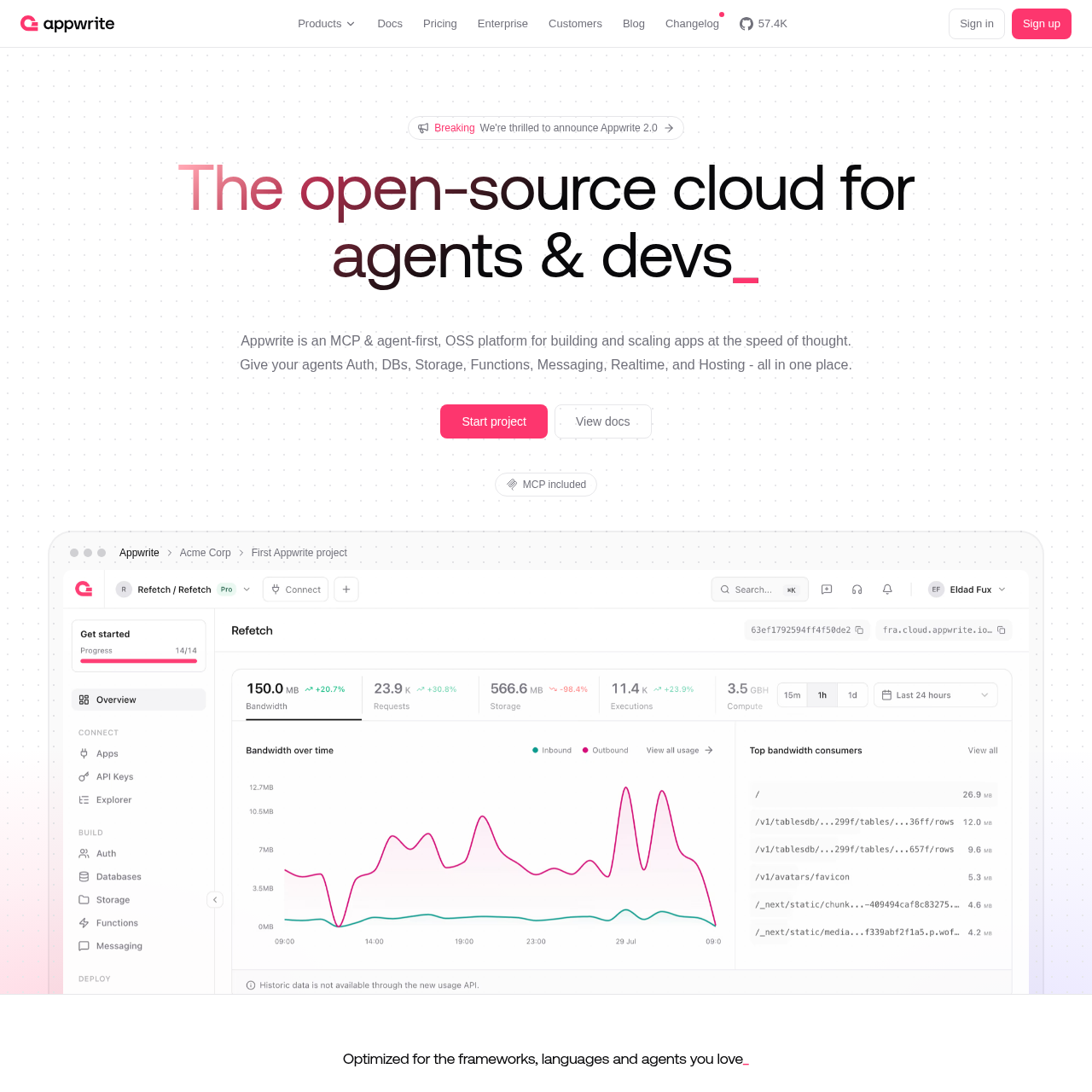
Appwrite 2.0
Appwrite 2.0 updates the platform with a coroutine engine, native PostgreSQL and MySQL support, S3 storage, and OAuth 2.1 identity capabilities.
What the product does and how it is positioned
Appwrite 2.0 represents a major architectural revision of the backend-as-a-service platform, emphasizing direct compatibility with industry-standard protocols alongside its traditional APIs.
Key platform updates include the Hyperloop B coroutine engine, native database support across PostgreSQL and MySQL, S3-compatible object storage, VectorsDB for similarity search, and an OAuth 2.1 identity provider.
Source-supported ways to use the product
Connecting external application frameworks and ORMs directly to managed PostgreSQL or MySQL databases using standard connection strings.
Managing high-dimensional vector embeddings in VectorsDB while persisting flexible application data inside schemaless JSON DocumentsDB collections.
Using an Appwrite project as an OpenID Connect and OAuth 2.1 provider to authenticate users across external web or mobile applications.
Appwrite 2.0 replaces the earlier worker process structure with Hyperloop B, a coroutine-based execution model. Under this architecture, worker processes yield execution while waiting on database queries, cache responses, or network I/O, allowing single processes to service multiple concurrent requests concurrently.
To reduce lock-in to proprietary client SDKs, Appwrite 2.0 exposes native network protocols across core subsystems. Developers can use standard database clients for PostgreSQL and MySQL, standard S3 tools for file operations, and standard OpenID Connect discovery endpoints for authentication.
Checks to run with your own material and workflow
What was checked and when
Answers based on the source-checked product record
Appwrite 2.0 supports PostgreSQL as the default for new self-hosted installations, along with MySQL, MariaDB, MongoDB, DocumentsDB, and VectorsDB.
Appwrite Storage exposes an S3-compatible API endpoint, enabling direct integration with tools like the AWS CLI, AWS SDKs, and rclone.
Hyperloop B is the coroutine engine underpinning Appwrite 2.0 that yields during I/O operations to handle concurrent requests in a single process.
Yes, Appwrite 2.0 includes an OAuth 2.1 and OpenID Connect server allowing projects to issue scoped access tokens and authenticate external apps.
No, Appwrite Firewall traffic control rules and Appwrite Domains management are currently documented as Appwrite Cloud features.