ApiFlux
Sponsored product video
See ApiFlux in motion
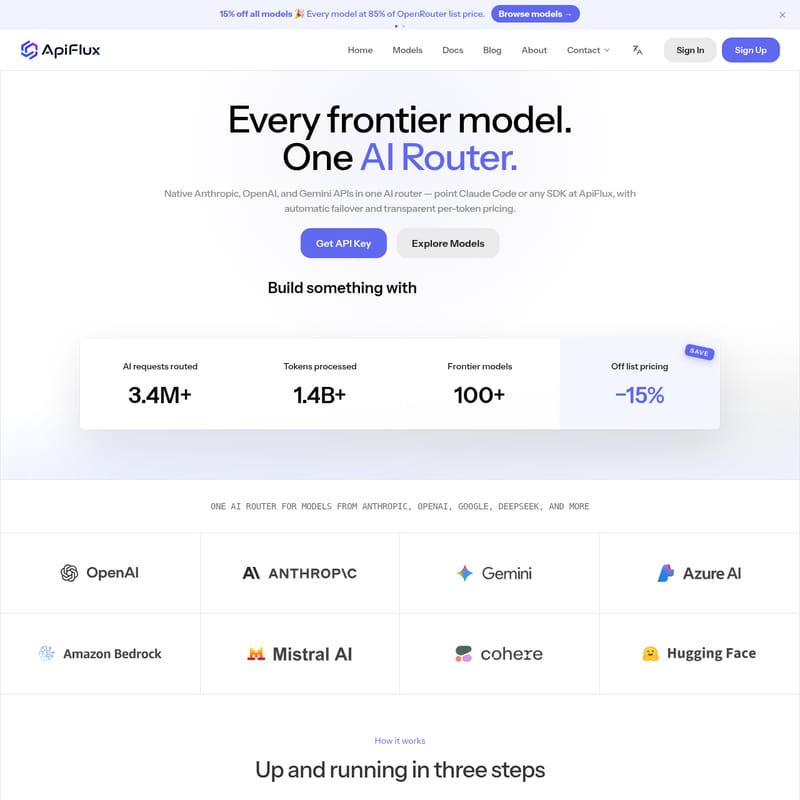
ApiFlux: Unified AI Router for Models
Access 100+ frontier models with ApiFlux. This AI router provides a single OpenAI-compatible API with automatic failover for developers.
2026-08-05
--K
Structured product information
ApiFlux: At a glance
Last checked: · Official source
Key features
100+ frontier models
Access to models from Anthropic, OpenAI, Google, DeepSeek, Kimi, and Qwen through a single endpoint.
OpenAI-compatible API
Drop-in replacement for any OpenAI SDK or client by changing the base URL.
Automatic failover
Reroutes requests to healthy paths when an upstream provider experiences degradation.
Live usage dashboard
Real-time tracking of token usage, latency, and errors for every request.
Per-key logs
Audit trails and usage limits for individual API keys within a team.
Best for
- Developers using AI coding tools like Claude Code or Codex CLI
- Production applications requiring high availability through failover
- Teams wanting to manage multiple AI providers with a single balance
- Prototyping across different model architectures
Supported platforms
- Web
- OpenAI SDK compatible environments
- Claude Code
- Codex CLI
- OpenCode
Pricing
Pricing provided in the product submission
Starting price
$10.00
Usage basedLimitations
- Requires manual base URL configuration in existing SDKs
- Dependent on upstream provider availability for specific model access
Privacy & security
- Provides per-key usage logs for auditing
- Supports per-key limits to control access
ApiFlux Product Information
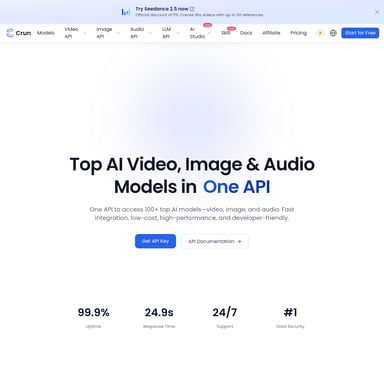
ApiFlux functions as a centralized AI Router designed to simplify how developers interact with various large language models. By providing a single access point, the platform allows users to connect to over 100 frontier models from providers such as Anthropic, OpenAI, Google, and DeepSeek. This setup eliminates the need to manage multiple individual provider accounts or API keys, offering a Unified AI API that aggregates industry-standard models into one stream.
According to provider data, ApiFlux has processed over 1.4B tokens and routed more than 3.4M AI requests. The infrastructure is built to serve as a Multi-model API, enabling developers to switch between different architectures like Claude, GPT, and Gemini without changing their underlying integration logic. This approach is used for teams that require high availability and want to avoid vendor lock-in by maintaining a flexible model layer.
Unified Model Access and OpenAI-Compatible Endpoint
The core functionality of ApiFlux revolves around its OpenAI-compatible endpoint. This feature allows developers to integrate the service into existing workflows by changing the base URL in their configuration. Because the interface mirrors the standard OpenAI SDK, it requires no code rewrite for applications already built on that framework. This compatibility extends to various development environments, making it a functional AI router for coding tools such as Claude Code, Codex CLI, and OpenCode.
By utilizing this single gateway, developers can access a wide range of models. The platform handles the translation of requests to the requirements of each upstream provider. This unified structure also facilitates model evaluation, as users can compare the performance of different models on the same prompt within a single environment.
Automatic Failover and Reliability
To maintain service continuity, ApiFlux incorporates automatic failover for AI models. When an upstream provider experiences a service degradation or outage, the router is designed to detect the failure and reroute the request to a healthy alternative path. This mechanism helps prevent application downtime and ensures that end-users do not encounter errors during provider-specific incidents.
As an LLM Gateway, the system monitors the health of connected models. If a specific model becomes unavailable or exhibits high latency, the routing logic can prioritize stable versions. This reliability feature is intended for production applications and autonomous agents that require consistent uptime across different geographic regions.
Live Usage Dashboard and Monitoring
ApiFlux provides a live usage dashboard that offers visibility into every request processed through the router. This interface displays metrics such as token usage, latency, and model health without requiring additional instrumentation from the developer. Users can monitor performance trends across different models and API keys.
For teams, the dashboard supports per-key logs and limits. This allows organizations to share a balance across multiple teammates while maintaining an audit trail of who accessed specific models and when. The transparency provided by these logs helps in managing resource allocation and identifying which models are efficient for specific tasks within a project.
Frequently asked questions
What is an AI router
An AI router is a middle layer that sits between an application and multiple AI model providers. It provides a single API endpoint that can distribute requests to various models based on availability or performance requirements. This allows developers to use one integration to access models from different companies.
How does the automatic failover work
When a request is sent to a specific model and the upstream provider returns an error or fails to respond, the router attempts to fulfill the request using a secondary healthy path. This process happens at the infrastructure level to minimize the impact on the application's performance and user experience.
Is ApiFlux compatible with existing AI coding tools
Yes, the platform is designed to work with tools that support custom OpenAI-compatible endpoints. This includes Claude Code, Codex CLI, OpenCode, and other agents. Users typically update the base URL and provide their ApiFlux API key to begin routing their coding assistant requests through the service.