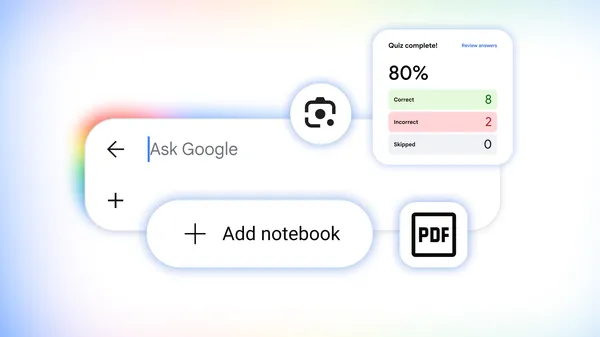
Google Integrates New AI Study Tools into Search and Gemini to Capture Student Market and Compete with OpenAI
Google has officially launched a suite of new AI-driven study tools integrated into both Google Search and its Gemini AI platform. This strategic move is specifically designed to position Gemini as the primary AI assistant for students during their learning and study processes. By enhancing these platforms with educational features, Google aims to strengthen its competitive edge against rivals like OpenAI in the rapidly evolving AI education sector. The update reflects Google's ongoing commitment to integrating advanced artificial intelligence into everyday academic workflows, providing students with more robust resources for information retrieval and comprehension. The launch marks a significant step in Google's effort to ensure its AI ecosystem remains the top choice for the next generation of learners.
Key Takeaways
- Google has launched new AI-powered study tools integrated across Google Search and the Gemini platform.
- The primary objective is to establish Gemini as the go-to AI assistant for students' educational and study needs.
- This initiative is a direct strategic response to increasing competition from AI companies like OpenAI.
- The update focuses on making learning and studying more efficient through AI-assisted features.
In-Depth Analysis
Strategic Integration Across Search and Gemini
Google's latest update represents a calculated effort to capture the student demographic by embedding specialized study tools within its most foundational and modern platforms: Google Search and Gemini. By tailoring these tools specifically for the acts of learning and studying, Google is attempting to create a seamless academic workflow that keeps users within its ecosystem. The integration into Search—a tool already synonymous with information retrieval—allows Google to bridge the gap between traditional web searching and advanced AI interaction. This suggests that Google views the educational sector as a critical battleground for AI adoption, where establishing early loyalty among students can lead to long-term platform stickiness and brand preference.
The Competitive Dynamics with OpenAI
As noted in the original report, the release of these features is explicitly framed as a response to the growing competition from OpenAI. As AI assistants become more integrated into the classroom and home study environments, the race to become the "default" assistant for the academic world has intensified. Google is leveraging its massive existing user base in Search to drive the adoption of Gemini, attempting to outpace OpenAI's ChatGPT in terms of accessibility and specialized utility for students. This competition highlights a broader shift in the AI industry where general-purpose large language models (LLMs) are being refined into specialized assistants capable of handling specific user intents, such as academic research, complex problem solving, and study support.
Positioning Gemini as the Student Assistant
The core of this launch is the transformation of Gemini from a general AI chatbot into a specialized educational companion. By focusing on the specific needs of students, Google is addressing a high-frequency use case that demands accuracy and ease of use. The goal is to make Gemini the first tool a student thinks of when they encounter a difficult concept or need to organize their study materials. This positioning is vital for Google as it seeks to maintain its dominance in the information space, ensuring that the next generation of users views Gemini, rather than competing AI models, as their primary source of knowledge and assistance.
Industry Impact
The introduction of these tools signifies a major step in the evolution of the "AI for Education" sector. As major tech giants like Google and OpenAI vie for dominance, the focus is shifting toward utility-driven AI that provides tangible value to specific user groups. For the AI industry, this move indicates that the next phase of growth will likely come from specialized applications rather than just general model improvements. Furthermore, by targeting students, Google is influencing the future of how information is consumed and processed. This move could accelerate the normalization of AI assistants in both formal and informal education, potentially changing the standard for how students interact with digital information and conduct research online. The competition between Google and OpenAI will likely continue to drive rapid innovation in educational AI, benefiting users with more sophisticated and intuitive learning tools.
Frequently Asked Questions
What is the goal of Google's new study tools?
Google's goal is to make Gemini the primary AI assistant that students turn to for learning and studying, providing them with specialized tools within Search and the Gemini platform to enhance their academic experience.
Who is Google competing with in the AI education space?
Google is primarily competing with OpenAI, as both companies strive to capture the student market and establish their respective AI platforms as the leading choice for educational assistance.
Where can students access these new AI study features?
The new features are being integrated across Google's core platforms, specifically within Google Search and the Gemini AI assistant, making them accessible during standard research and interaction workflows.