Google Announces Gemini API Managed Agents Updates Featuring 3.6 Flash and New Developer Hooks
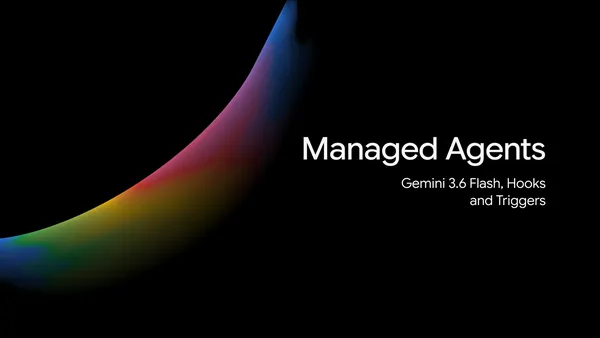
Google has unveiled significant enhancements to Managed Agents within the Gemini API, specifically introducing the 3.6 Flash model and new 'hooks' functionality. These updates are designed to provide developers with the necessary tools to build reliable, production-ready AI agents. By focusing on stability and developer control, the latest release aims to streamline the transition from experimental AI projects to robust, scalable applications. The inclusion of 3.6 Flash suggests a focus on speed and efficiency, while the introduction of hooks offers developers more granular control over agent behavior and integration. This announcement marks a pivotal step in Google's efforts to provide a comprehensive ecosystem for agentic AI development.
Key Takeaways
- Introduction of Gemini 3.6 Flash: A new model iteration integrated into Managed Agents to enhance performance and efficiency.
- New 'Hooks' Functionality: Developers now have access to hooks, allowing for better control and customization of agent workflows.
- Focus on Production Readiness: The updates specifically target the creation of reliable, production-grade AI agents.
- Enhanced Developer Tools: Google continues to expand the Gemini API ecosystem to support complex agentic architectures.
In-Depth Analysis
Advancing Managed Agents with 3.6 Flash
The announcement of Gemini 3.6 Flash within the Managed Agents framework represents a significant technical milestone for the Gemini API. By integrating the 3.6 Flash model, Google is addressing the industry's demand for high-speed, efficient AI processing within agentic workflows. Managed Agents are designed to handle complex tasks autonomously, and the inclusion of a 'Flash' designated model suggests an optimization for latency and throughput. This is critical for developers who require real-time or near-real-time responses in production environments. The transition to 3.6 Flash indicates a continuous refinement of the underlying architecture, ensuring that Managed Agents can leverage the latest advancements in model efficiency without requiring developers to overhaul their existing setups.
The Strategic Importance of Hooks
One of the most notable additions in this update is the introduction of 'hooks.' In the context of software development and AI orchestration, hooks provide a mechanism for developers to intercept or augment the standard execution flow of an agent. By providing these hooks within Managed Agents, Google is giving developers the ability to build more reliable and predictable systems. This feature allows for better integration with external services, custom validation steps, and more precise monitoring of agent actions. For production-ready agents, the ability to 'hook' into specific lifecycle events is essential for maintaining security, compliance, and operational consistency. This move signals Google's shift toward providing more 'white-box' control over what have traditionally been 'black-box' AI processes.
Building Reliable, Production-Ready Systems
The core theme of this update is the move from experimental AI to production-ready applications. Google explicitly states that these new capabilities are intended to help developers build 'reliable' agents. Reliability in the AI space often refers to the consistency of output, the ability to handle edge cases, and the stability of the infrastructure. By combining the efficiency of 3.6 Flash with the control offered by hooks, the Gemini API is positioning itself as a robust platform for enterprise-grade AI. Managed Agents simplify the overhead of managing state and context, and these new features further reduce the friction for developers looking to deploy sophisticated AI agents at scale.
Industry Impact
The expansion of Managed Agents in the Gemini API has several implications for the broader AI industry. First, it intensifies the competition among major cloud providers to offer the most developer-friendly agent orchestration platform. By focusing on 'production-ready' features, Google is directly targeting enterprise developers who need more than just a raw LLM; they need a managed environment that handles the complexities of agent behavior.
Second, the introduction of versioned models like 3.6 Flash within the agent framework suggests a rapid iteration cycle that could become the new standard for AI services. As developers grow accustomed to these managed services, the barrier to entry for creating complex AI agents will continue to lower, potentially leading to a surge in autonomous AI applications across various sectors, including customer service, software development, and data analysis. Finally, the emphasis on hooks and reliability reflects a maturing industry that is moving past the 'hype' phase and into a phase focused on practical, dependable utility.
Frequently Asked Questions
Question: What is the primary goal of the new updates to Managed Agents in the Gemini API?
The primary goal is to enable developers to build reliable, production-ready AI agents. By introducing features like the 3.6 Flash model and hooks, Google is providing the tools necessary for creating stable and efficient agentic workflows that can be deployed in professional environments.
Question: What are 'hooks' in the context of Gemini Managed Agents?
Hooks are new capabilities that allow developers to better control and customize the behavior of their agents. They provide a way to integrate custom logic or external checks into the agent's execution process, which is vital for ensuring reliability and consistency in production applications.
Question: How does the 3.6 Flash model benefit developers using the Gemini API?
While specific technical benchmarks were not detailed in the brief announcement, the 'Flash' designation typically refers to models optimized for speed and efficiency. Integrating 3.6 Flash into Managed Agents allows developers to build agents that respond faster and handle higher volumes of tasks more effectively, which is a key requirement for production-grade software.