Meituan LongCat Team Unveils WBench: The First Systematic Multi-Round Benchmark for Interactive Video World Models
Meituan's LongCat team has officially introduced and open-sourced WBench, a pioneering evaluation benchmark designed to test the limits of interactive video world models. Functioning as a diagnostic "CT scanner," WBench provides a systematic framework for multi-round assessments, specifically targeting the transition of AI from passive observation to active interaction. By identifying the technical bottlenecks that prevent models from effectively engaging with dynamic environments—ranging from lunar landscapes to cybernetic cities—WBench offers a critical tool for the AI community. This benchmark marks a significant milestone in standardizing how researchers measure the interactive capabilities of world models, ensuring a clearer path toward more responsive and realistic AI-driven simulations.
Key Takeaways
- Introduction of WBench: Meituan's LongCat team has developed and open-sourced the first systematic multi-round evaluation benchmark for interactive video world models.
- Diagnostic Capability: The benchmark acts as a "CT scanner," providing precise diagnostics to identify where world models struggle during the transition from passive viewing to active interaction.
- Focus on Interaction: Unlike traditional benchmarks, WBench emphasizes multi-round interactivity, testing how models respond to sequential inputs and environmental changes.
- Open-Source Contribution: By making WBench open-source, the LongCat team provides the global AI community with a standardized tool to measure and improve world model boundaries.
In-Depth Analysis
The "CT Scanner" for Artificial Intelligence
The LongCat team from Meituan has introduced a metaphorical "CT scanner" for the AI industry with the release of WBench. In the rapidly evolving field of world models, understanding the internal limitations of a system is often as difficult as building the system itself. WBench addresses this by providing a high-resolution diagnostic tool that can "scan" a model's performance across various scenarios. By applying this systematic evaluation, developers can pinpoint exactly where a model fails to maintain consistency or logic when moving beyond simple video generation. This diagnostic approach is essential for moving past the "black box" nature of large-scale models, allowing for targeted improvements in how AI perceives and reacts to simulated physical laws and interactive prompts.
Bridging the Gap: From Passive Viewing to Active Interaction
One of the most significant hurdles in current AI research is the shift from "passive" models—those that merely generate or observe content—to "active" world models that can interact with users or environments in real-time. WBench is specifically designed to measure this boundary. The benchmark evaluates how a model handles multi-round interactions, which is a departure from single-turn generation tasks. In a multi-round scenario, the model must not only understand the initial state but also maintain a coherent "world state" as new interactions are introduced. Whether the simulation involves a walk on the moon or navigating a cybernetic city, WBench tests if the model can sustain the logic of the environment over time. This focus on the "active" component is what distinguishes WBench from previous benchmarks that focused primarily on visual fidelity or single-frame accuracy.
Systematic Multi-Round Evaluation Framework
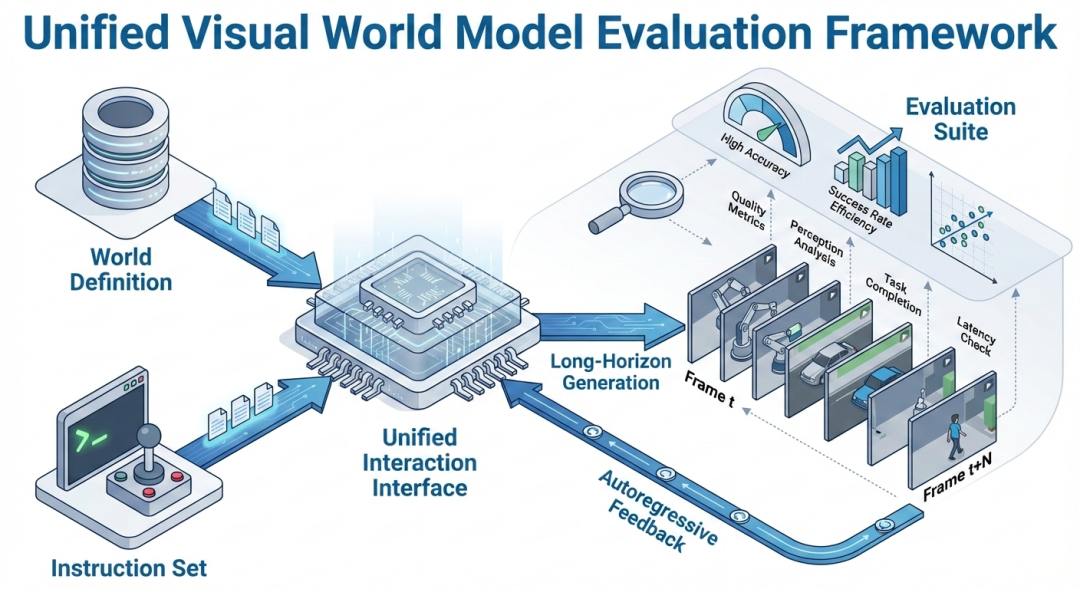
The complexity of a world model lies in its ability to handle sequential logic. WBench introduces a systematic framework that subjects models to multiple rounds of testing, simulating a continuous stream of interactions. This methodology is crucial because many models that appear performant in short, single-burst tasks often degrade when faced with the cumulative complexity of a multi-turn dialogue or interaction. By standardizing these multi-round tests, the LongCat team ensures that the evaluation of a world model is not just a snapshot of its capabilities but a comprehensive stress test of its underlying architecture. This systematic approach allows for a more rigorous comparison between different modeling techniques and helps the industry define what a "successful" interactive world model truly looks like.
Industry Impact
The release of WBench by Meituan's LongCat team is poised to have a significant impact on the AI industry, particularly in the development of autonomous systems, gaming, and simulation technologies. By providing the first systematic benchmark for interactive video world models, WBench fills a critical void in the current evaluation landscape.
Firstly, it establishes a common language and set of metrics for "interactivity," which has previously been a subjective or loosely defined term in AI research. This standardization will likely accelerate the development cycle for world models, as researchers can now use WBench to validate their progress against a recognized baseline.
Secondly, the open-source nature of WBench democratizes access to high-level diagnostic tools. Smaller research teams and independent developers can now evaluate their models with the same rigor as major tech firms, fostering a more competitive and innovative ecosystem. As AI continues to move toward more immersive and interactive applications, tools like WBench will be fundamental in ensuring these models are not only visually impressive but also functionally robust and logically consistent.
Frequently Asked Questions
Question: What is WBench and who developed it?
WBench is the first systematic multi-round evaluation benchmark specifically designed for interactive video world models. It was developed and open-sourced by the LongCat team at Meituan.
Question: Why is the "CT scanner" metaphor used to describe WBench?
The metaphor is used because WBench is designed to perform a deep, precise diagnostic of world models. Much like a medical CT scanner identifies internal issues in a patient, WBench identifies the specific technical bottlenecks and failure points in an AI model as it attempts to transition from passive observation to active interaction.
Question: What makes WBench different from other AI benchmarks?
WBench is unique because it focuses on "multi-round" interaction rather than single-turn tasks. It evaluates how a world model maintains consistency and logic over a series of interactions, which is a critical requirement for creating truly interactive and responsive AI environments.