LongCat Open-Sources VitaBench 2.0: A New Benchmark for Long-Term Dynamic AI Agent Modeling
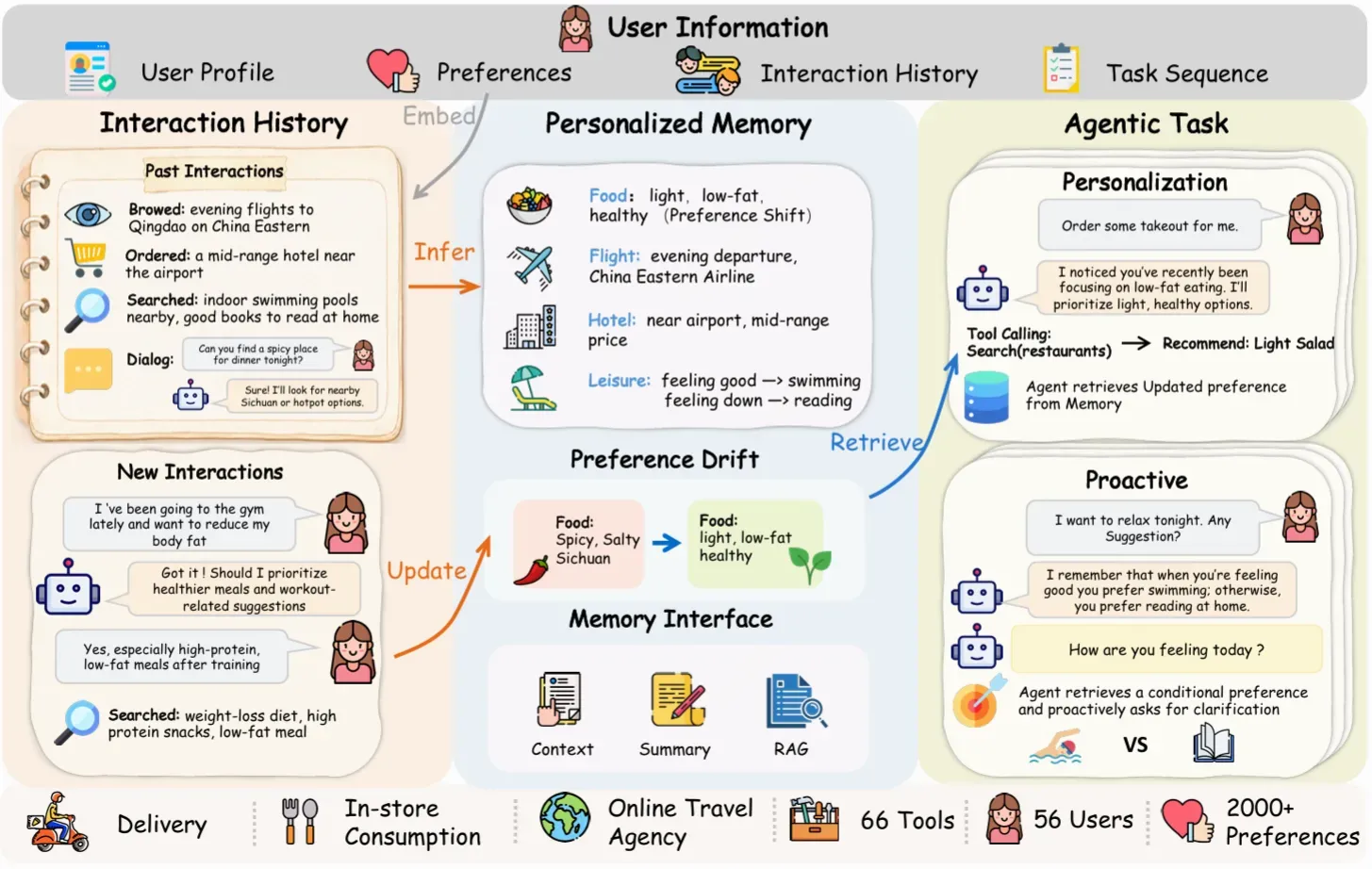
The Meituan technical team, under the LongCat project, has officially open-sourced VitaBench 2.0. This release marks the introduction of the first evaluation benchmark specifically designed for real-life scenarios involving long-term dynamic user modeling. VitaBench 2.0 aims to fill a critical gap in the industry by providing a systematic framework to assess how Large Language Models (LLMs) handle personalization and proactivity during extended, evolving interactions with users. By focusing on the complexities of real-world dynamics, the benchmark shifts the focus from static task completion to the sustained intelligence required for sophisticated AI agents to function effectively in daily life applications.
Key Takeaways
- Pioneering Benchmark: VitaBench 2.0 is identified as the first benchmark to focus on long-term dynamic user modeling within real-life scenarios.
- Focus on Personalization: The framework provides a systematic method for evaluating how well Large Language Models can maintain and adapt personalized interactions over time.
- Proactivity Assessment: A core component of the benchmark is measuring the 'proactivity' of AI agents, moving beyond simple reactive command-following.
- Real-World Dynamics: Unlike static datasets, VitaBench 2.0 emphasizes the importance of 'dynamic' user interactions, reflecting the changing nature of human needs and environments.
In-Depth Analysis
Redefining Agent Evaluation through Long-Term Dynamics
The release of VitaBench 2.0 by the LongCat team represents a significant shift in how the AI industry approaches the evaluation of Large Language Models (LLMs). Traditionally, benchmarks have focused on short-term accuracy, logic, or specific knowledge retrieval. However, as AI agents move into roles as personal assistants and long-term collaborators, the industry requires a way to measure performance over extended periods. VitaBench 2.0 addresses this by introducing the concept of "long-term dynamic user modeling."
This approach recognizes that user behavior is not static. In real-life scenarios, a user's preferences, context, and requirements evolve. A benchmark that only tests a single interaction fails to capture whether an agent can remember past preferences or adapt to new information provided days or weeks later. By focusing on "long-term" interactions, VitaBench 2.0 challenges LLMs to maintain a consistent yet flexible understanding of the user, which is essential for any AI intended for integrated daily use.
The Pillars of Modern Agents: Personalization and Proactivity
According to the Meituan technical team, VitaBench 2.0 is built to systematically evaluate two critical capabilities: personalization and proactivity. These two pillars are what distinguish a basic chatbot from a sophisticated AI agent.
Personalization in the context of VitaBench 2.0 is not just about knowing a user's name; it is about the model's ability to model the user's unique patterns and needs dynamically. As the interaction progresses, the model must demonstrate that it can tailor its responses and actions based on the accumulated history of the user. This requires high-level reasoning and memory management within the LLM architecture.
Proactivity, the second pillar, evaluates the agent's ability to take initiative. In a real-life dynamic setting, an effective agent should not always wait for a direct prompt. It should be able to anticipate user needs or suggest actions based on the evolving context of the "long-term" relationship. VitaBench 2.0 provides the first structured environment to measure these specific traits, which are often the most difficult to quantify in traditional AI testing environments.
Industry Impact
The introduction of VitaBench 2.0 is poised to influence the AI industry by setting a new standard for "agentic" behavior. As developers strive to create AI that can handle real-world complexity, the availability of an open-source benchmark focused on dynamic modeling provides a necessary North Star.
By prioritizing real-life scenarios, the benchmark encourages the development of models that are more robust and reliable in unpredictable human environments. Furthermore, by making this benchmark open-source, the LongCat team allows the broader research community to align on what constitutes a "personalized" and "proactive" agent. This standardization is crucial for the transition from experimental LLMs to consumer-ready AI agents that can truly understand and anticipate user behavior over the long term.
Frequently Asked Questions
Question: What makes VitaBench 2.0 different from other AI benchmarks?
VitaBench 2.0 is the first benchmark to specifically target long-term dynamic user modeling in real-life scenarios. While most benchmarks test static knowledge or short-term logic, VitaBench 2.0 evaluates how an AI agent evolves its understanding of a user over a long period of interaction.
Question: Why are personalization and proactivity emphasized in this benchmark?
These two factors are essential for creating AI agents that feel like true assistants rather than just search engines. Personalization ensures the AI understands the specific user context, while proactivity measures the AI's ability to take helpful actions without being explicitly told to do so at every step.
Question: Who developed VitaBench 2.0 and is it accessible?
VitaBench 2.0 was developed by the Meituan technical team under the LongCat project. It has been open-sourced to provide the industry with a systematic way to evaluate and improve the long-term interaction capabilities of Large Language Models.