Meituan LongCat Team Unveils WBench: The First Systematic Multi-Round Benchmark for Interactive Video World Models
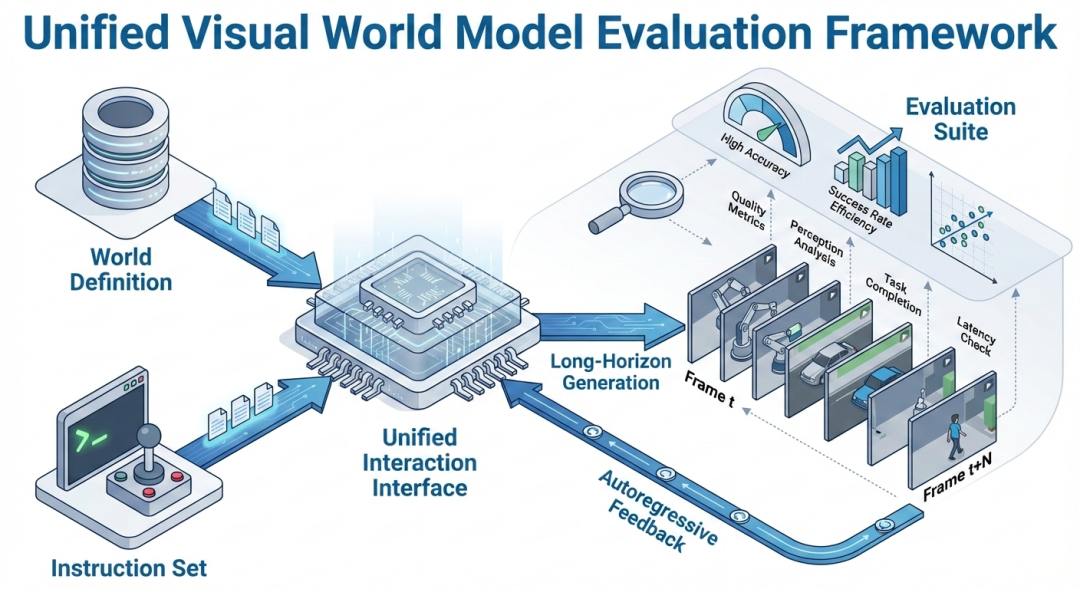
The Meituan LongCat team has officially introduced and open-sourced WBench, a groundbreaking evaluation framework designed to assess the capabilities of interactive video world models. As the first systematic multi-round benchmark of its kind, WBench serves as a diagnostic tool—likened to a 'CT scanner'—that identifies the specific limitations and bottlenecks of current AI models. The benchmark focuses on the critical transition from 'passive viewing' to 'active interaction,' providing a structured way to measure how world models handle complex, multi-stage interactive scenarios. By open-sourcing this tool, the LongCat team aims to provide the research community with a standardized method to explore the boundaries of world models, ranging from lunar walks to cybernetic urban environments.
Key Takeaways
- Pioneering Benchmark: WBench is the first systematic, multi-round evaluation benchmark specifically designed for interactive video world models.
- Open-Source Contribution: Developed by Meituan's LongCat team, the tool has been made open-source to facilitate broader industry research and development.
- Diagnostic Precision: The framework acts as a 'CT scanner' for AI, pinpointing exactly where models fail during the transition from passive observation to active interaction.
- Focus on Interaction: WBench addresses the gap in current evaluations by focusing on multi-round, interactive capabilities rather than static or single-shot video generation.
In-Depth Analysis
The Evolution from Passive Viewing to Active Interaction
In the current landscape of artificial intelligence, world models have primarily been evaluated on their ability to generate or predict video sequences based on static prompts—a process often described as 'passive viewing.' However, the next frontier for AI involves 'active interaction,' where the model must respond dynamically to inputs and maintain consistency across multiple rounds of engagement. The Meituan LongCat team identified a significant gap in how these interactive capabilities are measured.
WBench was developed to bridge this gap. By providing a systematic framework, it allows researchers to observe how a model maintains its internal logic and environmental consistency when subjected to interactive prompts. This transition is crucial for the development of more sophisticated AI applications, such as autonomous systems and immersive virtual environments, where the agent must not only see the world but also interact with it in a predictable and physically accurate manner.
WBench as a 'CT Scanner' for World Models
The LongCat team describes WBench as a 'CT scanner' for the AI industry. This analogy highlights the benchmark's ability to look beneath the surface of a model's output to identify underlying structural weaknesses. Traditional benchmarks might only indicate that a model has failed, but WBench is designed to 'diagnose' the specific point of failure within the multi-round interaction process.
Whether the model struggles with spatial consistency, temporal logic, or the physics of interaction, WBench provides the granular data necessary for developers to understand the 'boundaries' of their world models. This diagnostic capability is essential for iterating on complex architectures that aim to simulate diverse environments, from the low-gravity physics of a 'moonwalk' to the dense, high-complexity data of a 'cybernetic city.' By identifying exactly where a model 'gets stuck,' WBench enables more targeted improvements in model training and architecture design.
Industry Impact
The introduction of WBench marks a significant milestone in the standardization of world model evaluation. As the industry moves toward more interactive and agentic AI, the lack of a systematic benchmark has been a hurdle for comparing different approaches and measuring progress. By open-sourcing WBench, Meituan's LongCat team provides a common language and set of metrics for the global AI community.
This tool is likely to accelerate the development of interactive video technologies. By exposing the current boundaries of world models, it challenges researchers to solve the specific bottlenecks identified by the benchmark. Furthermore, the focus on multi-round interaction sets a new standard for what constitutes a 'capable' world model, moving the goalposts from simple video synthesis to complex, interactive environmental simulation. This has far-reaching implications for fields such as robotics, gaming, and professional simulation training.
Frequently Asked Questions
Question: What makes WBench different from existing video evaluation benchmarks?
Unlike traditional benchmarks that focus on single-shot video generation or passive prediction, WBench is the first to offer a systematic, multi-round evaluation specifically for interactive capabilities. It measures how a model handles continuous interaction over time, rather than just a single output.
Question: Who can benefit from the open-sourcing of WBench?
AI researchers, developers of world models, and companies working on interactive AI applications (such as autonomous driving or virtual reality) can use WBench to diagnose the limitations of their models and benchmark their performance against industry standards.
Question: Why is the 'multi-round' aspect of WBench so important?
Multi-round evaluation is critical because it tests a model's ability to maintain consistency and logic over a sequence of interactions. In real-world scenarios, AI must be able to handle ongoing feedback and changes, and WBench provides the first systematic way to measure this specific skill set.