Meituan LongCat Team Unveils WBench: The First Systematic Multi-Round Benchmark for Interactive Video World Models
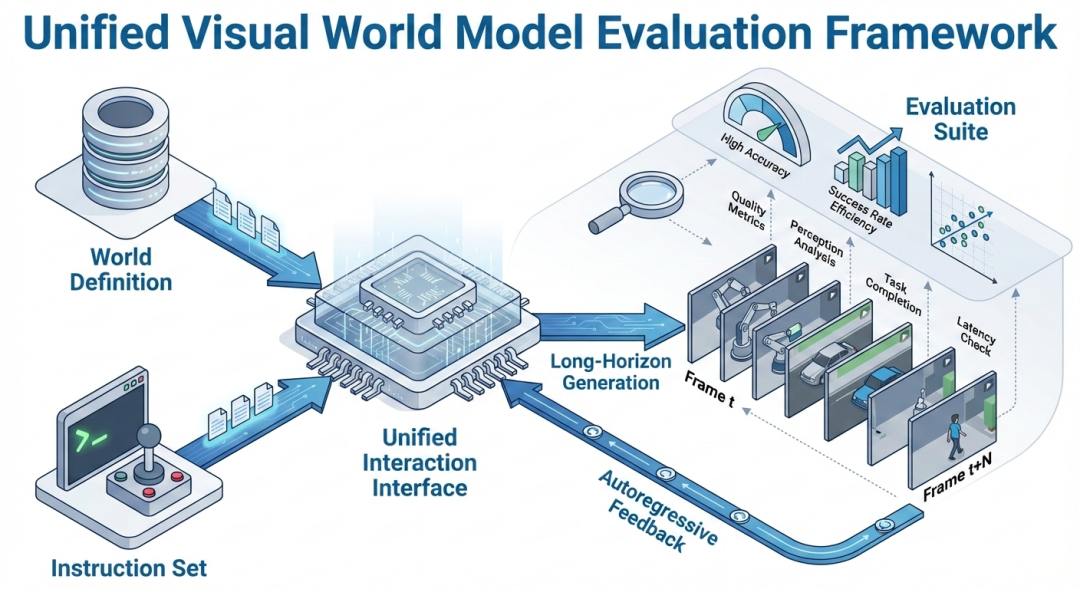
The Meituan LongCat team has officially introduced and open-sourced WBench, a pioneering evaluation benchmark designed specifically for interactive video world models. As the first systematic multi-round assessment tool of its kind, WBench serves as a diagnostic 'CT scanner' for the AI industry. It is engineered to precisely identify the technical bottlenecks that occur when world models attempt to transition from 'passive viewing'—simply generating or observing video—to 'active interaction,' where the model must respond to dynamic inputs over multiple stages. By testing these models across diverse environments, ranging from lunar walks to cybernetic cities, WBench provides the necessary framework to define the current boundaries of world model capabilities and highlights where the technology currently struggles in maintaining consistency during complex, interactive sequences.
Key Takeaways
- Pioneering Benchmark: Meituan's LongCat team has launched WBench, the first systematic multi-round evaluation benchmark for interactive video world models.
- Open Source Contribution: The tool has been open-sourced to provide the global AI community with a standardized method for testing world model boundaries.
- Diagnostic Precision: Described as a "CT scanner," WBench is designed to pinpoint exactly where models fail during the transition from passive observation to active interaction.
- Focus on Interaction: Unlike traditional benchmarks, WBench emphasizes multi-round interactions, testing how models handle sequential changes in environments like lunar landscapes and futuristic cities.
In-Depth Analysis
Bridging the Gap Between Passive Viewing and Active Interaction
The development of world models has reached a critical juncture where the ability to generate high-quality video is no longer the sole metric of success. The Meituan LongCat team identifies a significant hurdle in the current AI landscape: the transition from "passive viewing" to "active interaction." In a passive context, a world model might generate a seamless video of a lunar walk or a bustling cyber city. However, the complexity increases exponentially when that model is required to interact with a user or an external agent over multiple rounds.
WBench is specifically designed to address this gap. By focusing on interactive video world models, the benchmark evaluates how well an AI can maintain spatial, temporal, and logical consistency when subjected to dynamic inputs. The "CT scanner" metaphor used by the Meituan team is particularly apt; it suggests that WBench does not merely provide a surface-level score but performs a deep diagnostic of the model's internal logic and its ability to sustain a coherent "world" across sequential interactions. This level of scrutiny is essential for moving beyond simple video synthesis toward truly immersive and responsive digital environments.
The Significance of Systematic Multi-Round Evaluation
One of the most innovative aspects of WBench is its emphasis on "multi-round" evaluation. Most existing benchmarks for video generation focus on single-turn outputs—where a prompt leads to a single video clip. However, a true "world model" must be able to function as a continuous environment. WBench introduces a systematic approach to testing these models over several iterations of interaction. This multi-round structure exposes weaknesses that might not be visible in a single-shot generation, such as cumulative errors, loss of environmental state, or the inability to process feedback loops.
By testing models in scenarios ranging from the low-gravity environment of a "moonwalk" to the dense, high-information setting of a "cyber city," WBench pushes the boundaries of what these models can represent. The benchmark provides a structured way to measure how a model's understanding of physics, object permanence, and cause-and-effect holds up when a user intervenes. This systematic evaluation is crucial for developers who need to know exactly where their models "get stuck"—whether it is a failure in long-term memory, a breakdown in physical simulation, or an inability to map interactive commands to visual changes.
Industry Impact
The release of WBench by Meituan's LongCat team is likely to have a profound impact on the AI research community. By open-sourcing the benchmark, Meituan is providing a much-needed standard for a rapidly evolving field. As world models become more central to the development of autonomous systems, robotics, and immersive simulations, having a common "CT scanner" to diagnose performance will accelerate the pace of innovation.
Furthermore, WBench sets a new bar for what constitutes a "world model." It shifts the industry focus from mere visual fidelity to functional interactivity. This transition is vital for the practical application of AI in fields like virtual reality, gaming, and even industrial digital twins, where the ability to interact with a simulated world is just as important as the world's appearance. WBench provides the roadmap for identifying and overcoming the current limitations of these models, paving the way for the next generation of interactive AI.
Frequently Asked Questions
Question: What makes WBench different from other AI video benchmarks?
Unlike traditional benchmarks that focus on the quality of a single generated video, WBench is the first to provide a systematic, multi-round evaluation specifically for interactive world models. It measures how well a model can handle ongoing interactions and maintain consistency over time, rather than just producing a one-off visual output.
Question: Why does the Meituan team refer to WBench as a "CT scanner"?
The team uses this metaphor because WBench is designed to perform a deep, precise diagnostic of a world model's capabilities. It doesn't just give a pass/fail grade; it identifies the specific technical "bottlenecks" or areas where the model's logic breaks down during the transition from observing a scene to interacting with it.
Question: What kind of scenarios does WBench use for testing?
WBench tests models across a variety of complex environments, including "lunar walks" and "cyber cities." These scenarios are chosen to challenge the model's ability to simulate different physical laws and high-density urban environments under the pressure of multi-round user interaction.