Scaling Past Informal AI: Carina Hong and the Evolution of Verified Generation at Axiom Math
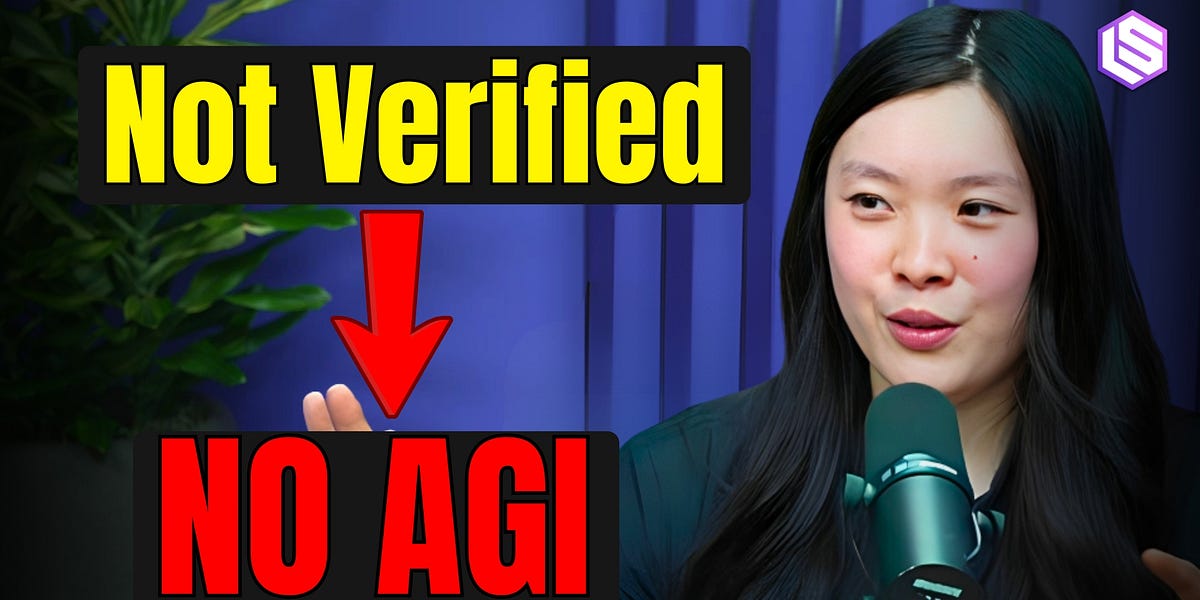
This analysis explores the transition from informal artificial intelligence to structured, verified systems as discussed by Carina Hong of Axiom Math. The core focus lies on the shift toward 'Verified Generation' and the development of 'Compounding Intelligence.' By moving beyond the probabilistic nature of current informal AI models, Axiom Math aims to establish a framework where mathematical reasoning is not only generated but rigorously verified. This approach addresses the limitations of existing large language models in high-stakes reasoning tasks. The concept of compounding intelligence suggests a trajectory where AI systems build upon verified truths to reach higher levels of cognitive capability, marking a significant departure from traditional scaling laws that rely primarily on data volume and compute power.
Key Takeaways
- Transition to Formalism: The industry is moving from 'informal AI'—characterized by probabilistic outputs—toward systems capable of verified generation.
- Verified Generation: A critical methodology focused on ensuring the accuracy and provability of AI-generated content, particularly in mathematics.
- Compounding Intelligence: The strategic development of AI systems that utilize verified outputs to iteratively build more complex and reliable intelligence.
- Axiom Math's Vision: Under the leadership of Carina Hong, Axiom Math is positioning itself at the forefront of this shift, focusing on scaling reasoning capabilities through formal verification.
In-Depth Analysis
The Shift from Informal AI to Verified Systems
The current landscape of artificial intelligence is largely dominated by 'informal AI.' These systems, primarily large language models (LLMs), operate on statistical probabilities to predict the next token in a sequence. While highly effective for creative writing and general conversation, this 'informal' nature often leads to hallucinations and logical inconsistencies when applied to rigorous fields like mathematics. Scaling past informal AI requires a fundamental change in how models are trained and how they process information. Instead of merely mimicking human-like patterns, the next generation of AI must adhere to formal logic and verifiable structures. Carina Hong and the team at Axiom Math are addressing this by prioritizing 'Verified Generation,' a process where every step of an AI's reasoning can be checked against established mathematical axioms.
The Mechanics of Verified Generation
Verified Generation represents a paradigm shift in AI development. In traditional generative models, the output is the final product, and its correctness is often judged post-hoc by human users. In a verified system, the generation process itself is integrated with verification tools. This ensures that the AI does not just produce an answer that looks correct but one that is mathematically sound. By implementing these rigorous checks, Axiom Math is creating a foundation for AI that can be trusted in scientific and engineering applications where the margin for error is zero. This methodology effectively bridges the gap between neural network-based intuition and symbolic logic-based precision, allowing for a more robust scaling of intelligence that is not limited by the noise inherent in informal datasets.
Understanding Compounding Intelligence
One of the most compelling concepts introduced in this context is 'Compounding Intelligence.' In the realm of informal AI, scaling is often linear or sub-linear relative to the amount of data ingested. However, by focusing on verified generation, Axiom Math suggests a path toward exponential growth in capability. Compounding intelligence occurs when an AI system uses its own verified outputs as building blocks for more complex reasoning. Because these building blocks are verified and error-free, the system can layer complexity without the risk of 'error compounding' that plagues informal models. This creates a virtuous cycle where the AI's ability to solve complex problems grows as it establishes a larger library of verified mathematical truths, leading to a form of intelligence that is both deeper and more reliable than current scaling methods allow.
Industry Impact
The move toward verified generation and compounding intelligence has profound implications for the AI industry, particularly in STEM (Science, Technology, Engineering, and Mathematics) fields. As AI moves beyond informal reasoning, we can expect a surge in the utility of these tools for formal verification of software, complex architectural modeling, and advanced theoretical research. Axiom Math’s focus on these areas signals a broader industry trend where 'correctness' is becoming as valuable as 'creativity.' For enterprises and researchers, this means a shift in focus from simply increasing model size to improving the architectural integrity and verification layers of AI systems. This evolution is likely to redefine the benchmarks for AI performance, moving them away from human-like fluency and toward mathematical and logical perfection.
Frequently Asked Questions
Question: What is the primary difference between informal AI and verified generation?
Informal AI relies on probabilistic patterns and statistical likelihood to generate responses, which can lead to errors in logic. Verified generation, as pursued by Axiom Math, integrates formal verification processes to ensure that every step of the AI's reasoning is mathematically or logically sound and provable.
Question: How does compounding intelligence differ from traditional AI scaling?
Traditional scaling typically involves increasing parameters, data, and compute to improve performance. Compounding intelligence focuses on the iterative building of knowledge where the AI uses previously verified, error-free outputs to tackle more complex tasks, allowing for a more reliable and potentially exponential increase in reasoning capability.
Question: Why is Axiom Math focusing specifically on mathematical reasoning?
Mathematics provides a unique environment where truths are absolute and can be formally verified. By solving for 'Verified Generation' in mathematics, Axiom Math creates a blueprint for high-fidelity reasoning that can eventually be applied to other fields requiring rigorous logical consistency.