Zerostack: A Unix-Inspired Coding Agent Developed in Pure Rust
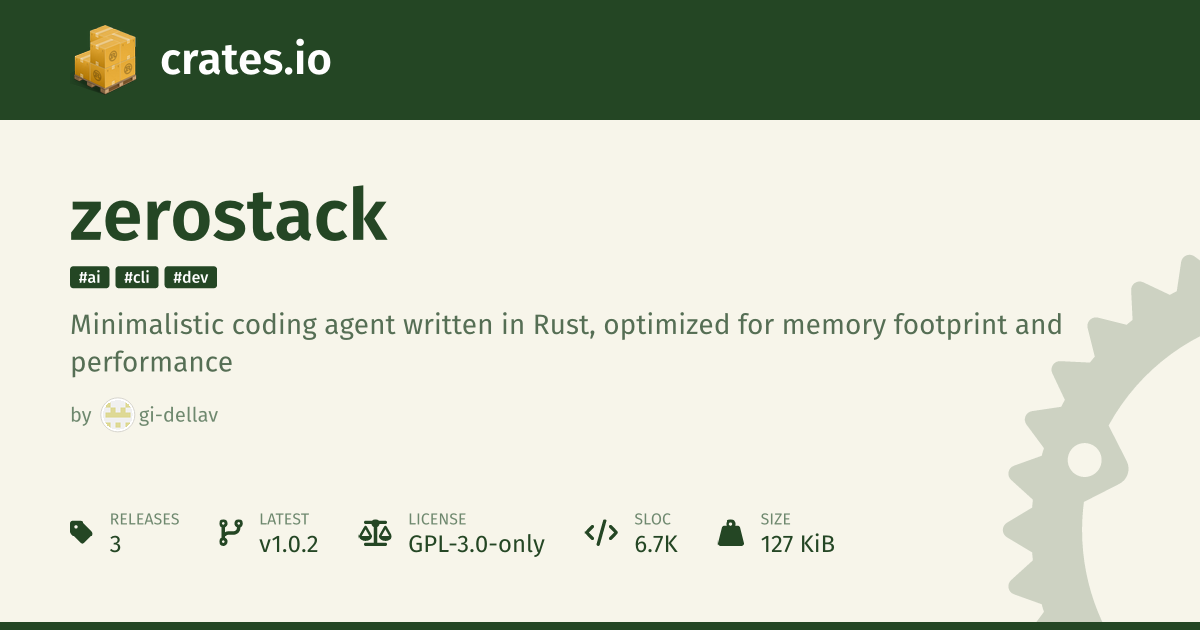
Zerostack is a newly released coding agent written entirely in the Rust programming language. Drawing inspiration from Unix principles, this tool has been published as a package on crates.io, the official Rust package registry. As of its version 1.0.0 release, Zerostack represents a specialized approach to AI-driven development, focusing on the performance and safety characteristics inherent to Rust. While detailed documentation within the registry listing is currently minimal, the project positions itself as a Unix-inspired solution for developers seeking a native Rust coding assistant. The release marks a significant milestone for the Rust ecosystem, providing a systems-level alternative to existing AI development tools.
Key Takeaways
- Pure Rust Implementation: Zerostack is built entirely in Rust, prioritizing memory safety and high performance.
- Unix-Inspired Philosophy: The agent follows Unix design principles, emphasizing modularity, simplicity, and composability.
- Official Registry Release: The project has reached version 1.0.0 and is available on the official Rust package registry, crates.io.
- Developer-Centric Tooling: It is positioned as a specialized coding agent designed for integration into modern development workflows.
In-Depth Analysis
The Significance of Pure Rust in AI Tooling
The announcement of Zerostack as a "pure Rust" coding agent is a notable development in the AI tooling landscape. By utilizing Rust, the developers of Zerostack are leveraging a language known for its strict memory safety guarantees and high-performance capabilities. In the realm of coding agents, where processing large codebases and executing complex logic is required, the choice of Rust can lead to significant efficiency gains over agents written in interpreted languages.
The "pure Rust" designation further implies that the tool avoids heavy dependencies on external runtimes, potentially offering a more streamlined and secure installation process via the crates.io registry. This approach aligns with the growing demand for tools that are not only intelligent but also architecturally robust. By avoiding non-Rust dependencies, Zerostack ensures that it can run with the speed and safety that systems-level developers expect, making it a potentially attractive option for those working in performance-critical environments.
Unix Principles Applied to Modern Coding Agents
Zerostack identifies as "Unix-inspired," a descriptor that suggests a specific architectural approach rooted in decades of software engineering wisdom. In software design, Unix-inspired tools typically adhere to the philosophy of creating small, modular components that can be composed to perform complex tasks. For a coding agent, this might manifest as a focus on command-line interfaces, pipe-ability, and a lack of unnecessary graphical bloat.
This approach stands in contrast to many modern, monolithic AI assistants that require extensive setup or heavy graphical interfaces. Instead, a Unix-inspired agent like Zerostack likely prioritizes being a "good citizen" in the terminal, allowing developers to pipe code into the agent or use its output in other scripts. The version 1.0.0 release on crates.io marks the formal introduction of this philosophy to the Rust community, providing a foundation for further development and community contribution. By focusing on doing one thing well—assisting with code—Zerostack follows the classic Unix mantra that has defined successful developer tools for generations.
The Role of crates.io in Project Accessibility
By hosting Zerostack on crates.io, the developers have ensured that the tool is easily accessible to the global Rust community. Crates.io serves as the central hub for Rust libraries and tools, providing a standardized way to manage versions and dependencies. The release of version 1.0.0 is a symbolic milestone, often indicating that the project has reached a level of stability suitable for public use. For a coding agent, being part of the Rust registry means it can be easily installed using standard Rust tooling, further lowering the barrier to entry for developers who are already working within the Rust ecosystem.
Industry Impact
The introduction of Zerostack represents a broader shift toward high-performance, language-native AI agents. As developers increasingly rely on AI to assist with coding tasks, the demand for tools that are not only intelligent but also fast and reliable grows. By building in Rust and following Unix principles, Zerostack addresses a niche of developers who prioritize system efficiency and modular design. This release may encourage further development of specialized AI agents within the Rust ecosystem, potentially challenging the dominance of more generalized, resource-heavy AI platforms. Furthermore, it highlights the increasing maturity of the Rust ecosystem as a viable environment for building complex AI-driven applications.
Frequently Asked Questions
Question: What is the primary purpose of Zerostack?
Answer: Zerostack is designed as a coding agent that assists developers with programming tasks, utilizing a Unix-inspired design and written entirely in the Rust programming language.
Question: Where can I find the Zerostack package?
Answer: Zerostack is hosted on crates.io, the official package registry for the Rust programming language, under version 1.0.0.
Question: Why is the "Unix-inspired" label important for this tool?
Answer: It suggests that the tool is built with modularity, simplicity, and composability in mind, adhering to long-standing software design principles that favor efficient, specialized tools that work well within a terminal-based workflow.