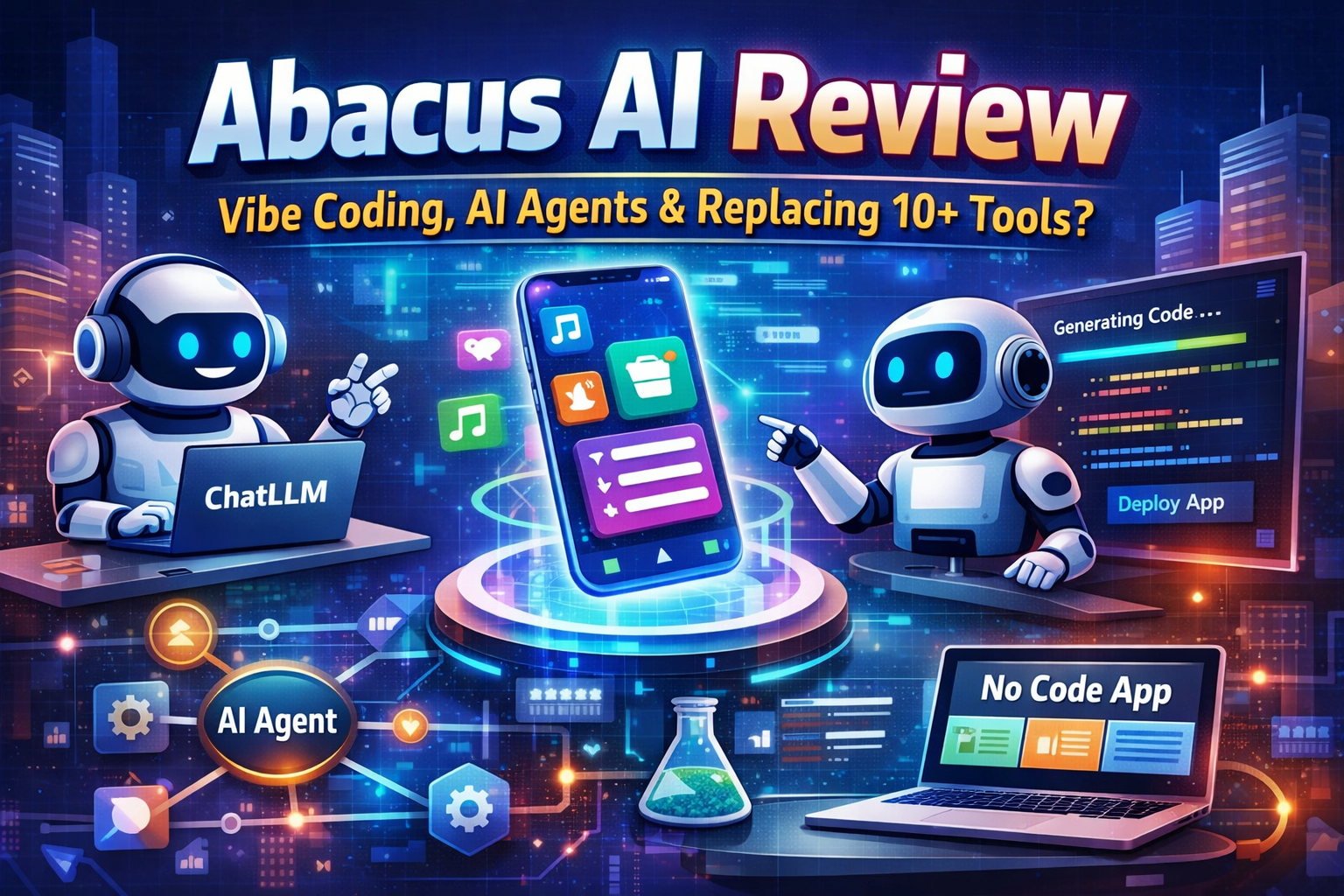
Abacus AI Review: Exploring Vibe Coding, DeepAgent, and Workflow Automation Features
This comprehensive review of Abacus AI examines the platform's core capabilities, focusing on its innovative 'vibe coding' approach and the DeepAgent framework. As an AI agent platform designed to streamline development, Abacus AI aims to help users build applications and automate complex workflows with increased speed. The review highlights how the platform potentially replaces multiple tools by consolidating features for agent creation and workflow management. By providing a detailed look at its features and pricing structure, the analysis explores how Abacus AI positions itself as a versatile solution for developers and businesses looking to leverage advanced AI agents in their operational processes.
Key Takeaways
- Vibe Coding Integration: Abacus AI introduces 'vibe coding' features to simplify the application development process.
- DeepAgent Framework: The platform utilizes DeepAgent technology to facilitate the creation of sophisticated AI agents.
- Workflow Automation: A primary focus of the platform is helping users automate workflows faster than traditional methods.
- Tool Consolidation: Abacus AI is positioned as a comprehensive platform that can potentially replace 10 or more individual tools.
In-Depth Analysis
The Rise of Vibe Coding and DeepAgent
Abacus AI is gaining attention for its implementation of 'vibe coding,' a methodology that streamlines how developers interact with AI to generate code and build applications. By integrating this approach, the platform seeks to lower the barrier to entry for complex software creation. Central to this ecosystem is DeepAgent, a specialized framework designed to power the next generation of AI agents. These agents are not merely chatbots but are built to handle intricate tasks and decision-making processes within an application, allowing for more dynamic and responsive software solutions.
Streamlining Development and Workflow Automation
The core value proposition of Abacus AI lies in its ability to accelerate the development lifecycle. By providing a unified environment for building agents and automating workflows, the platform addresses the fragmentation often found in AI development stacks. The review indicates that the platform's architecture is specifically optimized for speed, enabling users to move from concept to automated workflow more efficiently. This focus on rapid deployment is critical for businesses looking to stay competitive in an environment where AI integration is becoming a standard requirement.
Industry Impact
The emergence of platforms like Abacus AI signifies a shift toward consolidated AI development environments. By offering a suite of tools that covers everything from 'vibe coding' to agent deployment, Abacus AI challenges the need for a multi-tool stack, which often leads to integration overhead and increased costs. For the AI industry, this represents a move toward more accessible, high-level abstractions in programming, where the focus shifts from manual coding to orchestrating intelligent agents and automated systems. This could lead to a significant increase in the volume of AI-driven applications entering the market.
Frequently Asked Questions
Question: What is 'vibe coding' in the context of Abacus AI?
'Vibe coding' refers to the platform's feature set that allows users to build applications and generate code through a more intuitive, AI-assisted process, focusing on the intent and 'vibe' of the project rather than just manual syntax.
Question: How does DeepAgent contribute to the platform?
DeepAgent is the underlying technology within Abacus AI used to build and manage AI agents, enabling them to perform complex tasks and automate specific workflows within the platform's ecosystem.
Question: Can Abacus AI really replace multiple tools?
According to the review, Abacus AI is designed to consolidate the functionality of over 10 different tools into a single platform, specifically targeting tools used for coding, agent building, and workflow automation.