
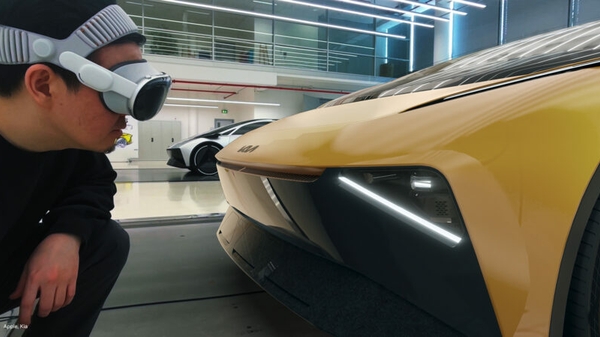
NVIDIA and Apple Collaborate to Bring RTX-Accelerated Graphics and CloudXR 6.0 to Apple Vision Pro
NVIDIA has announced a significant technical integration that connects NVIDIA RTX-accelerated computers directly to the Apple Vision Pro. Through the native integration of NVIDIA CloudXR 6.0 into Apple's visionOS, users can now securely stream high-fidelity simulators and professional 3D graphics applications. This collaboration enables the delivery of demanding workloads, such as Immersive for Autodesk VRED via Innoactive’s XR streaming solutions, onto the Apple Vision Pro headset. By leveraging NVIDIA's powerful RTX technology and the CloudXR framework, the partnership bridges the gap between high-end workstation performance and the portable spatial computing capabilities of visionOS, marking a major milestone for professional XR workflows and industrial simulation.
Key Takeaways
- Native visionOS Integration: NVIDIA CloudXR 6.0 now features native integration with Apple’s visionOS, allowing for direct connectivity.
- RTX-Powered Streaming: The collaboration enables the secure delivery of NVIDIA RTX-powered simulators and professional 3D graphics to the Apple Vision Pro.
- Professional Application Support: High-end tools like Autodesk VRED can now be streamed to the headset via Innoactive’s XR solutions.
- Enhanced Spatial Computing: This partnership combines NVIDIA's computational power with Apple's spatial hardware for advanced professional use cases.
In-Depth Analysis
Bridging RTX Power and visionOS
The core of this announcement lies in the native integration of NVIDIA CloudXR 6.0 into the visionOS ecosystem. This technical bridge allows the Apple Vision Pro to act as a high-fidelity display for heavy-duty processing occurring on NVIDIA RTX-accelerated computers. By utilizing CloudXR, the system can stream complex 3D environments and simulations that would typically exceed the standalone processing capabilities of a mobile headset, ensuring that professional users do not have to sacrifice visual quality or model complexity for portability.
Professional 3D Workflows and Simulation
A primary beneficiary of this integration is the industrial design and simulation sector. The news highlights the use of "Immersive for Autodesk VRED" on Innoactive’s XR streaming solutions as a prime example of this technology in action. Autodesk VRED is a standard in the automotive and manufacturing industries for high-end 3D visualization. By enabling these professional applications to run securely on the Apple Vision Pro, NVIDIA and Apple are providing engineers and designers with the ability to interact with photorealistic digital twins and complex simulators in a fully immersive spatial environment.
Industry Impact
This collaboration signifies a major shift in the professional XR (Extended Reality) landscape. By bringing NVIDIA's enterprise-grade graphics power to Apple's consumer-and-prosumer hardware, the industry moves closer to a unified workflow where high-end workstation performance is decoupled from physical location. For the AI and simulation industry, this means faster iteration cycles for digital twins and more accessible high-fidelity collaborative environments. It also reinforces the Apple Vision Pro's position as a viable tool for enterprise-level industrial applications rather than just a media consumption device.
Frequently Asked Questions
Question: What version of NVIDIA CloudXR is required for Apple Vision Pro integration?
NVIDIA CloudXR 6.0 is the version that brings native integration to Apple's visionOS.
Question: Which professional applications are specifically mentioned as compatible?
The announcement specifically mentions Immersive for Autodesk VRED, utilized through Innoactive’s XR streaming solutions.
Question: Is the streaming of graphics data secure?
Yes, the integration is designed to securely deliver NVIDIA RTX-powered simulators and professional 3D graphics applications to the headset.


