
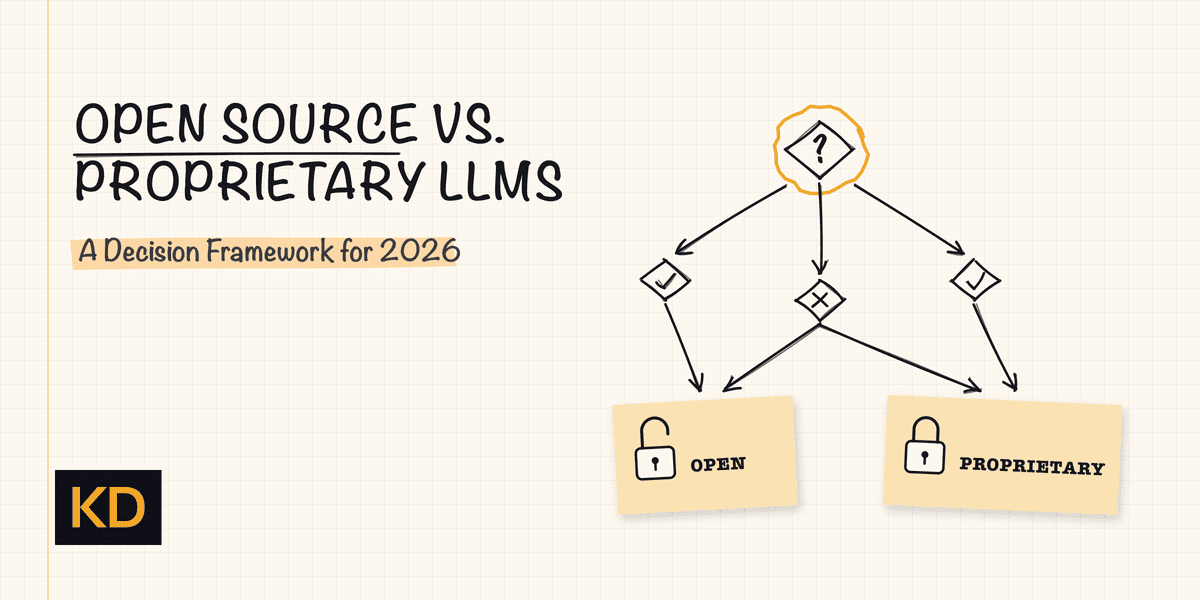
Open Source vs. Proprietary LLMs: A Four-Question Decision Framework for 2026
Vinod Chugani’s KDnuggets guide, published on November 20, 2026, frames the choice between open-weight and commercial large language models (LLMs) around four questions. Its premise is that the right answer depends on the use case, rather than on a general preference for either model category. The headline describes the comparison as open source versus proprietary LLMs, while the supplied description uses the terms open-weight and commercial models. That description establishes the guide’s purpose and structure but does not list the four questions or explain how to apply them. It also does not name specific models or recommend one category. The available information therefore shows how the guide frames the decision, but not how it reaches an answer for any particular use case.
Key Takeaways
- Vinod Chugani’s KDnuggets article presents a practical decision framework for choosing between open-weight and commercial large language models (LLMs).
- The framework is organized around four questions, with the choice tied to the reader’s use case.
- The headline uses “open source” and “proprietary,” while the supplied description uses “open-weight” and “commercial.”
- The supplied description does not disclose the four questions, name specific models, or state a preferred model category.
In-Depth Analysis
The guide puts the use case at the center of the decision
The headline of Vinod Chugani’s KDnuggets article, published on November 20, 2026, sets up a comparison between open source and proprietary LLMs. The description narrows that comparison to a practical decision: choosing between open-weight and commercial models for a particular use case. That qualification matters because it defines the kind of answer the guide promises. The description does not announce a winner across the two categories. Instead, it presents the right choice as one that depends on the use case being considered. A reader looking for a general verdict would therefore be asking a different question from the one the description sets out. The wording also leaves one distinction unresolved. The headline and description use different terms for the comparison, and the material provided does not explain how the article defines them or whether it treats them as interchangeable. The clearest way to report the guide’s scope is to preserve the headline’s framing while using “open-weight” and “commercial” to describe the choice named in the description.
Four questions define the format, but their contents are not disclosed
The number of questions is the most specific detail given about the framework. The description presents four questions as the basis for determining which option is right for a use case. This gives the comparison a stated structure: the guide is organized around questions intended to inform a choice, rather than described simply as an overview of two model categories. But the number tells readers nothing about the questions themselves. The supplied description does not identify the criteria the questions cover, the order in which a reader should consider them, or how the answers lead to a decision. It also does not show a worked example that would demonstrate the framework in use. Those limitations apply to the description available here, not necessarily to the full KDnuggets article. From the excerpt alone, it is possible to explain what the framework is meant to do and what organizes it. It is not possible to reconstruct it, test it against a scenario, or say what it would recommend for a particular reader.
Industry Impact
The article’s relevance to the AI industry, as described, lies in its framing of model selection. It treats open-weight and commercial models as options to consider against a use case, rather than presenting the category distinction as an answer in itself. For readers making an LLM selection decision, this is the central point the description supports: the guide starts from what the model is meant to be used for and presents four questions as the route to a choice. The industry relevance is therefore about how the decision is approached, not about evidence that one kind of model performs better or is more widely used.
The description also distinguishes a decision framework from a recommendation. A recommendation would tell the reader which option to favor; the description instead says that the guide helps determine the right answer for the reader’s use case. It does not report the outcome of applying the framework, either for an individual model or for one of the categories as a whole. Nor does it provide evidence of industry adoption or market effects. The guide’s stated contribution is narrower: it offers a question-based way to approach a model choice. Whether any particular reader would reach a clear answer, or which option that answer would favor, cannot be established from the information supplied.
Frequently Asked Questions
What choice does the KDnuggets guide address?
The guide addresses how to choose between open-weight and commercial large language models for a specific use case. Its headline frames the topic as open source versus proprietary LLMs, but the supplied description uses “open-weight” and “commercial” when stating the decision the guide is designed to help readers make. It does not identify particular models to compare.
What are the four questions in the 2026 LLM decision framework?
The supplied description does not list them. It says only that the guide is built around four questions intended to determine the right answer for a use case. As a result, the number and purpose of the questions can be reported, but their wording and the criteria they address cannot be recovered from the description alone.
Does the description recommend open-weight models over commercial models?
No preference is stated in the supplied description. Its focus is on finding the right answer for the reader’s use case, not on naming a universally better option. That does not establish what the full article recommends in any given situation; it establishes only that the excerpt does not provide a recommendation or an example of the framework’s outcome.