Why Fine-Tuning Jobs Take Longer Than Theoretical FLOP Calculations Predict in Practice
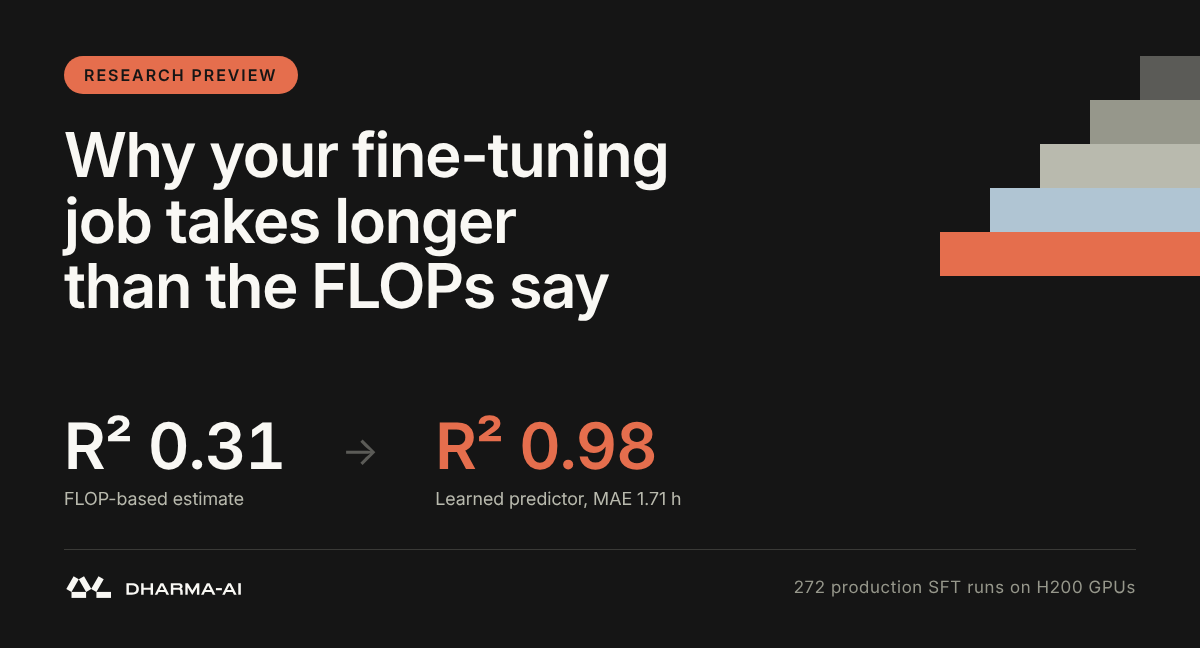
Published on the Hugging Face Blog by Dharma-AI, the article titled 'Why your fine-tuning job takes longer than the FLOPs say' investigates the practical discrepancies between theoretical FLOP estimations and actual fine-tuning duration. In machine learning workflows, calculating expected runtime purely based on floating-point operations often overlooks real-world engineering bottlenecks and hardware constraints. This analysis examines the primary factors contributing to extended execution times in model fine-tuning and provides insights into predicting actual project runtimes more accurately without relying solely on idealized computational metrics.
Key Takeaways
- Theoretical vs. Real Runtime: Standard FLOP calculations provide an idealized baseline but consistently underestimate the actual time required to fine-tune modern machine learning models.
- Unaccounted Overhead: System-level factors, communication latency, memory bandwidth, and I/O bottlenecks account for significant execution delays.
- Accurate Estimation Needs: Effective project planning requires modeling real-world fine-tuning time rather than purely relying on theoretical peak compute metrics.
In-Depth Analysis
The Limitations of FLOP-Based Time Estimation
When planning machine learning fine-tuning pipelines, practitioners frequently estimate hardware requirements and training time using total floating-point operations (FLOPs). However, relying exclusively on theoretical peak FLOPs assumes continuous maximum compute utilization across all accelerators. In practice, fine-tuning workloads rarely achieve peak efficiency due to memory access patterns, framework overheads, and hardware stalls.
Primary Bottlenecks in Fine-Tuning Workflows
Several hardware and software constraints prevent jobs from finishing within theoretical FLOP-based expectations:
- Memory Bandwidth Bottlenecks: Modern large language models frequently encounter memory-bound operations where data transfer speeds between high-bandwidth memory (HBM) and compute cores dictate execution speed.
- Data Loading and I/O Stalls: Pipeline delays during data preprocessing, tokenization, and disk reading prevent GPUs and TPUs from operating at continuous capacity.
- Distributed Interconnect Latency: Multi-device or multi-node training setups incur substantial synchronization and gradient exchange overheads that FLOP calculations ignore.
Practical Approaches to Predicting Job Duration
To bridge the gap between theory and execution, engineering teams must incorporate system overhead, memory throughput limits, and communication penalties into their forecasting models. Profiling small-scale pilot runs provides empirical baseline metrics that far exceed the accuracy of static FLOP equations.
Industry Impact
Understanding the delta between theoretical compute and actual fine-tuning duration has major implications across the AI ecosystem:
- Resource Budgeting and Cloud Cost Management: Underestimating fine-tuning runtimes directly causes cloud compute budget overruns and inefficient hardware scheduling.
- Infrastructure Optimization: Highlights the need for infrastructure teams to invest in communication optimization, pipeline parallelism, and efficient data loaders rather than focusing solely on raw accelerator compute capacity.
Frequently Asked Questions
Why do theoretical FLOP estimates fail to match real-world training times?
Theoretical FLOP numbers calculate execution under the assumption of 100% hardware compute utilization, ignoring system overheads such as memory bandwidth constraints, kernel launch delays, and distributed synchronization latency.
What are the main non-compute bottlenecks during fine-tuning?
The most common bottlenecks include data loading latency, inter-GPU gradient communication overhead, and memory bandwidth limitations during parameter reads and writes.
How can teams better estimate model training duration?
Teams can establish more accurate projections by benchmarking small representative batches, profiling hardware utilization with monitoring tools, and factoring in empirical utilization rates (MFU/HFU) rather than peak theoretical numbers.