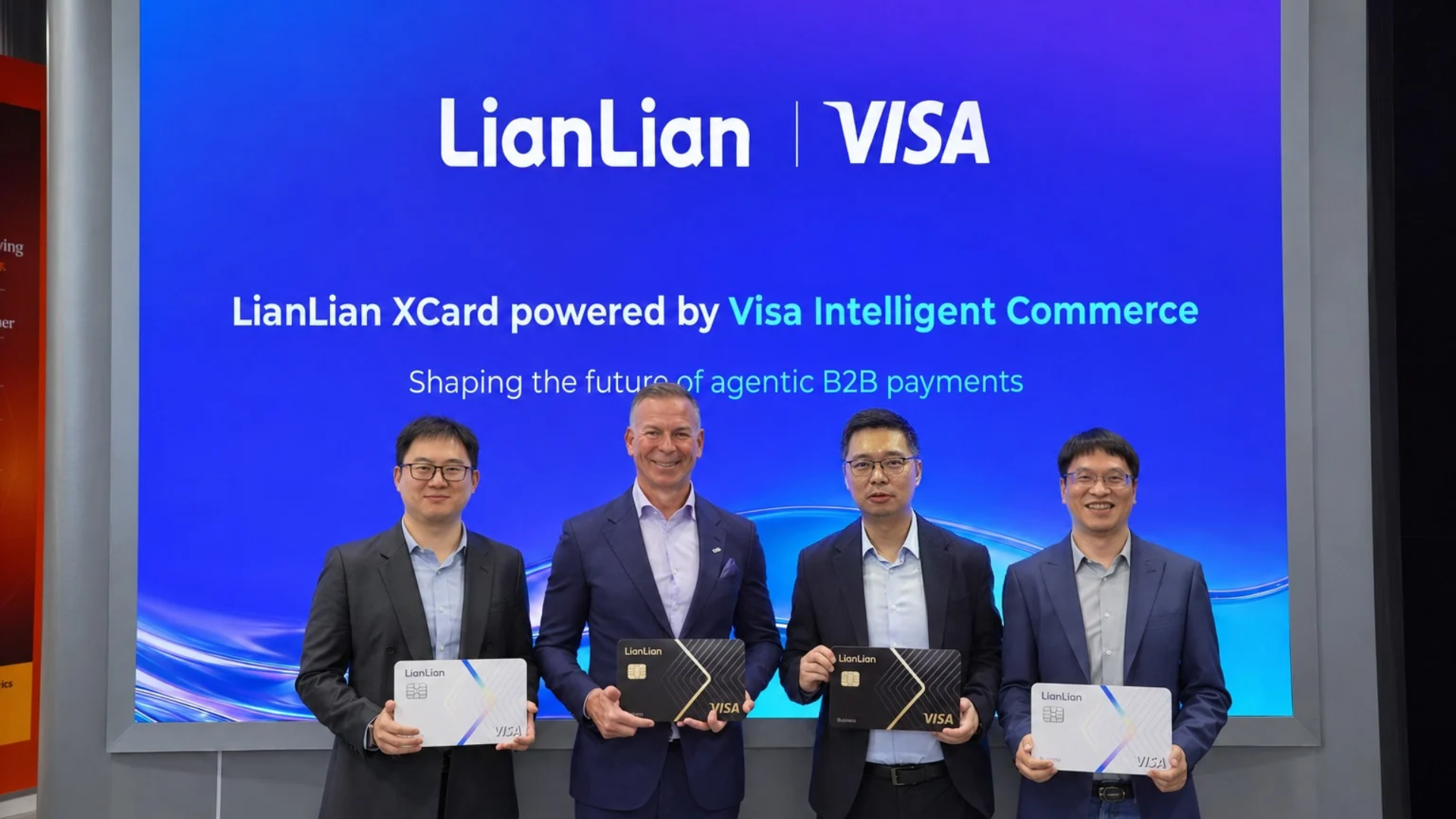
Visa and Lianlian Complete Live AI-Agent B2B Payment for an Office Supplies Purchase
Visa and Lianlian completed a live AI-agent business-to-business (B2B) payment, Tech in Asia reported. Lianlian’s AI agent, LianLian XWorker, used a tokenized credential to buy office supplies. The report identifies the companies involved, the agent that made the purchase, the type of credential it used, and what it bought. It does not specify the transaction value, the supplier, how the credential was issued, or whether a person approved the purchase. The reported outcome is therefore specific: LianLian XWorker used a tokenized credential to complete an office supplies purchase in a live B2B transaction. The report does not describe a broader rollout.
Key Takeaways
- Visa and Lianlian completed a live AI-agent business-to-business (B2B) payment, according to Tech in Asia.
- Lianlian’s AI agent, LianLian XWorker, used a tokenized credential to buy office supplies.
- The report documents a completed purchase but does not explain the approval process or how the credential was issued.
In-Depth Analysis
What the live B2B payment establishes
The central fact is that the agent made a purchase, not merely that it was described as capable of making one. Tech in Asia identifies office supplies as what LianLian XWorker bought and describes the payment as a completed live B2B transaction involving Visa and Lianlian. That wording gives the report a concrete outcome: a named AI agent used a credential to buy a specified type of goods. It does not, however, document the procurement process around that purchase. The report does not say whether the agent selected the items, chose the supplier, or received instructions to buy items that had already been selected. Those are separate questions from whether the agent used the credential for the purchase. The completed payment is the reported result; the decisions that led up to it are not described.
What the report says about the tokenized credential
The tokenized credential is the one payment detail the report gives. It identifies what LianLian XWorker used for the purchase, but it does not explain who issued the credential, how the agent obtained access to it, or what restrictions, if any, applied to its use. The report also does not assign each step of the transaction to Visa or Lianlian. It names the two companies in connection with the completed payment and identifies XWorker as Lianlian’s agent. Those statements should not be read as a breakdown of the companies’ respective roles in issuing the credential, approving the purchase, or processing the payment. For readers interested in how the payment worked, the distinction matters: credential use is documented, while the setup and division of responsibilities are not.
Why a completed payment does not establish full autonomy
The term “AI-agent payment” identifies the agent’s involvement in the transaction. It does not, on its own, establish that the agent had authority to spend without human approval. Tech in Asia says XWorker used the credential to buy office supplies, but it does not say whether a person initiated, reviewed, or approved the purchase. Equally, the absence of those details does not establish that a person intervened. The available account supports a claim about what the agent did in the purchase, not a claim about how independently it acted. That distinction is important because completing a payment and deciding whether a business should make that payment are different actions. The report confirms the former without explaining who was responsible for the latter.
Industry Impact
For the AI industry, the significance of the report is that it ties a named agent to a completed business purchase. The example has a specific outcome against which the claim can be understood: XWorker used a tokenized credential to buy office supplies. That is narrower than a claim about an agent handling an entire purchasing process, but it is also more concrete than a general statement that an agent can make payments. The office supplies purchase gives the reader a clear endpoint without requiring assumptions about how the agent arrived there.
The report is less informative about whether the approach can be repeated or made available more broadly. It does not mention other purchases, other agents, or a rollout. It also gives no transaction value or supplier name. As a result, readers cannot use this account to assess how the arrangement would handle a different purchase, a different supplier, or repeated transactions. Nor does it provide a basis for judging cost, speed, or reliability. Those are limits of the information available, not findings about what the payment arrangement can or cannot do.
The most useful industry reading is therefore to separate execution from governance. The reported execution is clear: the named agent used a tokenized credential in a purchase that was completed. The governance questions concern who gave the agent access, who authorized the spending, and what the agent could do with the credential beyond this purchase. The report does not answer those questions. Keeping the two issues separate preserves what is notable about the transaction without treating a single reported outcome as evidence of broader deployment or independent spending authority.
Frequently Asked Questions
What did LianLian XWorker buy?
LianLian XWorker bought office supplies. Tech in Asia identifies the purchase as part of a completed live B2B payment involving Visa and Lianlian. It does not identify the supplier, itemize the order, or disclose the transaction value.
How did the AI agent make the payment?
XWorker used a tokenized credential to make the purchase. That is the extent of the payment mechanism described in the report. It does not explain how the credential was issued, how it was made available to XWorker, or which steps Visa and Lianlian handled separately.
Did the agent make the purchase without human approval?
The report does not say. It establishes that XWorker used the credential to buy office supplies, but it does not specify who initiated or approved the purchase. A live payment confirms the reported transaction took place; it does not resolve how much discretion the agent had.