LangSmith Adds Coding Agent Reporting That Links Spend to Pull Request Outcomes
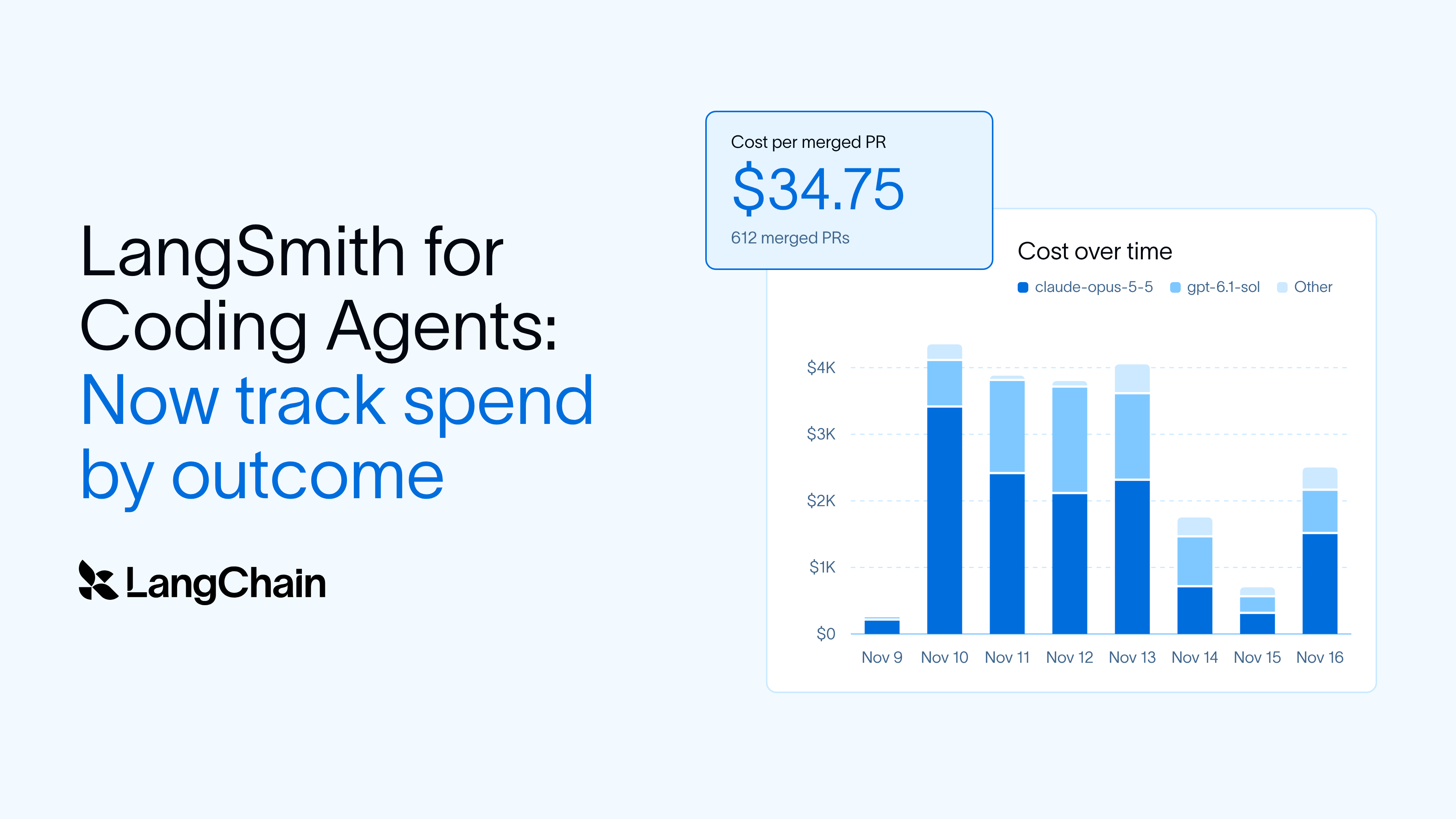
LangChain announced that LangSmith now offers reporting built for coding agents, with new capabilities that connect agent spend to the pull requests those agents produce. In this announcement, the pull request is the concrete outcome associated with spend. That link is the key distinction: the reporting connects what coding agents cost with a specific kind of work they produce. The announcement does not explain how LangSmith allocates spend, what the reports look like, or whether they distinguish between pull requests that are opened and those that are merged. It also does not report cost savings or establish that a pull request's value can be measured from its associated spend alone.
Key Takeaways
- LangSmith now offers reporting built for coding agents.
- The new capabilities connect coding agent spend to the pull requests those agents produce.
- The pull request is the outcome identified in the announcement; the source does not say that LangSmith measures whether it is merged or delivers value.
- LangChain does not specify how spend is attributed or what the reports show beyond the stated connection to pull requests.
In-Depth Analysis
What LangSmith announced
LangChain's announcement describes two related aspects of the LangSmith update: reporting built for coding agents and capabilities that tie their spend to the pull requests they produce. The second point gives the first a concrete focus. Rather than simply stating that LangSmith reports on coding agents, the announcement identifies a relationship the reporting is intended to capture: the connection between agent spend and a pull request produced by an agent. That is the main product change described in the source. The announcement does not show a report or describe its layout, so it does not establish how a reader would see that connection in LangSmith. It also does not specify whether a report displays a separate cost for every pull request or presents spend in some other form. The distinction matters because the source confirms that spend and pull requests are linked, but it does not define what the resulting report looks like or how much detail it provides.
What “spend by outcome” means here
The announcement's title frames the update as tracking spend by outcome, and the text identifies the outcome as a pull request produced by a coding agent. That gives “outcome” a specific meaning in this context. It refers to something the agent produces, not necessarily to what happens after it is produced. A pull request can be discussed as an output without drawing any conclusion about its review, acceptance, or eventual effect. The announcement does not say whether LangSmith distinguishes among those later stages, so reporting tied to pull requests should not be read as reporting tied specifically to merged changes. The same distinction applies to value: linking spend to a pull request can show which output the spend is associated with, but the announcement does not say that LangSmith assesses the quality or usefulness of that output. The update is therefore about connecting cost to a named result, not about establishing what that result was worth.
What the announcement leaves open about cost attribution
The link between spend and pull requests is explicit, but the method behind it is not. For example, the announcement does not say how the reporting would treat spending on work that produces no pull request, or how it would handle spending associated with work that produces more than one. These are questions about how to interpret the link, not claims about the feature's behavior. Without a stated attribution method, readers cannot tell from the announcement whether a given report accounts for all agent spend or only for spending that can be linked to the specified output. Nor does the announcement present figures that would show whether costs changed after the reporting was introduced. The supported conclusion is narrower: LangSmith offers a way to connect coding agent spend with the pull requests those agents produce. The source does not give enough detail to infer how that connection is calculated or to evaluate its completeness.
Industry Impact
For the AI industry, the significance of the update lies in the choice of a concrete output for cost reporting. A spend figure in isolation answers a cost question. Linking spend to a pull request puts the cost in the context of work a coding agent produced. That makes the reporting relevant to a different question: not only what was spent, but what output the spending is associated with. LangChain's announcement identifies that relationship without claiming that the relationship, on its own, demonstrates efficiency or return on investment.
The distinction also sets a limit on what comparisons would mean. Even if spend can be associated with pull requests, comparing spend does not by itself establish that the pull requests are comparable in scope or value. Likewise, the presence of an associated pull request does not show that an agent's work was accepted or that it achieved the intended result. Those judgments would require information beyond the spend-to-output link described here. The announcement's contribution is to identify the pull request as the point of reference for coding agent spend in LangSmith. It does not provide evidence of lower costs, higher productivity, or broader changes in how coding agents are evaluated across the industry.
Frequently Asked Questions
What did LangSmith add for coding agents?
LangSmith added reporting built for coding agents, along with capabilities that tie their spend to the pull requests they produce. LangChain did not describe the report layout or specify which details are displayed.
Does tracking spend by outcome mean tracking merged pull requests?
The announcement does not specify that. It refers to pull requests produced by coding agents, without saying whether the reporting distinguishes between pull requests that are opened, reviewed, or merged.
Does the update show whether coding agents deliver a return on investment?
The announcement says that LangSmith connects spend to pull request output. It does not provide a measure of the value of those pull requests or report a return on investment. Cost attribution and an assessment of value are separate questions.