
Optimizing High-Concurrency Generative SLM Inference Engines Under Strict Latency Constraints for Search and Recommendation
Meituan's technical team has unveiled an advanced high-concurrency inference engine tailored for Small Language Models (SLMs) with 0.5B to 1B parameters deployed in online search and recommendation systems. While traditional large language model serving architectures are tailored for open-ended text generation, search and recommendation platforms operate under extreme low-latency boundaries where standard systems falter. By categorizing tasks into bounded generation workloads—such as prefill-only classification and fixed-step beam search—the engineering team restructured the execution path using a static Directed Acyclic Graph (DAG) abstraction. Integrated with PyTorch AOTInductor compilation, packed prefill, intra-request KV cache sharing, and selective FP8 quantization, the engine keeps end-to-end latency strictly below 20 milliseconds. The system achieves a prefill-only effective Model FLOPs Utilization (MFU) of 67% and delivers a tenfold throughput improvement over SGLang, establishing a scalable paradigm for enterprise AI deployment.
Key Takeaways
- Targeted Architectural Shift for SLMs: Meituan introduces an engineering framework designed specifically for Small Language Models (0.5B to 1B parameters) operating within large-scale online search and recommendation (Search & Rec) platforms.
- Bounded Generation Workload Abstraction: The engine departs from traditional open-ended generation systems by modeling execution around bounded generation workloads, characterized by deterministic token generation upper bounds, known state capacities, and bounded resource limits.
- Static DAG and AOTInductor Acceleration: Online execution is organized via a static Directed Acyclic Graph (DAG) runtime coupled with PyTorch AOTInductor compilation, which systematically eliminates runtime scheduling overheads and runtime interpreter bottlenecks.
- Multi-Pronged Performance Optimization: By implementing packed prefill, intra-request Key-Value (KV) cache sharing, and selective FP8 precision, the system maximizes compute density while strictly curbing memory movement.
- Industry-Leading Metrics: The system compresses average end-to-end serving latency to below 20ms, achieves a prefill-only effective Model FLOPs Utilization (MFU) of 67%, and scales throughput to 10 times that of SGLang.
In-Depth Analysis
Characterizing Bounded Generation Workloads in Search and Recommendation
In modern search and recommendation architectures, engineering teams are increasingly turning to Small Language Models (SLMs) within the 0.5B to 1B parameter range to power latency-critical capabilities, including user intent understanding, relevance assessment, and generative item recommendation. Although these models retain the foundational Decoder-only Transformer architecture and next-token prediction mechanisms of full-scale Large Language Models (LLMs), their deployment characteristics diverge significantly from conversational assistants and open-ended generative applications. Standard open-ended generative workloads typically feature unpredictable decoding lengths, variable prompt-to-generation ratios, and elastic response times. In contrast, online search and ranking pipelines impose rigorous Service Level Objectives (SLOs), requiring model inference to conclude within milliseconds without delaying downstream multi-stage retrieval pipelines.
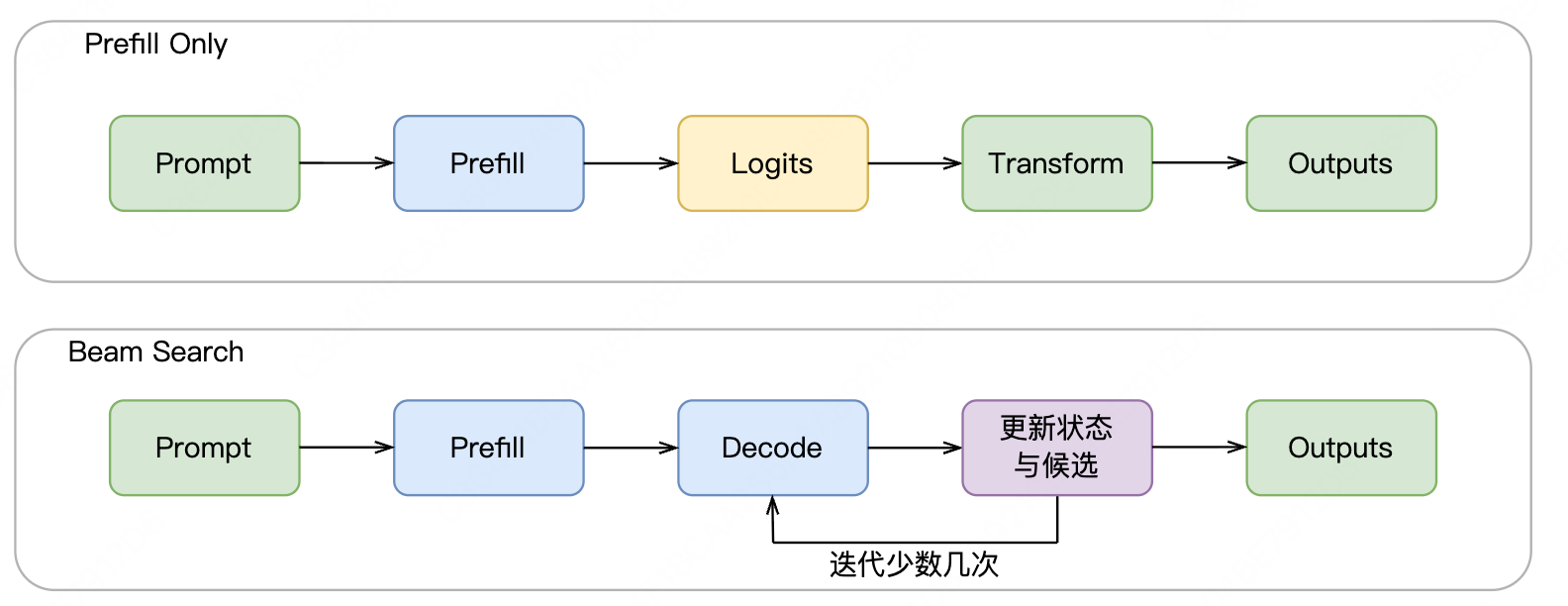
Meituan's technical team observed that these industrial workloads fall strictly into what they define as "bounded generation workloads". In this operational paradigm, the control-flow structure, maximum sequence context, state capacity, and decoding steps are statically determinable prior to runtime deployment. The workloads primarily manifest in two distinct operational modes:
- Prefill-Only Mode: In this setup, the inference framework processes input tokens in a single prefill forward pass. Logits from the final valid token position are directly harvested to produce classification categories or relevance scores, or the generated contextual embedding is piped into downstream Multilayer Perceptrons (MLPs). Because generation iterations are zero, the operation circumvents autoregressive token decoding entirely.
- Beam Search Mode: When candidate generation is required, the engine conducts a single prefill pass followed by a strictly bounded number of decoding iterations under a constrained beam width. Because the iteration boundary and search width are fixed in advance, system memory and compute allocations remain strictly deterministic.
During early deployment phases, Meituan deployed a baseline framework leveraging Python backends on Triton Inference Server alongside SGLang. While this initial configuration accelerated experimentation by facilitating tokenization and basic generation scheduling, the substantial serving overheads and resource costs under massive query concurrency prevented comprehensive production scale-out. This operational friction compelled the architecture of a custom, highly optimized high-concurrency inference engine.
Static DAG Abstraction and PyTorch AOTInductor Compilation
To overcome the latency and scheduling penalties of general-purpose serving runtimes, the team redesigned the online inference pipeline around a static Directed Acyclic Graph (DAG) abstraction. In this framework, the entire end-to-end business request serves as the unified boundary for DAG scheduling, performance measurement, and system capacity planning. By moving away from dynamic request tracking, the static DAG eliminates non-deterministic execution paths and Python runtime overheads.
Individual execution nodes in the DAG establish distinct compilation boundaries:
- Model Compute Nodes: Core matrix operations and transformer layers are compiled into native artifacts using PyTorch's Ahead-of-Time Inductor (AOTInductor). AOTInductor lowers PyTorch execution graphs directly into standalone C++ binaries and CUDA kernels, completely bypassing the Python Global Interpreter Lock (GIL) and removing runtime graph interpretation delays.
- Auxiliary Processing Nodes: Framework-level custom nodes govern preprocessing, token transformation, tensor packing, and post-inference business logic.
- High-Performance Runtime: A centralized execution runtime coordinates multi-stream concurrency, node dependencies, memory pools, and device resources, maintaining sub-millisecond scheduling discipline across parallel worker threads.
Latency Compression: Packed Prefill, Intra-Request KV Sharing, and FP8 Quantization
Achieving high effective throughput under an uncompromising 20ms latency budget required comprehensive elimination of redundant compute and memory thrashing. The architecture implements three complementary optimization pillars:
- Packed Prefill: Traditional batched prefill execution suffers from token padding waste caused by uneven input sequence lengths. The engine leverages sequence packing to concatenate multiple prefill sequences into continuous, unpadded batches. By feeding contiguous token streams through custom attention kernels, the system minimizes bubble cycles on tensor cores and dramatically increases memory bandwidth utilization.
- Intra-Request K/V Sharing: Within multi-candidate recommendation scoring and beam search passes, multiple sequences frequently share identical prompt prefixes or item contextual embeddings. The engine dynamically reuses Key-Value (KV) cache tensors within the boundary of a single business request. By eradicating redundant attention projection passes and memory allocations for overlapping tokens, memory footprint is slashed and compute cycles are conserved for unique sequence tokens.
- Selective FP8 Precision: Recognizing that uniform quantization can destabilize attention precision and recommendation recall, the engine applies selective FP8 numerical precision to memory-bandwidth-bound matrix multiplications while keeping critical score-sensitive operations in higher precision. This selective quantization approach doubles compute density and reduces intermediate memory movement without degrading ranking and classification fidelity.
Industry Impact
The breakthrough achieved by Meituan's SLM inference engine provides critical architectural insights for the broader AI and search infrastructure industry. As enterprises grapple with the massive capital expenditures required to maintain LLM-powered services, the industry is experiencing a strategic pivot toward domain-tailored Small Language Models. However, deploying 0.5B to 1B parameter models inside high-throughput recommender engines has historically been hindered by the reality that standard open-source serving stacks (e.g., vLLM, TensorRT-LLM, SGLang) are optimized for longer generation horizons and looser SLO profiles.
By demonstrating that an AOTInductor-compiled, static DAG architecture can deliver an effective Model FLOPs Utilization (MFU) of 67% in prefill-only execution and compress end-to-end latency below 20ms while outpacing general-purpose engines by 10x, this work proves that generative architectures can economically replace classical discriminant models in production recommendation ranking. It establishes a replicable standard for enterprise search and recommendation platforms seeking to harness generative AI under strict real-time operational constraints.
Frequently Asked Questions
What distinguishes a "bounded generation workload" from standard LLM inference?
Standard LLM inference typically involves open-ended textual interaction with unpredictable generation lengths, dynamic stop conditions, and elastic response timelines. A bounded generation workload, by contrast, has statically definable input sizes, bounded decode iterations (often zero in prefill-only tasks, or fixed in beam search), and strictly limited execution states known before deployment, enabling deterministic scheduling and compilation.
How does the system achieve a 10x throughput improvement over SGLang?
The 10x throughput improvement stems from a holistic redesign of the execution pipeline: replacing generic Python runtimes with PyTorch AOTInductor-compiled static DAG nodes, removing token padding through packed prefill, recycling intermediate KV caches across candidates within the same request, and adopting selective FP8 quantization. Together, these methods eliminate scheduling overhead and maximize GPU compute saturation under a sub-20ms SLA.
Why are Small Language Models (0.5B–1B) favored in search and recommendation platforms?
Search and recommendation engines must score hundreds to thousands of items within tight overall pipeline deadlines. SLMs provide the semantic comprehension and contextual reasoning power of Transformer architectures while maintaining parameter counts small enough to fit within strict sub-20ms latency envelopes at high queries-per-second (QPS).

