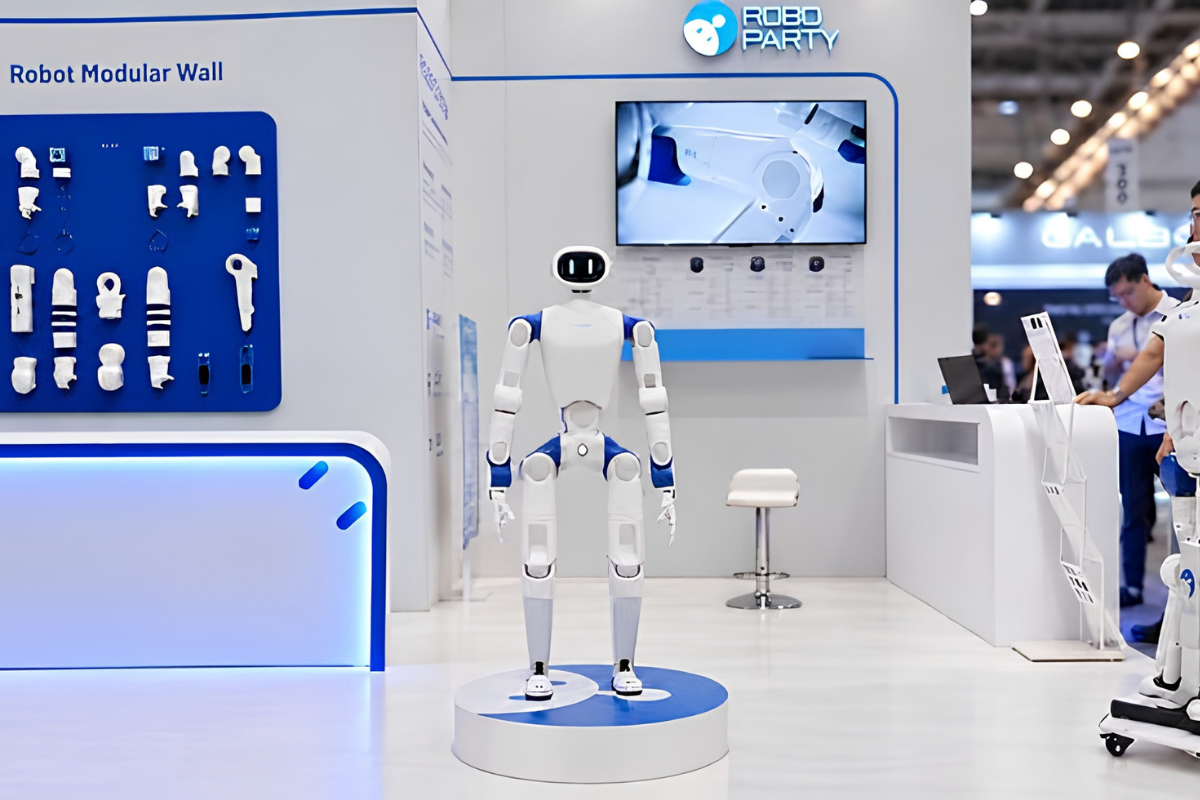
China's RoboParty Unveils RP1 Humanoid Robot Built for Developers with Live Balance Recovery Showcase
Chinese robotics firm RoboParty has officially introduced the RP1, a new humanoid robot engineered specifically for the developer community. During an interactive showcase, attendees were invited to directly test the platform's stability by pushing and kicking the unit, allowing RP1 to showcase its dynamic balance recovery and real-time stabilization capabilities under physical stress. Designed to support developers creating next-generation robotic applications, the unveiling highlights an increasing industry focus on resilient physical hardware platforms. While comprehensive hardware specifications and distribution schedules remain unannounced in the initial report, the live demonstration underlines RoboParty's emphasis on responsive locomotion and robust balance control as essential foundations for developer-driven humanoid innovation.
Key Takeaways
- Developer-Centric Unveiling: Chinese robotics company RoboParty has officially introduced the RP1, a humanoid robot platform tailored specifically for software and hardware developers.
- Dynamic Balance Demonstration: During the presentation, visitors physically pushed and kicked the RP1 to test and verify its dynamic balance recovery mechanisms.
- Focus on Locomotion Resilience: The demonstration underscored real-time reactive stabilization as a core capability of the RP1 platform.
- Targeted Ecosystem Growth: By directing the RP1 toward developers, RoboParty aims to provide an accessible hardware base for external software innovation and robotic development.
In-Depth Analysis
The Strategic Role of Developer-Oriented Humanoid Hardware
The introduction of the RP1 humanoid robot by China-based RoboParty represents a targeted effort to serve the robotics engineering community. Developing complete humanoid platforms from scratch presents massive financial and technical hurdles for software researchers, control engineers, and independent innovators. By positioning the RP1 explicitly as a developer platform, RoboParty focuses on delivering a functional physical chassis that allows third-party creators to build, iterate, and deploy sophisticated control algorithms, application logic, and domain-specific behaviors without having to design underlying structural hardware independently.
Developer platforms serve as a crucial transitional phase across the emerging humanoid robotics industry. Rather than waiting for closed, end-consumer deployments, providing developer kits and programmable units accelerates general ecosystem maturity. By placing physical units into developer workflows, robotics manufacturers can identify practical edge cases, refine lower-level motion libraries, and foster an active developer community capable of creating practical utility across diverse operational environments.
Analyzing Balance Recovery and Physical Disturbance Rejection
A central focus of RP1's public unveiling was its interactive physical demonstration. Visitors at the event were invited to actively push and kick the humanoid robot, creating severe external perturbations to evaluate how the system responded in real time. Rather than relying exclusively on scripted, controlled movements in isolated test cells, RoboParty demonstrated the robot's real-time closed-loop stabilization under unpredictable external forces.
Maintaining balance when subjected to sudden external kinetic impacts—such as being kicked or shoved—requires immediate coordination between sensory feedback, joint actuators, and center-of-mass adjustment algorithms. For bipedal humanoid platforms, disturbance rejection relies on rapid computation of foot placement strategies, reactive torque adjustment, and posture recovery. The RP1 demonstrated an ability to recover equilibrium without falling, signaling that its locomotion and balance architecture are built to withstand physical contact in unpredictable working environments.
Balancing Physical Resilience with Real-World Practicality
Demonstrating balance recovery through physical stress testing has long been an industry standard for measuring bipedal competence. However, doing so openly with public participants adds an element of practical validation. For developers, a humanoid robot that can recover from sudden physical contact lowers operational risk during testing cycles, where imperfect third-party code or unexpected workspace obstacles might otherwise lead to frequent tipping and hardware damage.
While detailed technical documentation regarding the RP1's specific motor torque ratings, degrees of freedom, computational hardware, and sensor suites has not been comprehensively published in initial reporting, the physical balance showcase demonstrates that fundamental mechanical stability and reactive control constitute the platform's core baseline. RoboParty's public trial underscores a focus on functional reliability as the baseline for developer engagement.
Industry Impact
The unveiling of the RP1 highlights the accelerating pace of humanoid robotics development emerging from China's technology sector. As competitive interest in bipedal automation increases worldwide, hardware developers are increasingly seeking to build developer ecosystems rather than isolated single-purpose machines.
By offering a humanoid robot that emphasizes balance resilience, RoboParty addresses one of the most critical barriers to widespread robotics experimentation: physical fragility. When hardware platforms demonstrate steady balance recovery under direct impact, they create a safer and more durable foundation for software teams to build autonomous navigation, manipulation, and collaborative tasks. The RP1's public debut reflects an ongoing trend toward validating humanoid technology through dynamic, hands-on physical interactions rather than static display models.
Frequently Asked Questions
What is the RoboParty RP1 humanoid robot?
The RP1 is a newly unveiled humanoid robot created by China's RoboParty, designed specifically to serve as a platform for developers working on humanoid robotics applications and software.
How was the RP1's balance tested during its unveiling?
During the live demonstration, attendees were permitted to kick and push the RP1 robot to directly observe its ability to maintain equilibrium and recover its balance in response to sudden physical disturbances.
What additional technical specifications are available for the RP1?
Beyond the initial balance demonstration and developer positioning reported at its unveiling, comprehensive technical details—such as full actuator specifications, retail pricing, and broader availability timelines—have not yet been formally detailed in the initial announcement.