LongCat Open Sources VitaBench 2.0: A Pioneering Benchmark for Evaluating Long-term Dynamic User Modeling in AI Agents
The Meituan Technical Team has officially announced the open-sourcing of VitaBench 2.0, a groundbreaking benchmark specifically designed to evaluate Large Language Models (LLMs) in the context of long-term, dynamic user interactions. As the first benchmark of its kind to focus on real-life scenarios, VitaBench 2.0 provides a systematic framework for assessing how AI agents handle personalization and proactivity over extended periods. By shifting the focus from short-term task completion to enduring user modeling, this release aims to set a new standard for the development of intelligent agents that can adapt to the evolving needs and preferences of users in authentic environments. The benchmark represents a significant step forward in measuring the practical utility of AI in complex, real-world applications.
Key Takeaways
- First-of-its-kind Benchmark: VitaBench 2.0 is established as the industry's first benchmark specifically targeting long-term dynamic user modeling within real-life scenarios.
- Focus on Personalization and Proactivity: The framework provides a systematic approach to evaluating Large Language Models (LLMs) based on their ability to tailor experiences and take initiative.
- Authentic Interaction Modeling: Developed by the Meituan Technical Team, the benchmark addresses the need for evaluating AI agents in evolving, non-static environments rather than isolated tasks.
- Open-Source Contribution: By open-sourcing VitaBench 2.0, LongCat provides the AI community with a standardized tool to measure and improve the continuity of human-AI interactions.
In-Depth Analysis
The Shift Toward Long-Term Dynamic User Modeling
The introduction of VitaBench 2.0 represents a pivotal moment in the evolution of artificial intelligence evaluation. Historically, benchmarks for Large Language Models (LLMs) have focused on isolated tasks, zero-shot reasoning, or short-term conversational accuracy. While these metrics are valuable for assessing core linguistic and logical capabilities, they often fail to capture the complexity of real-world human-AI relationships. VitaBench 2.0 addresses this gap by prioritizing "long-term dynamic user modeling."
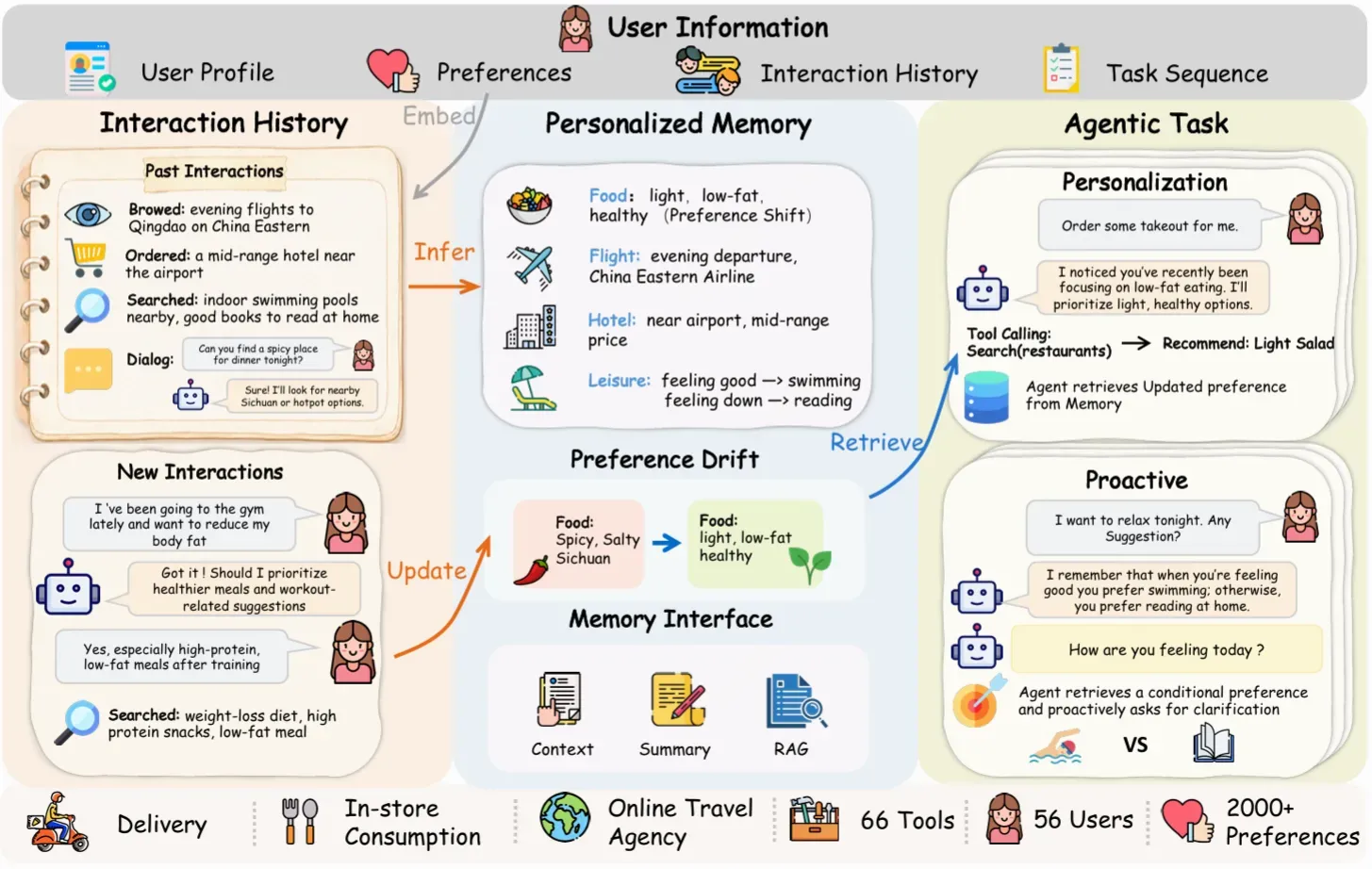
In a real-life context, user needs are rarely static. Preferences evolve, contexts change, and the history of past interactions informs future expectations. By focusing on "long-term" interactions, VitaBench 2.0 challenges AI agents to maintain a consistent and evolving understanding of the user. This "dynamic" aspect is crucial; it requires the model to not only remember past data but to interpret how that data changes over time. The technical challenge of long-term modeling involves maintaining a coherent "state" across vast windows of interaction. VitaBench 2.0 provides the metrics to evaluate how well models overcome the "forgetting" problem common in standard LLM architectures, ensuring that the AI remains relevant and helpful throughout a multi-stage, multi-day, or even multi-month user journey.
Evaluating Personalization and Proactivity in Authentic Scenarios
A significant contribution of VitaBench 2.0 is its systematic evaluation of two advanced agent traits: personalization and proactivity. Personalization, in the context of this benchmark, refers to the agent's ability to tailor its responses and actions to the specific nuances of an individual user's profile and history. In real-life scenarios, a "one-size-fits-all" approach is often insufficient. VitaBench 2.0 measures how well an LLM can leverage user-specific data to provide a bespoke experience that feels intuitive and aligned with the user's unique requirements.
Proactivity is perhaps an even more challenging metric to quantify. Most current AI systems are reactive—they wait for a prompt before providing an answer. However, a truly intelligent agent in a real-life scenario should be capable of anticipating needs and taking the initiative. VitaBench 2.0 evaluates this "proactive" capability, assessing whether an agent can identify opportunities to assist the user without being explicitly commanded to do so. In real-life scenarios, proactivity must be balanced with accuracy and relevance. VitaBench 2.0's systematic approach allows for the measurement of this balance, ensuring that agents are not just active, but helpfully and correctly proactive. By grounding these evaluations in "real-life scenarios," the Meituan Technical Team ensures that the benchmark reflects the actual challenges faced by AI deployed in consumer-facing or enterprise applications.
Systematic Evaluation of Real-World Interactions
The "systematic" nature of VitaBench 2.0 is what sets it apart as a new standard for the industry. Rather than relying on anecdotal evidence of an agent's intelligence, the benchmark provides a structured framework for testing. This involves simulating complex, multi-turn interactions that mirror the unpredictability of human life. By open-sourcing this tool, the Meituan Technical Team (LongCat) is providing the global AI community with a standardized yardstick.
This allows researchers and developers to move away from fragmented testing methods and toward a unified approach for measuring agent performance in dynamic environments. The focus on "authentic" interactions ensures that the models being tested are prepared for the messy, non-linear nature of real-world usage, rather than just performing well on curated, synthetic datasets. This systematic approach is essential for identifying the limitations of current LLMs in maintaining long-term context and for driving the development of more robust memory and reasoning architectures.
Industry Impact
The release of VitaBench 2.0 is likely to have a profound impact on the trajectory of AI agent development. By establishing a benchmark for long-term dynamic modeling, it encourages the industry to prioritize the development of persistent memory and context-awareness in LLMs. As developers strive to rank well on VitaBench 2.0, we can expect to see a surge in innovations related to long-context processing and state management.
Furthermore, the emphasis on proactivity and personalization will likely accelerate the transition of AI from simple chatbots to sophisticated digital assistants. Industries such as e-commerce, customer service, and personal productivity stand to benefit the most, as agents that can proactively manage long-term user goals will offer significantly higher value. The open-source nature of the project also democratizes access to high-quality evaluation tools, allowing smaller research teams to compete with larger labs in refining the next generation of personalized AI. Ultimately, VitaBench 2.0 shifts the industry's focus toward building AI that can truly integrate into the daily lives of users as a reliable and adaptive partner.
Frequently Asked Questions
Question: What is the primary goal of VitaBench 2.0?
The primary goal of VitaBench 2.0 is to provide a systematic and authentic evaluation framework for AI agents, specifically focusing on their ability to model user behavior dynamically and over long periods in real-life scenarios.
Question: How does VitaBench 2.0 define "proactivity" in AI agents?
In the context of VitaBench 2.0, proactivity refers to the agent's ability to take initiative and anticipate user needs within a dynamic interaction, rather than simply reacting to direct prompts or commands.
Question: Why is "long-term" modeling important for AI agents?
Long-term modeling is essential because real-life user interactions are continuous. For an AI to be truly effective, it must be able to remember, adapt to, and utilize information from past interactions to provide a personalized and coherent experience over time, avoiding the limitations of short-term memory buffers.