LongCat Releases VitaBench 2.0: A New Benchmark for Long-Term Dynamic AI Agent Personalization
LongCat, a project by the Meituan Technical Team, has officially open-sourced VitaBench 2.0, marking a significant milestone in AI evaluation. As the first benchmark specifically designed for long-term dynamic user modeling in real-life scenarios, VitaBench 2.0 addresses a critical gap in current Large Language Model (LLM) assessment. The framework focuses on systematically evaluating an agent's ability to maintain personalization and demonstrate proactivity during extended, evolving interactions with users. By simulating real-world dynamics, VitaBench 2.0 provides a rigorous environment to test how AI agents adapt to changing user needs over time, moving beyond static, short-term task completion toward more sophisticated, human-like digital assistance.
Key Takeaways
- First-of-its-Kind Benchmark: VitaBench 2.0 is the inaugural evaluation framework focused on long-term dynamic user modeling within authentic, real-life scenarios.
- Focus on Personalization: The benchmark systematically measures how well Large Language Models (LLMs) can tailor their behavior and responses to individual users over extended periods.
- Evaluation of Proactivity: Beyond simple response accuracy, VitaBench 2.0 assesses the ability of AI agents to take initiative in dynamic user interactions.
- Real-World Dynamics: The framework prioritizes "real" and "dynamic" interaction patterns, moving away from static or isolated testing environments.
- Open Source Contribution: Developed and released by the LongCat (Meituan Technical Team) to advance the industry's ability to build more capable AI agents.
In-Depth Analysis
Redefining AI Evaluation through Long-Term User Modeling
The release of VitaBench 2.0 by LongCat represents a fundamental shift in how the industry evaluates the capabilities of Large Language Models and AI agents. Traditional benchmarks often focus on "single-turn" or "short-context" tasks, where an AI is judged on its ability to answer a specific question or solve a localized problem. However, real-world utility requires agents that can function over weeks, months, or even longer.
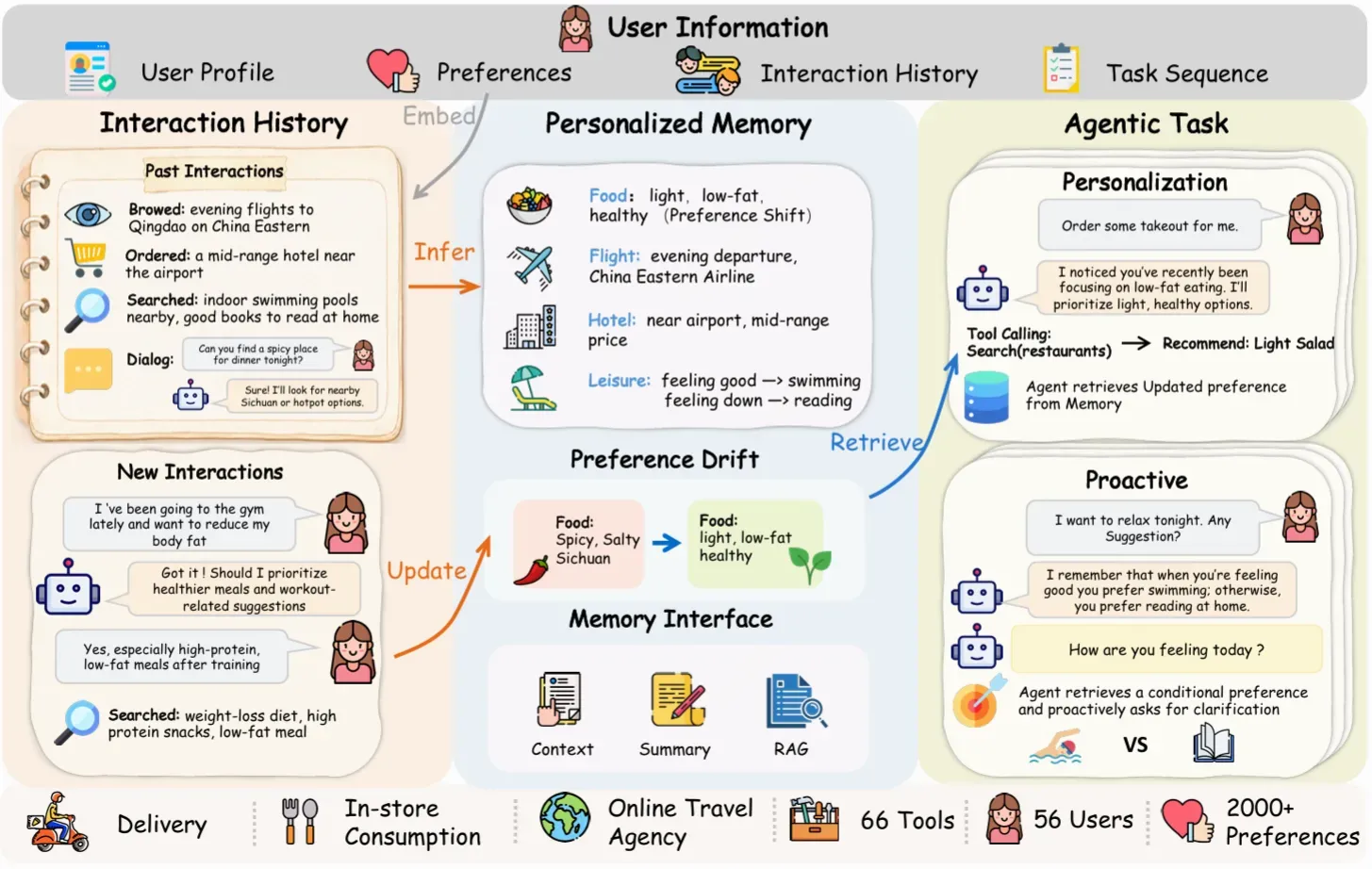
VitaBench 2.0 introduces the concept of "long-term dynamic user modeling" as a primary metric. This involves the agent's capacity to build a persistent understanding of a user—remembering preferences, past interactions, and evolving contexts. By focusing on the long-term aspect, the benchmark challenges models to maintain consistency and coherence over time, which is essential for creating digital assistants that truly understand their human counterparts. The "dynamic" nature of this modeling ensures that the AI is not just working from a static profile but is instead adapting to the natural changes in a user's life and requirements.
The Dual Pillars: Personalization and Proactivity
At the heart of VitaBench 2.0 are two critical dimensions of agent behavior: personalization and proactivity. In the context of this benchmark, personalization is not merely about using a user's name; it is about the systematic alignment of the model's logic and output with the specific, nuanced needs of a long-term user. This requires the model to synthesize historical data to provide relevant, context-aware support that feels bespoke rather than generic.
Proactivity, the second pillar, evaluates an agent's ability to act without explicit, immediate prompting. In real-life scenarios, a truly intelligent agent should be able to anticipate needs or suggest actions based on the dynamic flow of the interaction. VitaBench 2.0 provides a structured way to measure this "initiative," which has historically been difficult to quantify. By evaluating these two traits in tandem, the benchmark sets a high bar for what constitutes a "smart" agent, pushing developers to move beyond reactive systems toward more autonomous and helpful AI entities.
Bridging the Gap with Real-Life Scenarios
One of the most significant aspects of VitaBench 2.0 is its commitment to "real-life scenarios." Many existing AI tests rely on synthetic datasets that may not reflect the unpredictability and complexity of human life. VitaBench 2.0 seeks to simulate the messy, non-linear, and evolving nature of real-world interactions.
This approach ensures that the performance of an LLM on the benchmark is a reliable indicator of its performance in actual deployment. By testing agents in environments that mirror real-world dynamics, LongCat provides a tool that can identify the strengths and weaknesses of models in handling the nuances of human behavior. This focus on authenticity is crucial for the development of AI that can be integrated into daily life, from personal productivity tools to complex customer service systems.
Industry Impact
The introduction of VitaBench 2.0 is poised to have a lasting impact on the AI research community and the broader industry. By providing a standardized, open-source framework for long-term dynamic modeling, LongCat is enabling a more transparent and competitive environment for agent development.
For the AI industry, this benchmark serves as a new "North Star" for agentic behavior. It signals a transition from the era of "Chatbots" to the era of "Personalized Agents." As companies strive to create AI that can act as genuine partners to users, the metrics provided by VitaBench 2.0—specifically those regarding proactivity and long-term adaptation—will become the standard by which success is measured. Furthermore, by open-sourcing this tool, the Meituan Technical Team is fostering collaborative improvement, allowing researchers worldwide to refine their models against a benchmark that reflects the true complexity of human-AI interaction.
Frequently Asked Questions
Question: What is the primary difference between VitaBench 2.0 and traditional LLM benchmarks?
VitaBench 2.0 focuses on long-term, dynamic user modeling in real-life scenarios, whereas traditional benchmarks often focus on short-term, static task completion or single-turn accuracy. It specifically evaluates how an agent evolves and adapts over a long period of interaction.
Question: How does VitaBench 2.0 measure an AI agent's "proactivity"?
VitaBench 2.0 systematically evaluates the agent's ability to take initiative and act autonomously within the context of a dynamic user interaction, rather than just responding to direct commands. This measures the agent's capacity to anticipate user needs based on the established long-term model.
Question: Who is the developer of VitaBench 2.0 and is it accessible to the public?
VitaBench 2.0 was developed by the LongCat project under the Meituan Technical Team. It has been open-sourced, making it available for the global AI research community to use for evaluating and improving AI agents.