Meituan LongCat Team Open-Sources WBench: The First Systematic Multi-Round Benchmark for Interactive Video World Models
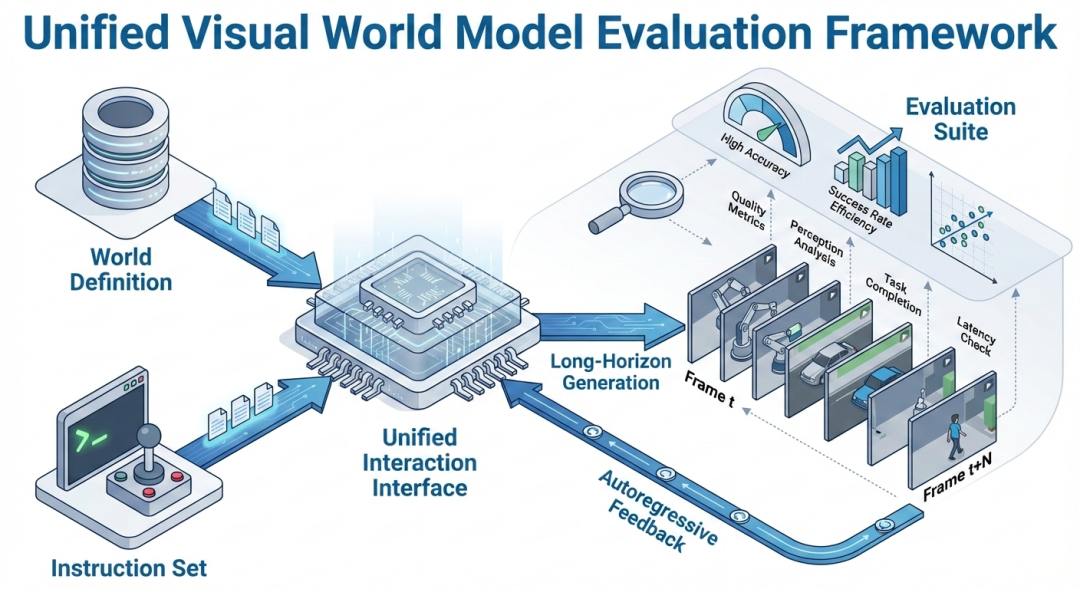
The Meituan LongCat technical team has officially introduced and open-sourced WBench, a pioneering evaluation framework designed to assess interactive video world models. As the industry's first systematic multi-round benchmark, WBench aims to bridge the gap between passive video observation and active environmental interaction. Described by its creators as a "CT scanner" for AI, the tool is engineered to precisely identify technical bottlenecks that occur when world models attempt to transition from merely generating footage to facilitating complex, multi-stage interactions. By testing models across diverse scenarios—from lunar exploration to futuristic urban settings—WBench provides a rigorous diagnostic standard for the next generation of AI development, offering deep insights into the current boundaries of world model capabilities and their potential for real-world interactive applications.
Key Takeaways
- Pioneering Benchmark: Meituan's LongCat team has launched WBench, the first systematic multi-round evaluation benchmark specifically for interactive video world models.
- Diagnostic Precision: The framework functions as a "CT scanner," allowing developers to pinpoint exactly where models fail during the transition from passive viewing to active interaction.
- Multi-Round Focus: Unlike traditional single-step evaluations, WBench emphasizes multi-round interactions to test the consistency and depth of world models.
- Open-Source Contribution: By open-sourcing WBench, Meituan provides the global AI community with a standardized tool to measure and push the boundaries of interactive AI environments.
In-Depth Analysis
Bridging the Gap: From Passive Viewing to Active Interaction
The development of world models has reached a critical juncture where the ability to generate realistic video is no longer the sole metric of success. The Meituan LongCat team identifies a significant hurdle in the current AI landscape: the transition from "passive viewing" to "active interaction." While many existing models can produce visually stunning sequences, they often struggle when required to respond dynamically to user inputs or environmental changes over multiple steps.
WBench is designed to address this specific limitation. By moving beyond static or single-action evaluations, the benchmark forces models to maintain logic, physics, and contextual consistency across multiple rounds of interaction. This shift is essential for the development of AI that can truly understand and navigate complex environments, whether they are simulated lunar landscapes or dense cybernetic cities. The benchmark serves as a rigorous testing ground, ensuring that the "world" within the model is not just a backdrop, but a functional, interactive space.
The "CT Scanner" for World Models
One of the most compelling aspects of WBench is its role as a diagnostic tool. The LongCat team describes the benchmark as a "CT scanner" for the AI industry. This metaphor highlights the tool's ability to look beneath the surface of a model's output to identify underlying structural weaknesses. In the context of interactive video, a model might appear successful in the first few frames but lose coherence as interactions become more complex.
WBench provides the metrics necessary to see where these "fractures" occur. By systematically evaluating performance across different scenarios, it allows researchers to see if a model's failure is due to a lack of spatial awareness, a breakdown in temporal consistency, or an inability to process specific types of interactive commands. This level of granularity is vital for iterative development, as it moves the industry away from trial-and-error approaches toward data-driven optimization. The open-source nature of the project further ensures that these diagnostic capabilities are accessible to the broader research community, fostering a more transparent and standardized path toward advanced world modeling.
Industry Impact
The introduction of WBench marks a significant milestone in the standardization of AI evaluation. For the AI industry, the lack of a unified benchmark for interactive world models has often led to fragmented progress and difficulty in comparing the efficacy of different architectures. By providing a systematic, multi-round framework, Meituan is setting a new bar for what constitutes a "capable" world model.
Furthermore, the focus on interactivity has direct implications for sectors such as robotics, autonomous driving, and immersive gaming. As these fields require AI that can interact with and predict the physical world, a benchmark that specifically measures these traits is invaluable. WBench not only highlights the current boundaries of the technology—showing us exactly where we are "stuck"—but also provides the roadmap for where the industry needs to go next to achieve true interactive intelligence.
Frequently Asked Questions
Question: What makes WBench different from existing AI benchmarks?
Unlike traditional benchmarks that may focus on static image generation or single-turn video synthesis, WBench is the first systematic benchmark designed for multi-round interaction within video world models. It evaluates how a model maintains consistency and logic over a series of interactive steps rather than a single output.
Question: Why does the LongCat team refer to WBench as a "CT scanner"?
The team uses this analogy because WBench is designed to perform a deep, diagnostic analysis of a world model. It doesn't just give a pass/fail grade; it identifies the specific technical points where a model's ability to interact with its environment breaks down, much like a medical scanner identifies internal issues.
Question: Is WBench available for public use?
Yes, the Meituan LongCat team has open-sourced WBench, making it available for the global research and development community to use, evaluate, and improve upon their own interactive world models.