Meituan LongCat Team Open-Sources WBench: The First Systematic Multi-Round Benchmark for Interactive Video World Models
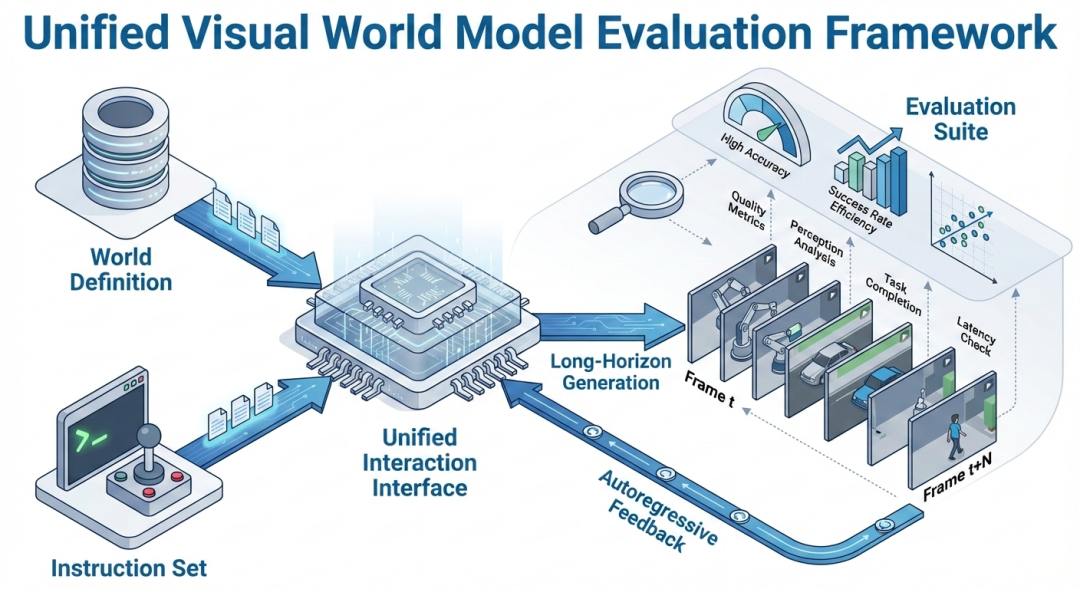
The Meituan LongCat team has officially introduced and open-sourced WBench, a groundbreaking evaluation benchmark designed specifically for interactive video world models. As the first systematic framework of its kind, WBench focuses on multi-round interactions, moving beyond traditional passive video observation. Described by the developers as a "CT scanner" for AI, the tool is engineered to precisely diagnose the limitations of current world models as they attempt to transition from "passive viewing" to "active interaction." By testing the boundaries of these models in diverse scenarios—ranging from lunar environments to cybernetic cities—WBench provides a critical diagnostic layer for the industry. This open-source initiative aims to identify exactly where models fail in interactive sequences, offering a structured path forward for the development of more responsive and capable world models.
Key Takeaways
- Meituan's LongCat team has launched WBench, the industry's first systematic multi-round evaluation benchmark for interactive video world models.
- The tool functions as a diagnostic "CT scanner," identifying specific failure points in the transition from passive observation to active interaction.
- WBench is designed to evaluate how world models handle complex, multi-stage scenarios such as moonwalking and navigating cybernetic environments.
- By open-sourcing WBench, the Meituan team provides a standardized framework to explore and define the current boundaries of world model capabilities.
In-Depth Analysis
Bridging the Gap Between Passive Viewing and Active Interaction
The development of WBench by the Meituan LongCat team marks a significant shift in how the AI industry evaluates world models. For a long time, the assessment of these models was largely confined to "passive viewing"—the ability of a model to generate or predict a video sequence based on static data. However, the true potential of a world model lies in its ability to facilitate "active interaction." WBench is specifically designed to measure this transition. By implementing a multi-round evaluation process, the benchmark tests whether a model can maintain consistency, logic, and responsiveness when subjected to continuous interactive inputs. This move from a single-output evaluation to a systematic, multi-round interaction framework allows researchers to see how a model evolves its understanding of a virtual environment over time, rather than just in a single snapshot.
The "CT Scanner" for AI: Diagnostic Precision
One of the most compelling aspects of WBench is its role as a diagnostic tool, which the Meituan team likens to a "CT scanner." In the context of AI development, a "CT scanner" implies a level of granularity and internal visibility that standard benchmarks often lack. Instead of simply providing a final score, WBench is built to "precisely locate" the specific areas where a world model "gets stuck." This diagnostic approach is crucial because the failure of a world model in an interactive setting can stem from various factors—be it a loss of temporal coherence, a failure to understand physical laws in a simulated space, or an inability to process complex environmental prompts like those found in a "cybernetic city." By pinpointing these exact boundaries, WBench allows developers to move beyond trial-and-error and toward targeted improvements in model architecture and training.
Exploring the Boundaries of Simulated Worlds
The scope of WBench, as highlighted by the Meituan LongCat team, covers a wide array of imaginative and complex scenarios, from "moonwalking" to "cybernetic cities." These examples are not merely aesthetic choices; they represent the diverse boundaries of what a world model must be able to simulate. A moonwalk requires an understanding of low-gravity physics and specific movement patterns, while a cybernetic city demands the management of dense, high-complexity visual and interactive data. WBench uses these varied environments to test the limits of a model's generative and interactive logic. As a systematic benchmark, it provides the first structured methodology to determine where the current generation of world models reaches its limit, effectively mapping the frontier of what is currently possible in interactive AI video generation.
Industry Impact
The introduction and open-sourcing of WBench have profound implications for the AI research community. By providing the first systematic multi-round benchmark, Meituan is essentially setting a new standard for how interactive world models should be measured. This standardization is vital for the industry to progress, as it allows different teams and organizations to compare their models using a consistent and rigorous metric. Furthermore, the open-source nature of WBench encourages a collaborative approach to solving the "interaction gap." As more researchers use this "CT scanner" to diagnose their models, the collective understanding of how to build more robust, interactive, and logically consistent world models will accelerate. This could lead to significant breakthroughs in fields that rely on simulated environments, including robotics, autonomous systems, and advanced digital content creation.
Frequently Asked Questions
Question: What makes WBench different from existing AI benchmarks?
WBench is unique because it is the first systematic benchmark specifically designed for "multi-round" evaluation of "interactive" video world models. Unlike traditional benchmarks that focus on passive video generation, WBench evaluates how a model responds to active, ongoing interaction over multiple stages.
Question: Why did the Meituan LongCat team open-source WBench?
By open-sourcing WBench, the Meituan LongCat team provides the AI community with a standardized tool to diagnose and understand the limitations of world models. This promotes transparency and allows researchers worldwide to use the same "CT scanner" methodology to improve the interactive capabilities of their AI systems.
Question: What does the term "CT scanner" imply in the context of WBench?
The term implies that WBench does more than just score a model; it provides a deep, diagnostic look into the model's performance. It is designed to precisely identify the specific points or scenarios where a world model fails to maintain logic or consistency during interaction, much like a medical scanner identifies issues within a body.